

Pick the sunset run out of Neos Marmaras for a half-day, the Kassandra coastal circuit for a full day, the Sithonia loop through Porto Koufo and Amouliani for three to four days, and the full coastal circuit for a week. Start from Neos Marmaras, Nikiti, or Paliouri during the main sailing season, and lean on a private charter to reach the coves no road ever touches.
TL;DR:
- Most sailing trips in Halkidiki should match the itinerary length with your available time, from a short sunset sail to a full week, to avoid rushing or underusing your stay.
- A private crew handles navigation and licensing, making multi-day routes easier, but provisioning and safety gear requirements increase with trip length.
- Strong wind usually blows from the northeast, with afternoons becoming windier, making early swim stops and flexible routing essential for comfort and safety.
- Local knowledge and flexibility are vital for finding calm anchorages, especially when afternoon Meltemi winds build quickly and catch sailors relying solely on charts.
- Sustainable sailing practices like anchoring in sand, respecting no-wake zones, and packing out trash help protect fragile coves and underwater ecosystems in Halkidiki.
Table of Contents
- What Is the Right Sailing Itinerary for Halkidiki?
- Sample Day-by-Day Halkidiki Sailing Routes
- Sailing Season, Winds, and Water Temperatures in Halkidiki
- Planning Checklist Before You Book a Halkidiki Sailing Trip
- A Local Skipper’s View on Private Halkidiki Charters
- Cultural Stops Worth Building Into Your Route
- Where to Eat and Stay Along the Route
- Protecting Halkidiki’s Waters While You Sail
- Navigating Halkidiki’s Waters: Rules and Realities
- An Editorial Take: What Generic Itineraries Get Wrong
- Book a Private Charter in Halkidiki
- Sources
- FAQ
What Is the Right Sailing Itinerary for Halkidiki?
Every itinerary below solves a different problem: how much time you have, who’s on board, and how much of Halkidiki’s coastline you actually want to see versus how much you want to relax in one perfect bay. Halkidiki sailing routes generally split into four workable shapes, and matching your trip to the right one saves you from either rushing a slow-paced group or under-using a week you paid for.
- Half-day sunset (4 hours): Depart Neos Marmaras in the late afternoon, sail toward a quiet cove, swim, then anchor for sunset before heading back. Best for couples or small groups who want maximum atmosphere with minimum planning.
- Full-day Kassandra circuit (7 hours): A loop along the Kassandra peninsula touching spots near Nea Fokea, Afytos, and Chrousso, with a lunch anchorage and a longer swim stop. Good for families or groups who want variety without an overnight.
- 3 to 4 day Sithonia loop: Overnight hops between sheltered bays like Porto Koufo and the Gulf of Sykia, with a detour out to Amouliani and Diaporos. This is the sweet spot for travelers who want island time without committing a full week.
- 7-day coastal circuit: A slower, fuller version of the Sithonia loop with room for a Mount Athos sea-sightline day and more flexible pacing, ideal for a weekly private cruise.
Sample Day-by-Day Halkidiki Sailing Routes
A Halkidiki boat itinerary reads differently on paper than it feels on the water., so here’s what each timeframe actually looks like hour by hour.
- Half-day sunset sail. Board around 5:00 PM in Neos Marmaras. Sail roughly 45 minutes to a secluded bay for a swim and snorkel stop, then reposition to an anchorage with an open west-facing horizon by 7:30 PM. Watch the sunset at anchor, then motor back under early stars, docking by 9:00 PM.
- Full-day Kassandra run. Depart by 10:00 AM, sailing north along Kassandra’s coastline past Nea Fokea, with a midday anchor near Afytos or Chrousso for lunch and a two-hour swim break. Afternoon brings a slower cruising leg back toward the start port with photography stops along limestone cliffs, returning by 5:00 PM.
- 3 to 4 day Sithonia loop. Day one covers the short hop from Nikiti to Porto Koufo, a naturally sheltered harbor known for its seafood tavernas. Day two heads into the Gulf of Sykia for calmer anchoring and a slower pace. Day three crosses to Amouliani and Diaporos for island exploring and clear-water snorkeling, with the final day retracing toward the starting marina. Provision sufficiently for multi-day trips, as some island stops have limited shopping.
- 7-day coastal circuit. The first two days mirror the Sithonia loop’s early legs, but pacing slows: extra time at Porto Koufo, an added day exploring Diaporos’s inlets, and a dedicated sightseeing day with a distant sea view of Mount Athos rather than a landing (which is restricted). Sample multi-day routing from regional guides supports stretching the Sithonia stops across a full week rather than compressing them, and the final two days allow a slow return leg with buffer time for weather.
Sailing Season, Winds, and Water Temperatures in Halkidiki
May through September is the working season for cruising this coastline, with June through August delivering the warmest air and calmest swimming conditions. Official regional guidance confirms this window as the primary sailing season, and water temperatures in peak summer typically feel comfortable for extended swim stops without a wetsuit.
Wind here is fairly consistent, which is either a blessing or a planning variable depending on your dates.
- Prevailing winds blow from the northeast for most of the season.
- Meltemi conditions tend to intensify in late summer and early autumn, pushing wind speeds higher on some afternoons.
- Mornings are typically calmer than afternoons, which is why full-day routes often front-load swim stops early.
- Shoulder months (May and September) bring lighter, less predictable wind but fewer crowds at anchorages.
Neos Marmaras, Nikiti, and Paliouri all function as practical start points, each offering fuel access, provisioning shops, and mooring space, while the broader Kassandra area adds another entry option for shorter runs. Among anchorages, Porto Koufo stands out as a genuinely protected harbor, useful when afternoon wind picks up faster than forecast. Pro Tip: Check the wind forecast the night before, not just the morning of. Halkidiki’s afternoon breeze builds gradually, and a route that looks calm at 8:00 AM can feel very different by 2:00 PM.
Planning Checklist Before You Book a Halkidiki Sailing Trip
Turning any of the itineraries above into a real booking comes down to five practical questions.
- Do you need a license? If you’re chartering with a professional crew, this question disappears entirely. A local skipper handles navigation, weather calls, and anchoring, which matters most on multi-day routes where conditions change daily.
- What do you provision for a half-day versus a multi-day trip? Half-day sails need little more than sunscreen and swimwear. Multi-day trips need fresh water reserves, non-perishable food, and a fuel buffer beyond the planned route.
- How much daylight do you actually have? Summer gives you roughly 14 hours of usable light, but afternoon wind often shortens the comfortable sailing window to the morning and early evening.
- What’s the etiquette at anchorages? Give moored boats reasonable swing room, and avoid crowding a sheltered bay that’s already occupied.
- What safety gear should be non-negotiable? A working VHF radio, a stocked first-aid kit, and snorkeling gear are baseline, not optional extras.
A Local Skipper’s View on Private Halkidiki Charters
Generic route maps miss the point of sailing this coastline: the best bays aren’t reachable by road at all. A private charter’s whole advantage is routing around that, trading a fixed public itinerary for one that bends to weather, guest pace, and light.
A skipper who knows these waters will swap a planned stop for a calmer bay if the afternoon breeze builds early, or extend a swim stop when the group clearly isn’t ready to move on. Guests consistently value three things above everything else: seclusion from crowded public beaches, flexible timing instead of a fixed schedule, and easy water access for snorkeling right off the boat.
— George
Cultural Stops Worth Building Into Your Route
Halkidiki’s coastline isn’t just scenery between anchorages. Neos Marmaras has a walkable harbor town with a mix of local tavernas and small galleries, worth a slow evening stroll if your itinerary docks there overnight. Nikiti carries an older village character a short walk inland from its beach front, with narrow streets and older architecture that reward wandering before or after a sailing day.
Paliouri, on Kassandra’s southern tip, sits closer to olive groves and quieter countryside, a contrast to the busier northern Kassandra beach towns. Porto Koufo, beyond being a sheltered anchorage, has a small fishing-village feel with a handful of tavernas right on the water, making it a natural choice for an overnight stop that doubles as a cultural pause rather than just a safe harbor.
Amouliani, Halkidiki’s only inhabited island, adds a different texture entirely: a small island community built around fishing and tourism, reachable only by boat, which makes arriving by sail feel like the intended way to see it. Diaporos, largely undeveloped, offers the opposite experience: near-empty coves and pine-backed shoreline with little more than nature itself. Building a half-day of cultural wandering into a multi-day Sithonia loop rounds out what would otherwise be a pure beach-and-swim itinerary, giving the trip a sense of place beyond turquoise water.
Where to Eat and Stay Along the Route
Porto Koufo’s waterfront tavernas are consistently mentioned as a highlight for multi-day itineraries, serving fresh seafood in a setting sheltered enough to enjoy a long, unhurried lunch even when the wind is up elsewhere. Neos Marmaras offers a wider spread of dining, from casual harbor-front grills to slightly more polished tavernas suited to a celebratory dinner after a full day on the water.
For overnight stays that bookend a sailing trip, Neos Marmaras and Nikiti both have small hotels and guesthouses within walking distance of the water, convenient if you’re starting or ending a multi-day route by land. Paliouri leans quieter, with fewer large resorts and more low-key rooms suited to travelers who’d rather spend evenings near the beach than in a busy town center.
If your itinerary includes an overnight anchorage rather than a marina stop, most nights on a private charter are spent at anchor rather than in a hotel bed, with the boat itself functioning as your accommodation. That’s part of what makes the multi-day and weekly routes different from a land-based Halkidiki holiday: your “hotel” changes location every day, and dinner is often whatever sheltered cove happens to have the best taverna within dinghy or walking distance. For groups sailing together, a group charter setup simplifies the coordination of meals and stops considerably.
Protecting Halkidiki’s Waters While You Sail
The coves that make Halkidiki sailing routes worth the trip are also fragile, and treating them carelessly is how they stop looking the way they do now. Anchoring only in sand rather than seagrass meadows protects the underwater ecosystems that keep the water this clear in the first place, and it’s a simple habit that costs nothing in planning time.
Snorkeling without touching coral or handling marine life, packing out every piece of trash generated on board, and avoiding single-use plastics where possible all matter more here than on a crowded resort beach, because these coves see far less cleanup traffic. Respecting no-wake zones near swimmers and other anchored boats also reduces erosion along fragile shorelines. Charter operators who build these habits into daily routine, rather than treating them as an afterthought, tend to keep the same bays worth returning to season after season. If sustainability matters to how you choose a provider, it’s worth asking directly about an eco-conscious approach before booking.
Navigating Halkidiki’s Waters: Rules and Realities
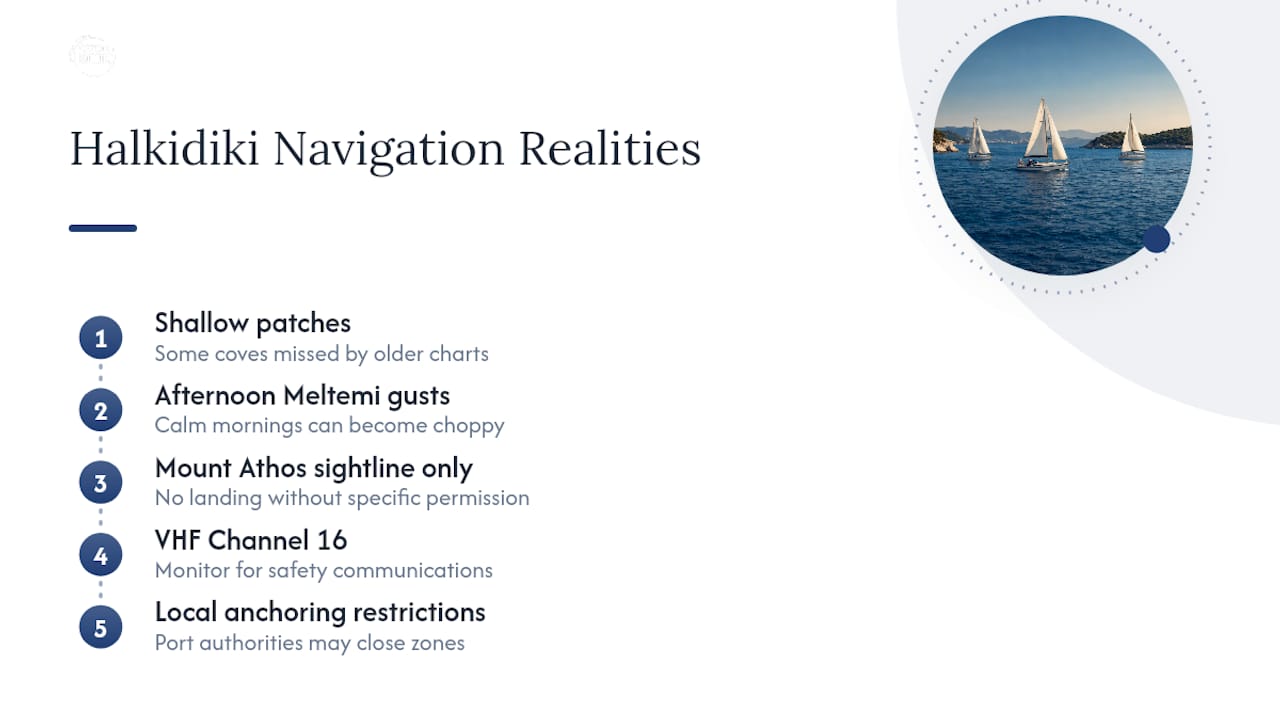
Halkidiki’s coastline is generally forgiving compared to more exposed parts of the Aegean, but it still has real navigation challenges worth respecting. Shallow patches near some coves catch out sailors relying purely on older charts, and afternoon Meltemi gusts can turn a calm morning bay into a choppier anchorage within a couple of hours.
Mount Athos, visible from several points along the Sithonia coast, carries restricted access rules. Boats can sail within sight of it but landing without specific permission isn’t permitted, which is why the seven-day circuit treats it as a sightline day rather than a stop. Greek coastal waters also require monitoring VHF Channel 16 for safety communication, and local port authorities can restrict anchoring in specific zones during high-traffic periods or adverse weather. None of this makes the region difficult to sail, but it does mean a route built without local knowledge of these restrictions risks wasted time or an unplanned detour.
An Editorial Take: What Generic Itineraries Get Wrong
Most published Halkidiki itineraries read like they were built from a map, not from actual time on the water. They list the same landmark stops in the same order, regardless of wind, group size, or what a specific afternoon’s light looks like from a specific bay.
The itineraries that actually work start from a different assumption: the plan should bend, not the guests. A route built around hidden coves only makes sense if someone on board can read the wind and swap the afternoon stop when it matters. Where conventional guides fall short is treating pacing as fixed, when the best days on the water are the ones where a skipper delays departure by twenty minutes because the light over Diaporos isn’t right yet. If you’re planning a private charter, prioritize flexibility and local knowledge over a rigid checklist of famous stops.
— George
Book a Private Charter in Halkidiki
Halkidiki Boat Sailing turns every itinerary above into an actual booking, without the extra step of comparing marinas, hunting for a skipper, or renting separate gear. The route ideas in this guide map directly onto three bookable formats aboard the sailing boat Off The Hook:
- A sunset private cruise (4 hours) for the half-day route.
- A full-day private cruise (7 hours) for the Kassandra circuit.
- A weekly private cruise for the full seven-day coastal loop.
Every option comes fully crewed with a professional local skipper, fuel, refreshments, snacks, and snorkeling gear bundled in, so there’s no separate gear rental or provisioning trip to arrange before you sail. Check current dates and reserve your preferred format directly through Halkidiki Boat Sailing to lock in your itinerary before peak summer weeks fill up.
Sources
For weather and seasonal guidance, check VisitGreece and Visit Halkidiki. For route references, see Sailica’s Chalkidiki routes and Gohalkidiki’s 7-day itinerary.
FAQ
What Is the Best Sailing Itinerary for Halkidiki?
It depends on your time: a half-day sunset sail from Neos Marmaras suits short trips, while a multi-day Sithonia loop through Porto Koufo and Amouliani suits travelers with more time and a taste for island stops.
What Is the Best Month to Sail in Halkidiki?
June through August offers the warmest water and most reliable weather, while May and September bring lighter crowds and gentler wind, all within the broader May to September sailing season.
Do I Need a License to Sail in Halkidiki?
Not if you’re booking a crewed private charter, since a professional skipper handles navigation and licensing requirements entirely; a license only becomes relevant if you’re chartering a boat without crew.
Where Do Larger Private Yachts Go in Halkidiki?
Larger yachts typically follow the same core route logic as smaller charters, favoring sheltered anchorages like Porto Koufo and the Sithonia coastline, though they tend to stick to deeper marinas near Neos Marmaras and Nikiti for docking, which is explained further in our Yacht Brokerage overview.
How Long Should a Halkidiki Sailing Trip Be?
Three to four days is enough to properly experience the Sithonia loop’s islands and sheltered bays, while a full week allows for slower pacing and an added Mount Athos sightline day.