
Most charters bill fuel separately from the base price, though a handful of packages fold it in. Expect low tens to low hundreds of euros for a sunset or half-day sail, roughly $50 to $250 for a full day depending on the vessel and how much you motor, and $80 to $250 for a week aboard a typical sailing yacht. Watch for three billing models on your quote: full-to-full, a flat fuel fee, or fuel already bundled into the price.
TL;DR:
- Most charters charge for fuel separately, with common costs ranging from about €45 to €250 depending on trip length and vessel size.
- The three billing options are full-to-full refills, flat fuel fees, or fuel included with a cap, so clarify which applies before booking.
- Engine hours and cruising speed significantly impact fuel use, with sailing yachts typically requiring only 2 to 5 engine hours daily.
- Refueling costs and charges can vary due to operator markup, regional prices, and whether fuel is metered or estimated, making transparency crucial.
- All-inclusive packages that bundle fuel and other costs into a single upfront price offer the easiest way to avoid unexpected charges and simplify planning.
Table of Contents
- How Fuel Charges Work on a Boat Charter: The Billing Models You’ll See
- How Operators Calculate Your Fuel Bill
- What Fuel Actually Costs: Half-Day, Full-Day, and Week-Long Examples
- Estimating Fuel for Your Own Charter: A Step-by-Step Method
- Booking Checklist: How to Avoid Surprise Fuel Bills
- A Skipper’s View: Fuel Use on a Sailing Charter in Halkidiki
- Why “Days” Are the Wrong Unit for Fuel Budgeting
- Skip the Fuel Math Entirely with an All-Inclusive Sailing Charter
- Sources
- FAQ
How Fuel Charges Work on a Boat Charter: The Billing Models You’ll See
Every operator picks one of three ways to handle fuel, and spotting which one is on your quote tells you almost everything about your final bill.
Full-to-full is the most common arrangement on private charters. You receive the boat with a full tank, use what you use, and refill it yourself at a fuel dock before handback. You pay only for what you actually burned, and the receipt from the pump becomes your proof of payment. Filovent’s breakdown of fuel surcharges confirms this is the standard model across most rental and charter contracts, with weekly fuel for a sailing yacht typically landing around €80 to €150.
A flat fuel fee works differently. The operator quotes one fixed number regardless of how much you actually burn. It’s predictable, which is nice for budgeting, but you may pay more than your real consumption if you spend most of the trip sailing rather than motoring. Flat fees tend to show up on shorter charters, where calculating exact usage isn’t worth the hassle for either side.
Then there’s “fuel included.” This phrase gets used loosely, so read the fine print. Sometimes it means genuinely all fuel for the trip; other times it means a set number of engine hours, with anything beyond that billed as an extra. Ask the operator to define the cap in writing.
Watch for contract language like “settled at base,” which usually means fuel gets reconciled at your home marina rather than wherever you happen to finish the trip. That can matter if your itinerary ends somewhere without a convenient fuel dock.
Before signing anything, confirm:
- Which of the three models applies to your booking
- Whether “included” fuel has an engine-hour cap
- Where and when you’re expected to settle the tank
- What currency the fuel charge will be billed in
How Operators Calculate Your Fuel Bill
Fuel cost isn’t really about how many days you’re on the water. It’s about how many hours the engine runs, and that distinction changes how you should think about your entire budget.
A boat anchored in a quiet cove for six hours burns nothing. The same boat motoring against wind and current for six hours burns plenty. This is why two charters of identical length can produce wildly different fuel bills: one crew sailed most of the route, the other motored the whole way because the wind never cooperated.
Several factors drive the actual number on your invoice:
- Engine hours, not calendar days, determine consumption
- Cruising speed matters enormously; pushing a boat faster burns disproportionately more fuel per mile
- Load and itinerary play a role too, since a boat loaded with gear and people, or one making frequent short hops between anchorages, uses more fuel than a single long, steady run
- Fuel-dock markups can add a real premium if the operator refuels the boat for you rather than having you do it yourself
That last point deserves attention. Operators who handle refueling as a convenience service often charge above local pump price to cover the labor and the schedule disruption of sending someone to the marina. It’s a legitimate service fee, but it should be disclosed, not buried.
There’s also a meaningful transparency gap between metered billing and arbitrary surcharges. Metered billing, based on engine hours or a fuel-flow meter, ties your charge directly to something measurable. An arbitrary surcharge, quoted as a flat “fuel fee” with no explanation of how it was calculated, gives you nothing to verify against.
Pro Tip: Ask the operator directly: “Is this fuel charge based on a meter reading, or is it a flat estimate?” A confident, specific answer is a good sign. A vague one is a reason to ask more questions before you book.
What Fuel Actually Costs: Half-Day, Full-Day, and Week-Long Examples
Numbers help more than percentages here, so let’s put real ranges next to real trip types.
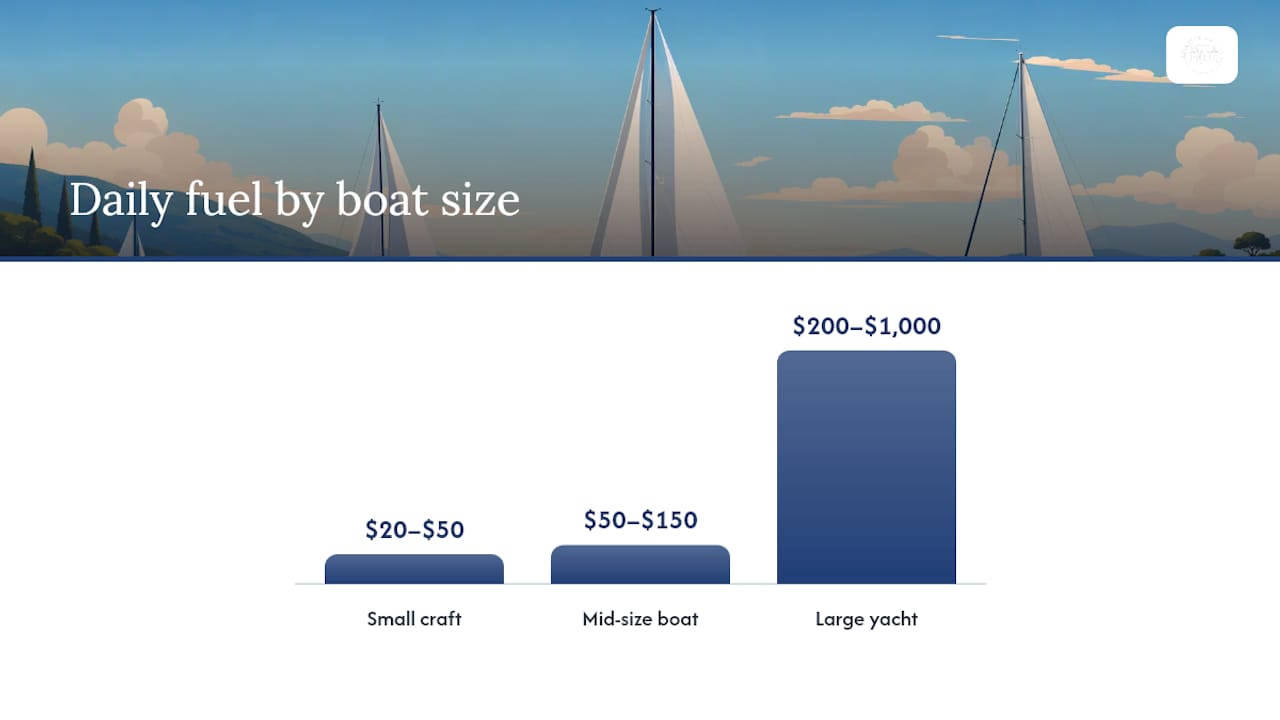
Click&Boat’s budgeting guide puts daily fuel costs anywhere from roughly €45 to €180, depending on the boat and how it’s used. BoatTomorrow’s charter cost breakdown lists similar territory, with weekly fuel commonly falling between €100 and €250 for typical charter itineraries. On the wider end, GetMyBoat’s cost guide shows just how much vessel size changes the math: small craft often run $20 to $50 a day in fuel, mid-size boats $50 to $150, and large yachts anywhere from $200 to $1,000 daily.
Sailing yachts sit at the friendlier end of that spectrum because so much of the trip happens under sail, not under power, as practical comparisons show on Share Your Boat. BoatTomorrow notes that a monohull typically burns just 3 to 5 liters of fuel per hour under engine, a fraction of what a motor-heavy itinerary demands.
Here’s how that plays out across common trip lengths:
The per-person math changes everything once you’re splitting costs across a group of four to eight. A €150 weekly fuel bill divided six ways is barely the price of a couple of coffees each day. A €400 motor-heavy week divided the same way is a real line item worth budgeting for in advance.
Regional pump prices shift these numbers, and currency matters too: a quote in euros for a Mediterranean charter won’t map cleanly onto a dollar-denominated quote for a different region, so always confirm which currency your operator is billing in before comparing numbers across websites.
Estimating Fuel for Your Own Charter: A Step-by-Step Method
You don’t need a finance degree to build an accurate fuel budget. You need four pieces of information and a bit of arithmetic.
- Ask the operator for consumption data. Request tank capacity and either liters or gallons burned per engine hour, or consumption at typical cruising speed. Any operator running a transparent business should have this number ready.
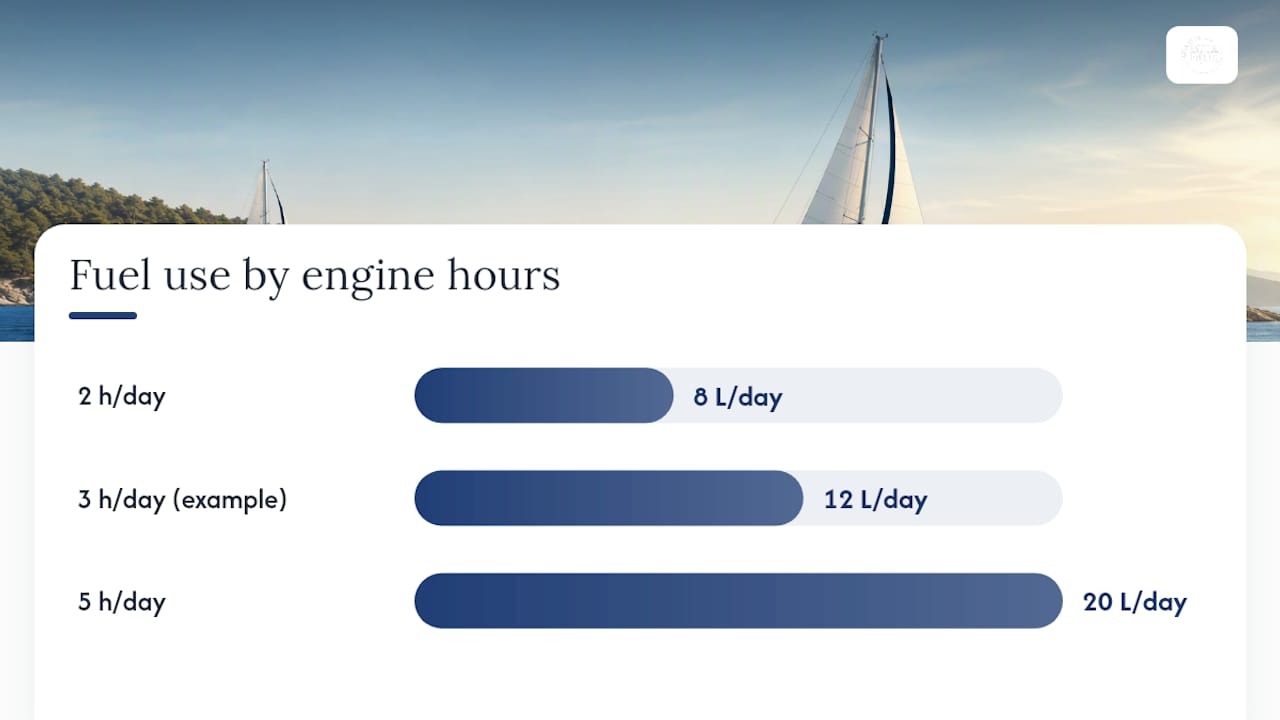
- Estimate your engine hours, not your trip days. Think through your actual route: how much time will you spend maneuvering out of the marina, transferring between anchorages, or motoring because the wind died? A sailing yacht on a route built around anchoring and short port transits might only need 2 to 5 engine hours a day.
- Multiply consumption by hours, then apply local fuel price. If your boat burns 4 liters an hour and you expect 3 hours of engine time daily, that’s 12 liters a day before you even check the price at the pump.
- Add a buffer. Build in 10% to 20% on top of your estimate to cover wind that doesn’t cooperate, extra maneuvering, or an unplanned motor-assisted leg.
- Verify against receipts at handback. If the model is full-to-full, the fuel-dock receipt is your final proof of what you actually used, and it should roughly match your estimate.
The Sithonia sailing guide covers routes and anchor-first strategies that naturally keep engine hours low, which is worth reading if you’re building your own estimate for a Halkidiki itinerary.
One number worth remembering: sailing yachts typically log only 2 to 5 engine hours per day on itineraries that favor sailing and anchoring, which is the single biggest reason fuel budgets for sailing charters run so much lower than motor-heavy ones.
Booking Checklist: How to Avoid Surprise Fuel Bills
A few minutes of questions before you book saves a lot of frustration at handback.
- Get the billing model in writing. Full-to-full, flat fee, or included, it should be spelled out in your contract, not explained verbally and forgotten.
- Ask how consumption gets measured. A meter reading, an engine-hour log, or an estimate all mean different things for your final bill.
- Confirm the fuel-dock details for your return port. Know the hours, the accepted payment method, and whether the currency matches your contract.
- Refuel the night before handback when the model is full-to-full. Fuel docks can have limited hours, and arriving on your last morning only to find the pump closed creates unnecessary stress.
- Keep every receipt. A pump receipt is your proof of payment and your best defense if a charge gets disputed later. Filovent recommends holding onto this documentation specifically because operators who refuel on your behalf sometimes apply internal rates well above the local pump price.
- Document the handback inspection. Photos of the fuel gauge and any written notes at drop-off protect you if a disagreement arises after the fact.
Pro Tip: If your itinerary runs through a region where marine fuel prices have spiked, ask about it directly. One Florida news report documented charter operators warning customers of $1 to $1.50 per gallon increases tied to global energy swings. A quick question about current pricing can prevent an unpleasant surprise at settlement.
A Skipper’s View: Fuel Use on a Sailing Charter in Halkidiki
Sailing charters and motor-heavy charters live in two different fuel universes, and nowhere is that clearer than on the waters around Sithonia.
On Off The Hook, most of our engine time happens leaving the marina, approaching a cove, or on the rare afternoon when the wind just isn’t cooperating. A typical day around Neos Marmaras or Nikiti might only need an hour or two of motoring, because the routes are built around sailing and anchoring, not racing between ports.
That pattern holds across most of the itineraries Halkidiki Boat Sailing runs, whether guests are headed toward the quieter coves near Paliouri or the anchorages around Kassandra. For select trip types, fuel is bundled into the package price rather than being billed separately, which removes one more line item for guests to track. The professional crew sailing page and George Dimitriadis’s skipper profile outline what a fully crewed charter includes beyond fuel, from local navigation knowledge to onboard service.
Why “Days” Are the Wrong Unit for Fuel Budgeting
Most fuel-budgeting advice treats charter length in days, and that habit costs readers money. A three-day trip built around anchoring and sailing can burn less fuel than a single motor-heavy day spent racing to cover distance. The unit that actually predicts cost is engine hours, and almost nobody asks about it before booking.
The conventional advice to “budget €50 to €100 a day for fuel” isn’t wrong exactly, but it flattens a number that varies enormously based on wind, route, and boat type. A sailing yacht averaging 2 to 5 engine hours daily on a Halkidiki itinerary belongs nowhere near the same bracket as a motor-driven charter running eight hours a day between distant ports.
If there’s one thing worth prioritizing above all else, it’s getting the billing model and measurement method in writing before you pay a deposit. Everything else, the exact euro amount, the per-person split, the buffer you build in, follows naturally once that foundation is set. Skip that step, and even a modest fuel bill can feel like a surprise.
— George
Skip the Fuel Math Entirely with an All-Inclusive Sailing Charter
If tracking engine hours and fuel-dock receipts sounds like more homework than vacation planning should require, that’s exactly the gap Halkidiki Boat Sailing closes. Certain Off The Hook trip types bundle fuel directly into a single upfront price, alongside a professional skipper, refreshments, snacks, and snorkeling gear, so there’s no separate line item to estimate, dispute, or settle at handback. That single-price model matters most on shorter trips, where a flat fuel fee elsewhere often overcharges you relative to a sailing-heavy route around Sithonia’s quiet coves.
A 4-hour sunset cruise or a full week aboard Off The Hook both come with clear, upfront pricing. Check the specific trip page for exact inclusions before you book, and if fuel budgeting has been the thing standing between you and a stress-free charter, this is the fastest way to remove it from your planning entirely.
Sources
- Fuel surcharge and additional fees: why and how much? (Filovent)
- Budgeting for your daily boat hire – Click&Boat Blog
- Yacht charter costs: full price breakdown (BoatTomorrow)
- How Much Does It Cost To Rent a Boat? (GetMyBoat)
- Florida charter boat company warns of price hikes due to rising fuel costs (CBS12)
FAQ
How much does boat fuel cost for 4 hours?
A 4-hour sunset sail on a sailing yacht typically runs €15 to €40 in fuel, since most of that time is spent under sail rather than under engine power.
What is the 1/3 rule in boating?
The 1/3 rule is a fuel-safety guideline: use one third of your fuel to reach your destination, one third to return, and keep one third in reserve for unexpected conditions or delays.
Why do marinas charge so much for gas?
Marina fuel docks often price above regional averages because of delivery logistics to waterside locations and limited competition, and operators who refuel a boat on a guest’s behalf may add a further service markup on top of that.
What is the 12 person rule on a yacht?
Commercial vessels in many jurisdictions face stricter safety and crewing regulations once they carry more than 12 passengers, which is why most private charter yachts, including sailing boats like Off The Hook, cap groups at 12 or fewer.
Is fuel usually included in a boat charter price?
No, most charters bill fuel separately using a full-to-full or flat-fee model, though some operators, including select Off The Hook packages, bundle fuel into an all-inclusive price for specific trip types.