

A bathroom on a yacht is called the head, and it packs marine-grade plumbing into a footprint you could measure in inches, not feet. Two rules matter more than any design choice: freshwater is limited, so showers stay short, and the toilets and pumps work nothing like the fixtures at home. Everything else, from AISI 316L fittings to spa-style finishes, builds on those two facts.
TL;DR:
- Compact heads combine toilet, sink, and shower into a small space, with the shower draining into the floor and no separate stall.
- Marine toilets require correct switching between “stand-by” and “flush” modes to avoid flooding or waste buildup, and freshwater should be conserved.
- AISI 316L stainless steel fittings resist corrosion from salt air, and removable shower columns facilitate easier maintenance and long-term durability.
- Slip-resistant flooring, accessible grab points, and privacy features like frosted windows ensure safety and comfort at sea.
- Crew demonstrations and clear instructions are essential to prevent sanitation issues caused by user error rather than mechanical failures.
Table of Contents
- Types of Bathrooms on a Yacht: From Compact Heads to Full Ensuites
- How Do Toilets and Showers Work on a Yacht?
- Why Materials Like AISI 316L Stainless Steel Matter Below Deck
- Safety and Privacy Features That Actually Matter at Sea
- Small-Space Design Ideas That Feel Like a Spa
- What to Ask Your Crew Before You Use the Head
- Why Engineering and Finish Choices Have to Work Together
- Sources
- FAQ
Types of Bathrooms on a Yacht: From Compact Heads to Full Ensuites
Size and layout on a sailing yacht depend almost entirely on hull width and cabin count, which means a “marine bathroom” can mean two very different things depending on the boat.
A compact wetroom head crams a toilet, a hand basin, and a handheld shower into one space, often with the shower draining straight into the floor pan. There’s no separate stall. You shower standing over the toilet, which sounds strange until you realize it’s the only way to fit sanitation into a hull that’s maybe six feet wide at that point. Larger sailing yachts flip the equation, giving each cabin a dedicated ensuite with a separated shower stall, storage cabinetry, and sometimes a proper vanity.
Placement follows the hull, not interior design instinct:
- Heads typically sit near cabins, close to the yacht’s centerline for stability in a swell.
- Ventilation usually comes from a small porthole, an overhead hatch, or a mechanical extractor fan, since natural cross breeze is hard to achieve below deck.
- Privacy is tighter in compact heads shared between cabins, versus dedicated ensuites on larger sailing yachts.
- The trade-off is constant: more comfort and privacy costs more hull space and adds servicing complexity for the crew.
Knowing which category your yacht falls into tells you what to expect before you ever step aboard.
How Do Toilets and Showers Work on a Yacht?
Marine sanitation runs on manual switches and pumps, not gravity and municipal sewage lines, and guests who don’t know that are the most common cause of onboard plumbing trouble.
Most manual toilets on sailing yachts use a handle paired with a multi-position switch, and you have to toggle correctly between “stand-by” and “flush” modes to control water intake and avoid clogging the system, according to Yachtic’s guide to yacht bathrooms. Get the sequence wrong and you either flood the bowl or leave waste sitting in the line. Showers work differently, too: the water collects in a shallow tray rather than draining away on its own, and that tray often needs a manual or automatic pump-out after each use to keep water from rising into the cabin floor.
A simple sequence keeps both systems working the way they’re built to:
- Confirm the toilet switch is on “stand-by” before you start, then move it to “flush” only when needed.
- Pump only as much water as required. Marine tanks are small, and freshwater conservation isn’t optional on a multi-day sail.
- After a shower, check whether the tray pump needs manual activation, and run it until the tray is clear.
- Never flush wipes, sanitary products, or anything besides toilet paper. These are the leading cause of blocked marine lines.
- Ask the crew to walk you through the exact procedure at check-in, since systems vary boat to boat.
Charter crews report that guest error, not mechanical failure, causes the majority of onboard sanitation problems, which is exactly why the demo at check-in matters more than any instruction sheet taped to the wall.
Why Materials Like AISI 316L Stainless Steel Matter Below Deck
Salt air destroys ordinary metal fast, which is why marine bathroom hardware gets built to a different standard than anything you’d install in a house.
Design guidance for marine bathrooms points consistently to AISI 316L stainless steel for fittings, taps, and shower bodies, because its molybdenum content resists the corrosion that saltwater and humidity cause in lesser alloys, per design guidance from Nautika Present. Ordinary chrome fittings pit and stain within a season at sea; 316L keeps its finish for years.

Removable shower columns extend that durability logic even further. A recessed deck support handles the structural work, precise positioning, hydraulic sealing, and long-term corrosion resistance, while the visible shower column above it can be unbolted for storage or replacement, according to Inoxstyle’s breakdown of yacht shower engineering. Separating the permanent support from the removable fixture means routine maintenance often comes down to swapping an O-ring rather than tearing into the deck structure.
Best practice for serviceability includes:
- Choosing fittings rated specifically for marine (not just “water-resistant”) environments.
- Confirming the deck support is a separate, permanent component from the shower column itself.
- Specifying hardware that can be removed without cutting into surrounding woodwork or gelcoat.
Pro Tip: When you’re evaluating a yacht’s bathroom, ask the shipyard or crew directly whether the hardware is AISI 316L and whether the shower column is removable. A confident, specific answer tells you a lot about how the whole boat was built.
Safety and Privacy Features That Actually Matter at Sea
A bathroom that looks beautiful in a photo can still be dangerous underway if the floor, grab points, and drainage weren’t designed for a moving deck.
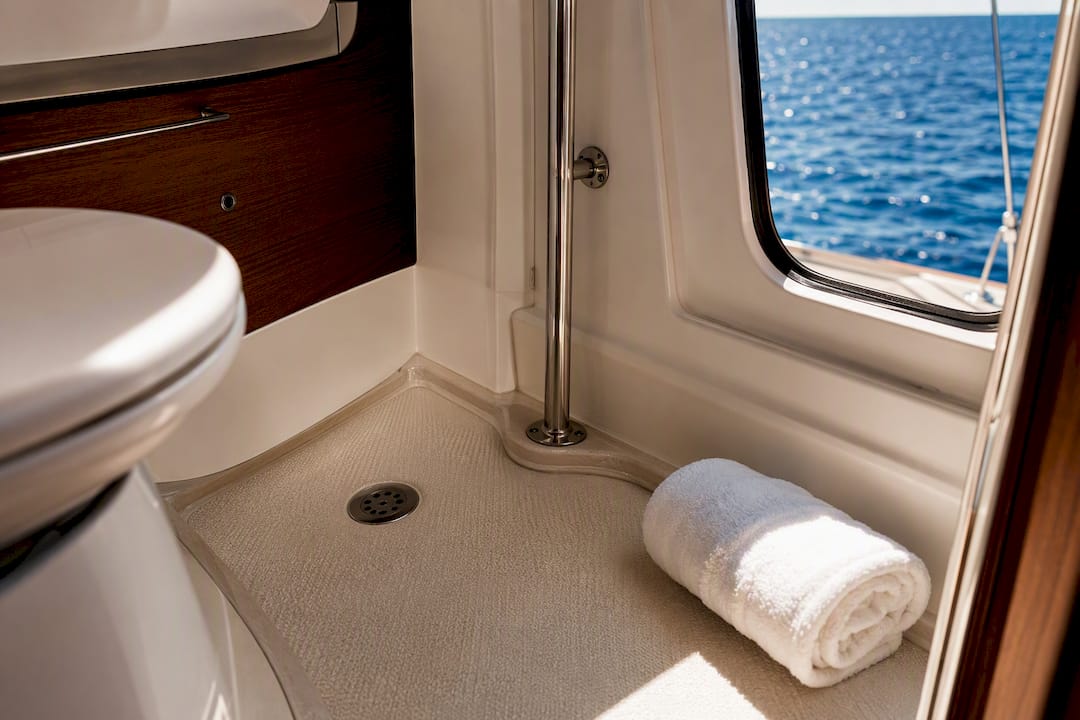
Flooring needs a genuinely high slip-resistance rating, not just a rating that performs well in a showroom. Ceramics that test fine under dry, stationary conditions can turn hazardous the moment the boat heels or a wave rolls through, which is why marine bathroom design leans on textured, higher-grip surfaces instead of polished tile, per Nautika Present’s design guidance.
A few details separate a well-thought-out head from a risky one:
- Grab rails positioned near the toilet, shower, and doorway, not just as an afterthought near the sink.
- Drains sized and placed to prevent pooling, especially in compact wetrooms without a separate shower pan.
- Frosted glazing or adjustable blinds so bathrooms stay bright without exposing guests to view while moored in a marina.
- Window sizing calibrated for privacy first when docked in a busy harbor, since that’s when boats sit closest together.
Charter yachts tend to prioritize durability and easy cleaning in these choices, while privately owned sailing yachts often push further into finish quality, since the same family uses the same fittings trip after trip.
Small-Space Design Ideas That Feel Like a Spa
Luxury in a yacht bathroom isn’t about square footage. It’s about a handful of deliberate choices that make a tight space feel considered rather than cramped.
Pressure-regulated showerheads solve the single biggest gap between a marine shower and a home one: weak, inconsistent water pressure. Recessed niches for toiletries, satin-finish metal fixtures, and continuous stone or composite surfaces eliminate the visual clutter that makes small rooms feel smaller. Large mirrors and recessed storage do double duty, adding light and cutting down on anything that needs a shelf.
A few finishing touches that repeat across well-designed sailing yachts:
- Warm, neutral palettes rather than literal nautical themes (no rope trim, no anchor motifs).
- Textured tile that reads as intentional, not just as a safety compromise.
- Hardware finishes that match throughout the cabin, not mixed chrome and brushed steel.
Modern sailing yachts have started treating the head as a genuine wellness space. The Southern Wind 96 Nyumba, for instance, brings pressure-regulated showers and satin-finish stainless fittings into a compact bathroom footprint, proving spa-level detail doesn’t require superyacht dimensions, according to Bathroom Review’s coverage of the Nyumba’s design.
What to Ask Your Crew Before You Use the Head
The single best thing you can do as a guest is ask for a quick demo before you ever need the bathroom, and any charter worth booking will offer one without you having to ask twice, like the Hobart Harbour Luxury Sailing Cruise that prioritizes guest comfort and crew hospitality.
A proper crew demo covers the toilet’s switch positions, where the shower tray pump button sits, and what happens if you flush the wrong thing. Halkidiki Boat Sailing builds that walkthrough into every charter aboard Off The Hook, with the professional skipper covering the head and shower setup as part of check-in, alongside the included refreshments and comfort touches that come standard on private sails around Sithonia.
Three requests worth making before you cast off:
- Ask where extra towels are stored, since compact heads rarely have room for a full stack.
- Ask which valves need to stay closed at anchor versus underway.
- Agree on a short-shower plan with your group so freshwater lasts the full day.
Why Engineering and Finish Choices Have to Work Together
Good yacht bathrooms come from engineering discipline first, finish second. A gorgeous satin fixture on a poorly sealed deck support fails within a season, while a plain fitting on a properly engineered base can serve a boat for years. The two decisions aren’t separable, and treating them that way is where most compact bathroom designs go wrong.
The same logic applies to guest procedures. A crew that explains the toilet switch clearly, once, with a demo rather than a laminated card, prevents nearly every sanitation problem before it starts. Materials and instructions both need to be simple enough to trust under pressure, at sea, in a small room, with limited water. That’s the whole discipline in one sentence.
— George
Sources
- Bathroom on a yacht
- 6 elements to think about when designing a yacht bathroom
- Hidden engineering: removable yacht showers and deck support
- Southern Wind 96 Nyumba brings spa-led bathroom design aboard hybrid sailing yacht
FAQ
What Is a Bathroom Called on a Yacht?
It’s called the head, a term that covers the toilet, sink, and shower area together, whether it’s a compact wetroom or a full ensuite.
What Is the 12-Person Rule on a Yacht?
This rule generally refers to licensing and safety regulations that cap passenger numbers on certain vessel categories, and it varies by country and vessel type rather than applying as one universal standard, so always confirm capacity limits directly with your charter operator.
How Do People Use the Bathroom on a Boat?
Guests use a marine toilet operated by a handle and switch, moving between “stand-by” and “flush” positions, then activate a shower tray pump afterward if the water doesn’t drain automatically.
What Is the Nautical Slang Term for a Toilet?
Sailors call it the head, a term with roots in old sailing ships where the toilet was located at the bow, or head, of the vessel.
What Should You Never Flush on a Yacht?
Never flush wipes, sanitary products, or anything besides toilet paper, since these are the leading cause of blocked marine sanitation lines.