
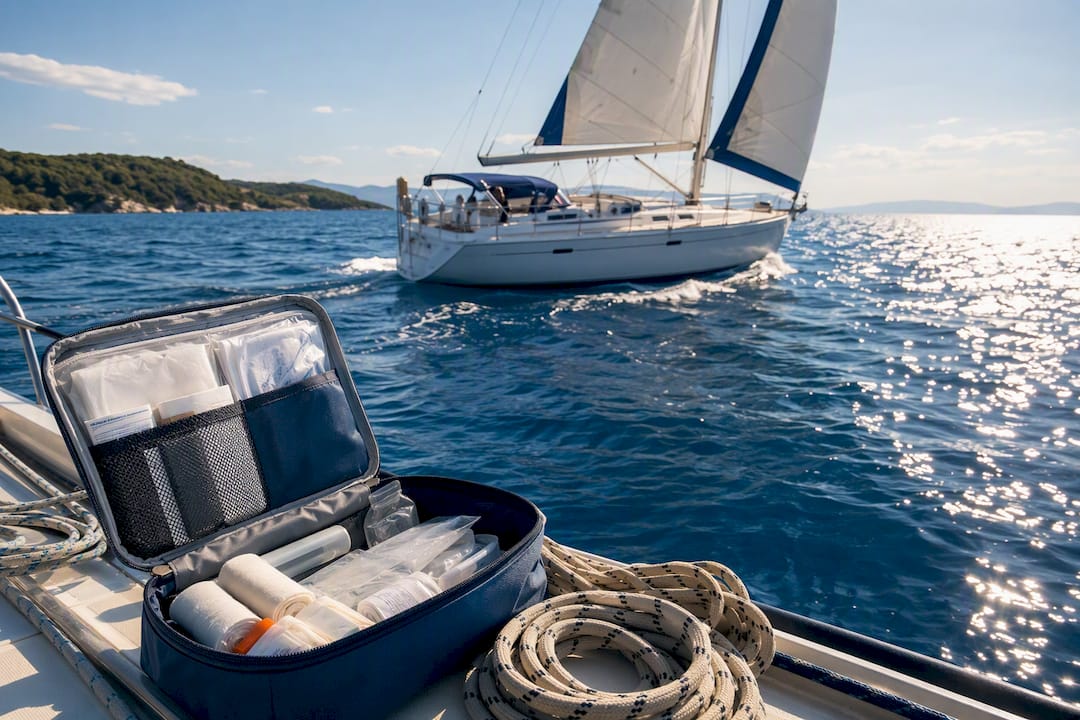
Yes, buy travel insurance for your boat trip if it involves a private charter, a multi-day passage, or any extended time at sea, and make sure the policy explicitly names sailing as a covered activity. A generic trip-protection plan bought as an afterthought will not cut it. For cruises, the same rule applies with even more urgency, since a medical evacuation from a ship mid-Atlantic or a missed embarkation in a foreign port can cost more than the entire vacation.
Aim for at least $100,000 in emergency medical coverage and $250,000 or more in medical evacuation limits before you look at anything else on the policy. Expect to pay somewhere in the 4% to 10% range of your total trip cost for a comprehensive plan with those limits, depending on your age, trip length, and how much cancellation coverage you add.
Three things to handle before you do anything else: For comprehensive advice, see our vehicle safety tips for cruise travel.
- Confirm the word “sailing” appears in the policy’s covered-activities list, not just “water sports” or “cruise travel,” since many standard plans quietly exclude it.
- Buy within 10 to 14 days of your first trip deposit if you want pre-existing condition waivers or “cancel for any reason” (CFAR) eligibility.
- Add CFAR only if you genuinely need the freedom to cancel for a reason the base policy will not cover, since it typically raises the premium by 40% to 60%.
TL;DR:
- Ensure the travel insurance policy explicitly names sailing as a covered activity, especially for private charters and extended trips at sea.
- Prioritize obtaining at least $250,000 in medical evacuation coverage, since evacuation costs can easily reach six figures from remote offshore locations.
- Purchase coverage within 10 to 14 days of your initial deposit to secure pre-existing condition waivers and “cancel for any reason” options if needed.
- Confirm your policy’s medevac limit exceeds $250,000, as lower caps may leave you paying significant out-of-pocket costs for emergencies.
- Verify that your chosen plan covers all relevant sailing scenarios, including activity type, vessel operation, and distance from shore, to avoid future claim denials.
Table of Contents
- Do You Need Travel Insurance for Boat Trips?
- What Exclusions Should Sailors Watch For?
- Which Travel Insurance Plans Actually Cover Boat and Cruise Trips?
- What Should Halkidiki Charter Guests Check Before Booking?
- Where the Conventional Advice Falls Short
- A Different Kind of Protection for Your Halkidiki Sail
- Key Takeaways
- Sources
- FAQ
Do You Need Travel Insurance for Boat Trips?
The honest answer depends on what “boat trip” means to you, but the range of scenarios where it matters is wider than most travelers assume. A weekend day-sail with a licensed operator near shore carries different risk than a week-long charter through open water, and your policy needs to match the actual trip, not a generic label.
Emergency medical coverage is the backbone of any sailing-capable policy. Picture a guest who slips on a wet deck and needs stitches, or someone who cuts a foot on a reef while snorkeling from the boat. These are routine claims on the water, and they matter more abroad because U.S. health insurance and Medicare generally do not cover care outside the United States. The CDC specifically recommends travelers arrange coverage for healthcare and emergency evacuation before departure, not after something goes wrong.
Medical evacuation (medevac) is where costs spiral fastest. A ship-to-shore helicopter transfer from a cruise liner, or moving an injured passenger from a remote anchorage to the nearest hospital with real surgical capacity, routinely runs into six figures. Evacuation from a remote island or offshore location can be one of the largest single expenses a traveler ever faces, and a policy with a $50,000 medevac cap will leave you covering the difference out of pocket. This is why marketplace guidance consistently points to medevac limits of at least $250,000 as the realistic floor, not a luxury tier.
Here is how the major coverage lines break down in practice:
- Trip cancellation and interruption reimburses prepaid, nonrefundable costs if you cancel before departure or cut the trip short for a covered reason, such as illness, a family emergency, or a natural disaster affecting the port.
- Missed-ship and missed-connection coverage pays for reasonable expenses to catch up with your vessel if a delayed flight causes you to miss embarkation, plus reimbursement if you miss a scheduled shore excursion because the ship departed early or weather rerouted the itinerary.
- Travel delay covers meals, lodging, and incidentals when your trip is held up past a policy-defined threshold, which is common when weather closes a port.
- Baggage coverage reimburses lost or delayed gear, which matters more on boat trips since specialized equipment (dive gear, sailing shoes, foul-weather layers) is expensive to replace at a marina shop.
- Search-and-rescue and specialty benefits appear on select sailing-specific policies and can cover the cost of a rescue operation itself, separate from the medical treatment that follows.
None of these lines help if the underlying policy treats sailing as an excluded activity, which brings up the exclusions that trip up more claimants than any of the above.
What Exclusions Should Sailors Watch For?
Most claim denials on boat trips trace back to one issue: the policy never covered sailing in the first place. Many standard travel insurance policies exclude sailing outright or restrict it based on distance from shore, your role on the boat, or whether the trip involves racing. Insurers treat sailing as a higher-risk activity category, similar to scuba diving or mountaineering, and they price and exclude accordingly.
The exclusions that cause the most trouble:
- Racing participation. Even casual regatta involvement can void coverage if the policy only contemplates recreational passenger travel.
- Operating the vessel yourself. A policy written for passengers often will not extend to someone acting as skipper or crew, since that shifts you from “traveler” to “operator” in the insurer’s eyes.
- Distance-from-shore limits. Some policies cap coverage at a set number of nautical miles from land, which matters on longer offshore passages.
- Crew duties. If you are working aboard, even informally, insurers may classify you differently than a paying guest.
- Adventure activities layered on top. Diving beyond recreational limits, kayaking in open water, or jet skiing away from a supervised area can fall outside base coverage even when sailing itself is included.
Your status on the boat changes what documentation an insurer will ask for during a claim. A passenger on a crewed charter typically only needs a booking confirmation and the operator’s certification. A bareboat charterer or someone acting as skipper may need to show a sailing qualification, a charter agreement, and proof the vessel carried its own liability coverage, since travel insurance and charter-damage liability are two separate things that do not overlap.
Pro Tip: Call the insurer before you buy, describe your exact trip (crewed day charter, bareboat week, ocean passage), and ask them to confirm in writing that your specific activity is covered. A five-minute call beats a denied claim.
If your trip involves anything beyond standard passenger travel, look for a sailing-specific endorsement or a policy from an insurer that names sailing explicitly, rather than assuming a broad “adventure sports” rider will do the job.
Which Travel Insurance Plans Actually Cover Boat and Cruise Trips?
Coverage falls into three practical categories: cruise-line branded plans, third-party comprehensive policies, and comparison marketplaces that let you check both side by side. Cruise-line plans are convenient because you buy them at checkout, but they often route claims through the cruise line’s own process and can carry thinner medevac limits than a standalone policy. Third-party comprehensive plans, purchased independently, generally give you higher customizable limits and the ability to add CFAR.
Squaremouth deserves separate mention because it is not an insurer itself but a comparison tool. It lets you filter by trip type, pull up the actual policy document (not just marketing copy) for each plan, and see medevac limits and CFAR availability side by side before you commit. Reading the actual PDS or policy document matters more than the sales page, since regulatory guidance from the NAIC consistently warns that exclusions and limits vary widely between plans that look similar on the surface.
A few decision rules to shortcut the research:
- A short cruise with no sailing activity beyond ship-based excursions: a cruise-line branded plan like Allianz’s cruise product or Travel Guard’s cruise plan is usually adequate, provided medevac limits meet the $250,000 floor.
- A private crewed charter or multi-day sail: choose a comprehensive third-party plan (Seven Corners, Travelex Ultimate, or WorldTrips Atlas Journey Elevate) and confirm sailing is named explicitly.
- An older traveler or one with health concerns: prioritize IMG or IMG’s iTravelInsured Choice Cruise plan for their higher medical ceilings and broader age eligibility.
- A traveler who needs maximum cancellation flexibility: add CFAR through Crum & Forster’s FlexiPAX or Tin Leg’s cruise plan rather than relying on the base cancellation benefit.
Whichever plan you land on, run it through Squaremouth first. Comparing three or four quotes against the same trip details takes fifteen minutes and often reveals a $200,000 gap in medevac coverage between two plans priced within $20 of each other.
What Should Halkidiki Charter Guests Check Before Booking?
On-water experience changes how you read an insurance policy, because you start noticing the gaps that a desk-bound comparison misses. Around Sithonia, anchorages near hidden coves and the quieter stretches around Neos Marmaras and Nikiti can be a genuine distance from the nearest clinic, which is exactly the scenario where medevac limits stop being an abstract number.
Two situations come up more than guests expect on private day sails: a snorkeling scrape near a rocky cove that needs proper wound care, and a sudden weather shift that pushes a return to port later than planned. Neither is dramatic, but both are the kind of claim a thin policy handles badly.
Guests booking a crewed charter should ask two questions before they ever ask about the itinerary: what does the operator’s own liability coverage handle, and what is left entirely to my personal travel policy? A licensed skipper and a properly certified vessel cover the boat and the professional crew. They do not cover your medical bills, your missed flight home, or your gear if it goes overboard.
Before boarding Off The Hook, confirm the operator holds a valid certificate and that you’re on the guest manifest. Then separately confirm your own travel policy names sailing as covered, not just general water sports.
Where the Conventional Advice Falls Short
Most guides treat travel insurance for boat trips as a box to check, the same advice repeated regardless of whether you’re on a seven-day cruise or a private afternoon sail. That framing misses the real decision point: your exposure isn’t defined by the word “boat,” it’s defined by distance from shore and who is legally operating the vessel.
The overrated fix is buying the most expensive plan available and assuming higher price means better sailing coverage. It often doesn’t. A premium plan with vague adventure-sports language can still exclude sailing, while a mid-tier plan that explicitly names it will pay a claim the expensive one denies. Read the activity list before you look at the price tag.
What actually deserves your attention first is the medevac number, not the medical limit. A $100,000 medical limit sounds solid until you realize the helicopter transfer alone can eat half of it before a single treatment begins. Prioritize medevac limits, confirm sailing is named, then worry about cancellation flexibility last.
— George
A Different Kind of Protection for Your Halkidiki Sail
Travel insurance handles the financial risk of your trip. It doesn’t reduce that risk in the first place, and that’s where the charter you choose actually matters. Halkidiki Boat Sailing built its entire model around one boat, Off The Hook, run by a dedicated local skipper who knows Sithonia’s coves, currents, and weather windows better than any large fleet operator juggling dozens of vessels could. That familiarity means fewer surprises on the water, which is the outcome your insurance policy is ultimately trying to protect you from having to use.
Unlike a compared insurer, Halkidiki Boat Sailing isn’t a policy you buy. It’s the trip itself, and a well-run one lowers the odds you’ll ever need to file that medevac claim. If you’re planning a private sail around Neos Marmaras or Nikiti, check availability for a sunset private cruise or a full week aboard Off The Hook, then arrange your travel insurance around the confirmed itinerary and dates.
Key Takeaways
Sailing-capable travel insurance requires confirming sailing is explicitly covered, securing at least $250,000 in medevac limits, and buying within the pre-existing condition window.
| Point | Details |
|---|---|
| Confirm sailing is covered | Verify the policy names sailing explicitly, since many standard plans exclude it by default. |
| Prioritize medevac over medical limits | Target $250,000 or more in medevac coverage before comparing base medical limits. |
| Buy within the deposit window | Purchase within 10 to 14 days of your first deposit to unlock pre-existing condition waivers. |
| Budget realistically | Expect to pay roughly 4% to 10% of your total trip cost for comprehensive coverage. |
| Match the charter, not just the policy | A well-run private charter like Off The Hook lowers your on-water risk before insurance is ever needed. |
Sources
- Compare Cruise Insurance Plans & Prices
- CDC: Health care abroad — travel insurance
- NAIC: Travel insurance
This article is general information, not a substitute for advice from a qualified doctor. Consult a qualified healthcare professional about your own circumstances before acting on anything here.
FAQ
Does travel insurance cover boat trips and sailing activities?
It can, but only if the policy explicitly names sailing as a covered activity. Many standard plans exclude it or restrict it by distance from shore, so confirm this before purchase.
What does boat insurance not cover?
Standard boat or charter liability insurance typically doesn’t cover your personal medical bills, trip cancellation, or evacuation costs. That’s the gap your personal travel insurance needs to fill.
How much is travel insurance for a $10,000 trip?
Expect to pay somewhere in the 4% to 10% range of your total trip cost for a comprehensive plan with those limits, depending on your age, trip length, and how much cancellation coverage you add.
What isn’t covered by travel insurance?
Common exclusions include pre-existing conditions bought outside the eligibility window, racing participation, operating the vessel yourself, and adventure activities beyond stated limits. Read the exclusions list, not just the benefits summary, before buying.
Which cruise line has the worst reputation?
Cruise line reputations shift based on incident reports and traveler reviews, and no single source tracks this consistently enough to name one definitively. Focus instead on confirming your own coverage regardless of which line you choose, since insurance protects you no matter the operator’s track record.