

Tip your Greek yacht crew 10% to 15% of the base charter fee, with 10% as the standard baseline recommended by MYBA for solid week-long service, moving toward 15% when the crew genuinely goes beyond the job description. Halkidiki charters tend to land at the lower end of that band, since day trips and half-day sails involve less sustained labor than a week aboard. The percentage applies to the charter fee itself, never to provisioning costs or fuel.
Here’s what that looks like in example amounts:
- A €3,000 week-long charter: a tip calculated accordingly
- A €7,000 crewed week: a tip calculated accordingly
- A €600 half-day sail in Halkidiki: a proportional tip for the shorter trip
Pro Tip: Work out your tip amount before you board, not on the last morning while you’re packing. A calm calculation beats a rushed guess every time.
Key Takeaways
| Point | Details |
|---|---|
| Standard tipping range | Use 10% as the baseline and 15% for exceptional service, per MYBA guidance. |
| Calculate on base fee only | Never include APA, VAT, fuel, or dock fees in your tip math. |
| Hand one envelope to the captain | Captain distributes shares among crew; don’t tip individuals separately for the base amount. |
| Adjust for conditions | Difficult weather, large groups, or special requests justify a higher tip within the range. |
| Halkidiki baseline | Halkidiki Boat Sailing’s private day and multi-day charters typically see tips between €40 and €100 for shorter trips, scaled up for weekly bookings. |
Table of Contents
- Yacht Crew Tipping Etiquette in Greece: The Baseline Rules
- How Do You Split the Tip Between Captain and Crew?
- When and How Should You Hand Over the Gratuity?
- What Factors Should Change Your Tip Amount?
- Is Tipping Expected in Greece, or Just Appreciated?
- Does the APA Affect How Much You Should Tip?
- What Halkidiki Skippers Actually See on the Water
- When Do Tips Go Above or Below the Standard Range?
- A Skipper’s View on Fair Tipping
- Ready to Book a Stress-Free Halkidiki Charter?
- Sources
- FAQ
Yacht Crew Tipping Etiquette in Greece: The Baseline Rules
The percentage-of-base-fee model is the backbone of yacht crew tipping etiquette across Greece, and it’s worth understanding why before you start doing math. MYBA, the Mediterranean’s leading yacht brokers’ association, sets 5% to 15% of the contracted gross charter fee as the standard range, with 10% treated industry-wide as the benchmark for a week that went well.
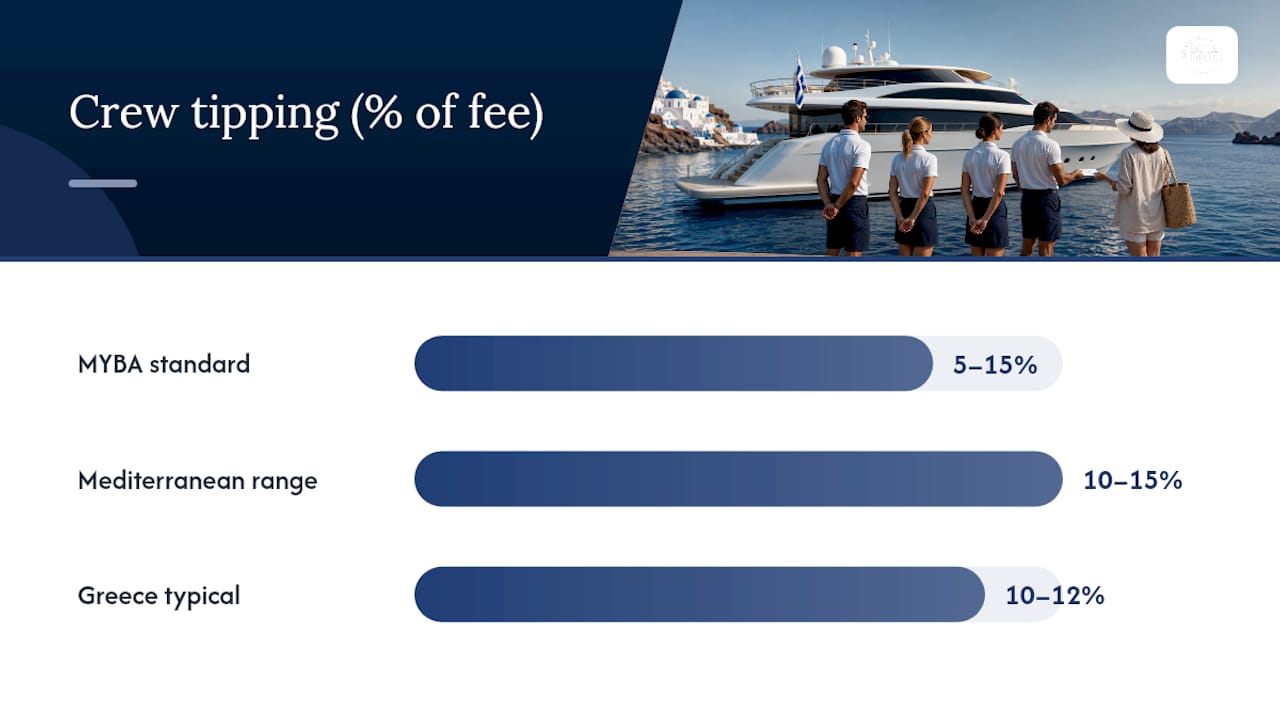
Greece itself tends to sit toward the lower end of the broader Mediterranean range of 10% to 15%, often closer to 10% to 12% for a straightforward, competently run charter. That’s not a knock on Greek crews. It reflects a market where day sailing and short multi-day trips are common, and where the culture around service compensation runs a little more modest than in the Caribbean or the French Riviera.
Skipper-only charters, common for smaller boats and day sails around Halkidiki, work differently. With one person handling navigation, safety, and hospitality, tips often run as a fixed amount rather than a percentage, typically €30 to €80 for a half-day or full-day trip depending on group size and service.
Day trips and half-day charters are usually tipped per person or as a flat sum rather than a strict percentage, since the base fee is smaller and less anchored to a formal contract.
A few worked examples show how the math scales:
- €3,000 charter fee: 10% = €300, 15% = €450
- €7,000 charter fee: 10% = €700, 12% = €840, 15% = €1,050
- €15,000 charter fee: 10% = €1,500, 15% = €2,250
For split weeks or multi-week bookings, prorate the tip across the actual days sailed rather than rounding to a full week’s figure, and factor in whether the same crew stayed on for the whole booking.
How Do You Split the Tip Between Captain and Crew?
You hand one envelope to the captain, and the captain distributes it. That single convention protects crew morale far more than it might seem to at first glance, because it keeps compensation decisions internal rather than turning gratuity into a guest-run popularity contest among the crew.
The typical distribution isn’t equal. Captains generally take the largest individual share, given their responsibility for safety, navigation, and overall guest experience. Senior crew, such as a chef or first mate, come next. Junior crew and deckhands receive smaller individual shares, though as a group they often make up a meaningful portion of the total.
On a small boat with a two-person crew, a €500 tip might split roughly €300 to the captain and €200 to the second crew member. On a larger week-long charter with four or five crew, a €1,200 tip might break down as:
- Captain: €500 to €600
- Chef or first mate: €300 to €350
- Remaining deckhands: split the balance evenly
Pro Tip: If one crew member went well out of their way for you personally, a small cash extra or a thoughtful gift handed directly to them is fine alongside the group envelope. Just don’t let it replace the captain’s distribution.
When and How Should You Hand Over the Gratuity?
Give the tip near the end of the charter as guided by the captain’s custom, usually functioning as a closing gesture tied to the whole experience.
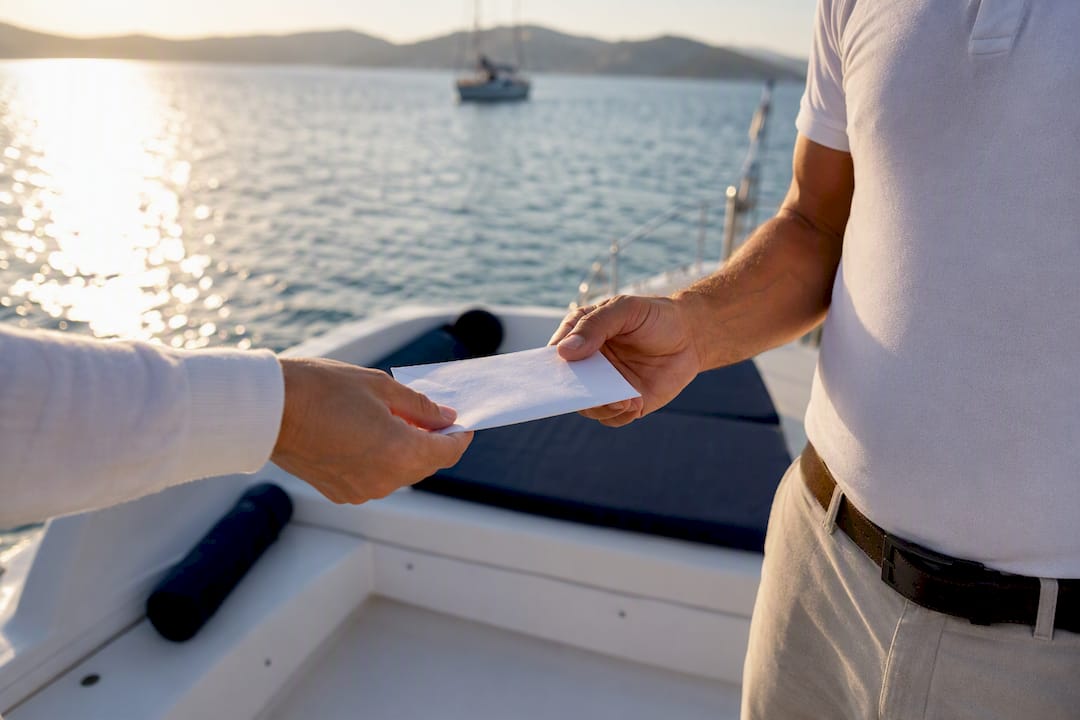
Cash in euros remains the standard and the most reliable method. Some charter brokers offer escrow-style transfers that fold the gratuity into pre-departure payments, suiting guests who prefer not to carry large amounts of cash.
Handing it over is simple:
- Put the cash in a plain envelope, addressed to the captain by name if you know it, or simply “For the Crew.”
- Find a quiet moment, away from other guests or nearby boats, rather than during a group goodbye.
- Hand it to the captain directly with a brief, genuine thank you.
Never announce the amount out loud, and never compare tips with other guests within earshot of the crew. If service genuinely fell short, a quieter, honest word to the captain (or the broker, if one was involved) does more good than a token tip meant to avoid confrontation.
Pro Tip: If you’re unsure whether the moment feels right, ask the captain quietly, “Is now a good time?” It removes the guesswork and avoids an awkward public handoff.
What Factors Should Change Your Tip Amount?
Difficult conditions matter too. A charter through choppy weather, tricky anchorages, or a long transfer day that demanded extra skill from the skipper deserves recognition on top of the baseline.
- Large groups or event charters that add hosting duties for the crew
- Special meal requests, dietary accommodations, or late-night arrangements outside the standard schedule
- Multiple destination changes that required extra route planning
Pro Tip: If your group made a lot of special requests, a slightly higher tip acknowledges the extra effort. Crews notice the difference between a straightforward sail and a charter with a long list of asks.
Is Tipping Expected in Greece, or Just Appreciated?
Tipping on Greek yachts is discretionary in the strictest legal sense but functions as an expected part of the experience for any full-service charter with a crew aboard. Skipping it entirely for good service reads as a significant oversight rather than a neutral choice.
Greek hospitality culture, often described through the concept of filoxenia, or friendship to strangers, shapes crew behavior more than tipping incentives do, but that doesn’t mean gratuities go unnoticed.
Pro Tip: When your group mixes guests with different tipping expectations, the host or organizer should quietly set the total ahead of time so nobody feels pressure to match a higher personal standard.
Does the APA Affect How Much You Should Tip?
The Advanced Provisioning Allowance, along with VAT, fuel, and dock fees, covers the running costs of your charter. None of it factors into the tip. Gratuity is calculated on the base charter fee alone, the contracted price for the boat and crew, not the total amount you end up paying.
On a €5,000 base fee with a €1,500 APA, your tip math uses €5,000, not €6,500.
Before calculating, confirm three things:
- What the contract lists as the base charter fee versus the APA
- Whether your broker holds the APA and, if so, where the gratuity should be routed
- Whether any service charge is already built into the price, which would change the math entirely
What Halkidiki Skippers Actually See on the Water
Most of our guests get this right without overthinking it. The ones who hesitate are usually worried about offending someone, when in reality a fair tip handed over quietly is never the wrong move.
For private day cruises around Neos Marmaras, Nikiti, and the wider Sithonia coastline, local baseline tips typically fall between €40 and €100 for a half-day or full-day sail, scaling with group size and how much extra effort the crew put in, whether that’s a shore stop near Paliouri or a longer run out toward Kassandra.
Locally, the two most common mistakes are calculating the tip on the total invoice instead of the base fee, and handing over loose coins or small bills instead of a folded, prepared amount. Halkidiki Boat Sailing’s professional crew charters regularly see guests reward crew-led extras like an improvised beach barbecue or a smooth handling of choppy afternoon winds with a noticeably higher tip.
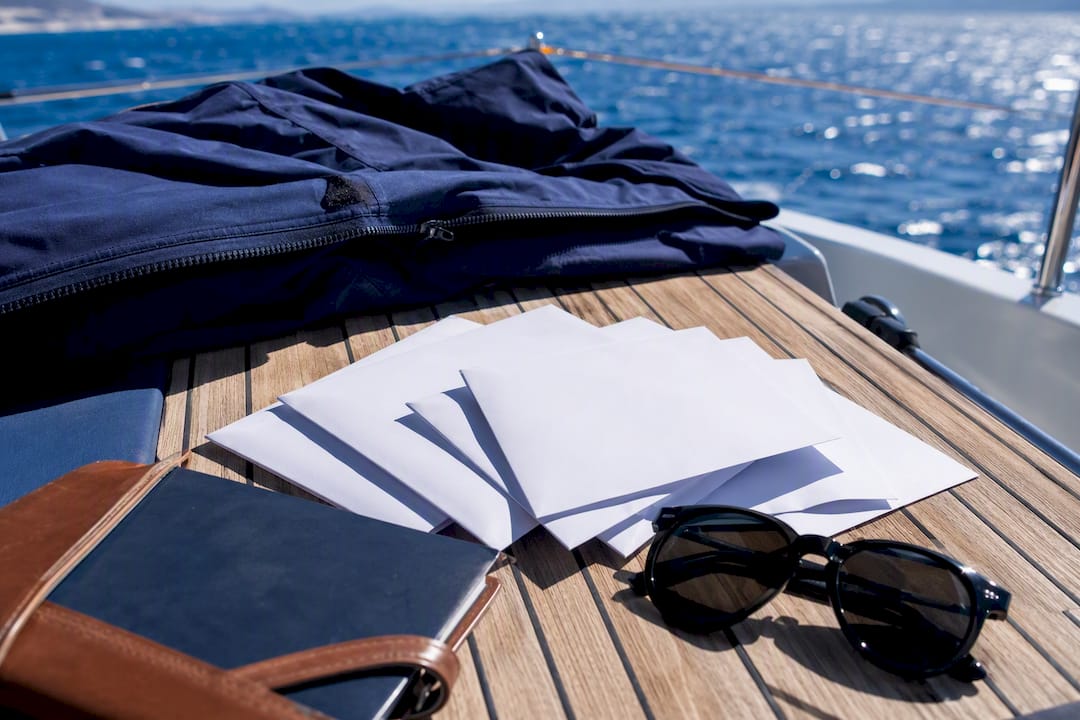
Pro Tip: Prepare the envelope before the final stretch of the trip, and keep the handover simple: “Thank you for a great day, this is for the crew.”
When Do Tips Go Above or Below the Standard Range?
A crew that navigates a sudden weather change safely, reroutes an itinerary on short notice, or handles a medical or safety issue with composure has earned recognition beyond the standard formula.
The opposite end deserves equal honesty.
Multi-day charters with a partial crew change midway present another edge case. If a new captain or deckhand joins for the second half, split the tip proportionally between the two teams based on days served, rather than giving the full amount to whichever crew happened to be aboard at the end. And for charters where a guest’s private chef or added specialist joins the regular crew, that person is typically tipped separately, since they usually operate outside the boat’s standing team and outside the base charter fee entirely.
A Skipper’s View on Fair Tipping
Crews in Halkidiki rely on gratuities as a real part of their income, not an afterthought, and fairness matters more to us than the exact number you land on. When you book with Halkidiki Boat Sailing, feel free to ask about tipping before you even step aboard. We’d rather you sail with a clear head than spend the trip second-guessing an envelope.
Ready to Book a Stress-Free Halkidiki Charter?
Halkidiki Boat Sailing replaces the guesswork of coordinating multiple vendors with one all-inclusive booking. Every private day cruise, sunset sail, and weekly charter around Neos Marmaras, the Sithonia peninsula, and Kassandra comes with a professional local skipper, fuel, refreshments, and snorkeling gear bundled into a single fixed price, so there’s no separate provisioning bill to untangle when it’s time to calculate a tip. If you want a pre-trip estimate for your gratuity or want to ask about broker-handled options, mention it when you book your weekly private cruise and George will walk you through the numbers before you ever set foot on “Off The Hook.”
Sources
FAQ
How Much Should You Tip a Catamaran Crew in Greece?
How Much Do You Tip the Crew on a Yacht?
Is It Rude Not to Tip in Greece?
Tipping is technically discretionary, but skipping it after solid crewed service is considered a significant oversight rather than culturally acceptable, especially on full-service charters.
How Much Should You Tip for a 5-Day Yacht Charter?
Does Halkidiki Boat Sailing Help With Tipping Questions?
Yes. Guests booking through Halkidiki Boat Sailing can ask George directly for a pre-trip tipping estimate based on their specific itinerary before boarding.