

For most casual travelers and families, snorkeling is the faster, lower-cost way to see the underwater world; for people who want deeper, longer, more immersive exploration, scuba diving is the better fit. The gap between the two isn’t just gear. It’s training time, budget, and how much of your vacation you want to spend learning a skill versus simply floating over it.
A few quick scenarios help narrow the choice:
- Family with young kids or non-swimmers: Snorkeling wins. No certification, minimal gear, and you can wade in from a calm cove.
- First-time traveler curious about reefs: Start with snorkeling; it’s the cheapest way to test your comfort in open water before committing to a course.
- Adrenaline seeker or underwater photographer: Scuba diving opens up depth, wrecks, and marine life that never comes near the surface.
The rest of this guide breaks down equipment, training, safety, cost, and the health research behind each activity, so you can match the right one to your skill level and your schedule.
Key Takeaways
Snorkeling works best for beginners and families because it requires no certification and minimal gear, while scuba diving rewards the training investment with deeper, longer, and more immersive access to marine life.
| Point | Details |
|---|---|
| Depth and duration differ sharply | Snorkeling stays near 1 to 4 meters; entry-level scuba reaches about 18 meters for 30 to 60 minute dives. |
| Training gap is the real divider | Scuba requires an Open Water certification course; snorkeling requires only basic comfort in water. |
| Safety habits differ by activity | Snorkelers should watch currents and sun exposure; divers must monitor air, ascent rate, and equalization. |
| Snorkeling carries a wellness signal | Small studies link snorkel training to respiratory gains and describe a stress-lowering “blue space” effect. |
| Private charters simplify logistics | Halkidiki Boat Sailing bundles snorkeling gear, a local skipper, and route planning into one guided trip around Sithonia. |
Table of Contents
- Snorkeling vs Diving: A Side-by-Side Comparison
- Gear Essentials for Snorkeling vs Scuba Diving
- Training and Safety: Where the Real Differences Show Up
- What Each Activity Actually Feels Like
- Cost and Logistics: Budgeting Your Trip
- Which One Matches Your Travel Style?
- Sources
- FAQ
Snorkeling vs Diving: A Side-by-Side Comparison
The core difference comes down to how you breathe. Snorkeling keeps your face in the water while you breathe through a tube connected to the surface. Scuba diving straps a compressed air tank to your back so you can breathe normally while fully submerged, far below where a snorkel could ever reach.
| Dimension | Snorkeling | Scuba Diving |
|---|---|---|
| Skill / training | None required; basic swim comfort helps | Certification course required (Open Water level) |
| Typical cost | Low; gear rental or a guided trip | Higher; course fees plus gear rental or ownership |
| Equipment complexity | Simple: mask, snorkel, fins | Complex: tank, regulator, BCD, dive computer, weights |
| Depth & duration | Roughly 1 to 4 meters, unlimited surface time | Entry-level to about 18 meters, dives last 30 to 60 minutes |
| Safety considerations | Currents, sun exposure, fatigue | Air management, ascent rate, equalization |
| What you’ll see | Sunlit reef tops, surface-dwelling fish | Deeper structure, larger marine life, wrecks |
| Accessibility | Almost anyone who can float | Requires fitness screening and training |
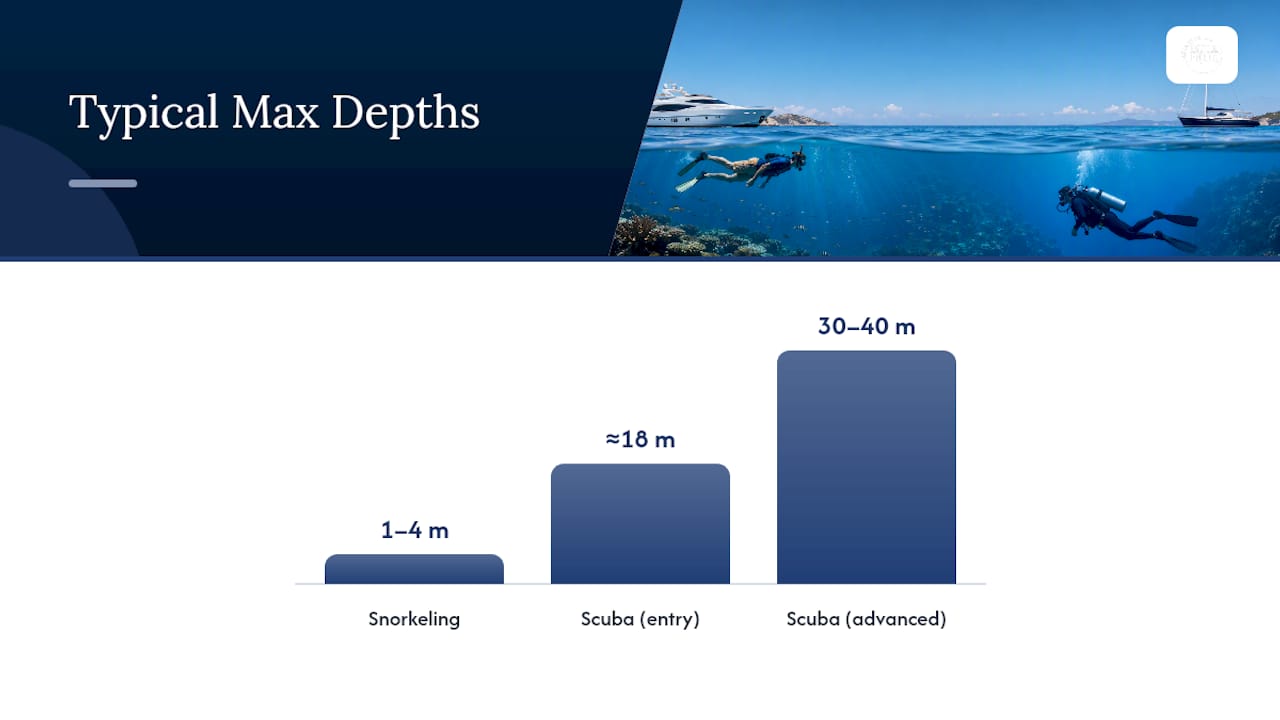
Certified scuba divers can push to 18 meters at entry level, with advanced training extending that to 30 or 40 meters, while snorkelers stay near the surface where sunlight and visibility are best anyway.
The biggest trade-off isn’t cost. It’s time. Snorkeling asks for zero prep; scuba asks for a course, a medical self-check, and a few days of your trip.
Pro Tip: Don’t assume snorkeling is the “easy” default. Strong current at an exposed point can tire out even a confident swimmer faster than a calm, guided dive would.
Gear Essentials for Snorkeling vs Scuba Diving
Snorkeling gear is refreshingly simple. Scuba gear is a system, and every piece depends on the next one working correctly.
Snorkeling essentials:
- Mask that seals without leaking
- Snorkel with a purge valve for easier clearing
- Fins for efficient, low-effort swimming
- Optional flotation vest for less confident swimmers
Scuba essentials:
- Mask, fins, and often a wetsuit for warmth
- Buoyancy Control Device (BCD) to manage depth
- Regulator to breathe from the tank
- Tank, weight system, and a dive computer to track depth and time
| Item | Snorkeling | Scuba Diving |
|---|---|---|
| Usually rented | Mask, snorkel, fins | Tank, weights, BCD |
| Usually owned by frequent users | Personal mask | Regulator, dive computer |
| Air travel consideration | Fits in carry-on easily | Tank never flies; rent locally |
Most travelers rent mask, snorkel, and fins locally rather than hauling gear through airport security. Regulators and dive computers are the pieces frequent divers tend to buy, since fit and familiarity matter when your air supply depends on them.
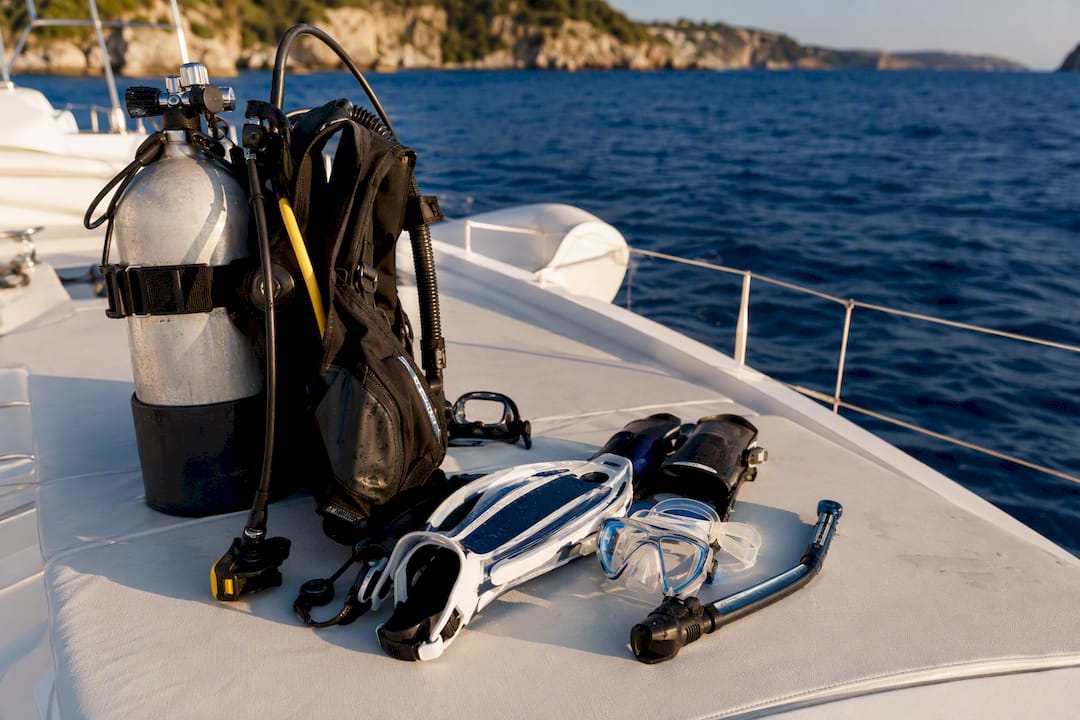
Pro Tip: If you’re a once-a-year snorkeler, skip buying gear altogether. A private charter that bundles snorkeling equipment into the trip price saves you both luggage space and the guesswork of sizing a mask correctly online.
Training and Safety: Where the Real Differences Show Up
Snorkeling has no certification requirement, but comfort in open water matters more than people expect. Weak swimmers who panic in a mask and snorkel account for a disproportionate share of snorkeling incidents, which is why a buddy system and a flotation vest are worth using even on calm days.
Scuba diving requires a certification course, typically an Open Water level program, before you can rent tanks or join a dive without direct supervision. That course covers equalizing your ears, monitoring your air gauge, controlling buoyancy, and performing a safety stop on ascent.
The risk profiles diverge sharply:
- Snorkeling risks: currents pulling you off course, sunburn from hours face-down at the surface, and fatigue in open water with no boat nearby.
- Scuba risks: running low on air, ascending too fast, and skipping equalization, which can cause ear injury.
A practical pre-trip safety checklist applies to both activities:
- Confirm you’re medically fit for exertion in water
- Check local current and wind conditions before entering
- Never snorkel or dive alone; use a buddy
- Inspect gear, especially mask seals and regulator connections
- Equalize early and often on any descent
- Know your air supply status throughout a dive
DAN’s safe-diving guidance centers on planning the dive, monitoring air continuously, performing safety stops, and never diving solo. If you haven’t been underwater in six months or longer, a refresher or checkout dive is strongly recommended before jumping back into open water, especially in variable conditions like Mediterranean currents.
Skipping a checkout dive after time away from the water is one of the most common, and most avoidable, safety lapses divers make. Poor buoyancy control and running out of air remain frequent underlying causes of diving incidents, which is exactly what a refresher session is designed to catch before it becomes a problem.
Medical guidance also flags that certain conditions, including untreated seizure disorders and recent lung injuries, generally rule out diving, and recommends waiting 12 to 24 hours before flying after a dive.
What Each Activity Actually Feels Like
Snorkeling gives you a wide, sunlit view. You float at the surface, looking down through clear water at a reef or seagrass bed, and you can cover a lot of ground quickly with fins doing the work. Scuba diving flips that perspective. You’re inside the scene, hovering at eye level with a grouper or drifting along a wall where the light fades and the water goes cooler.
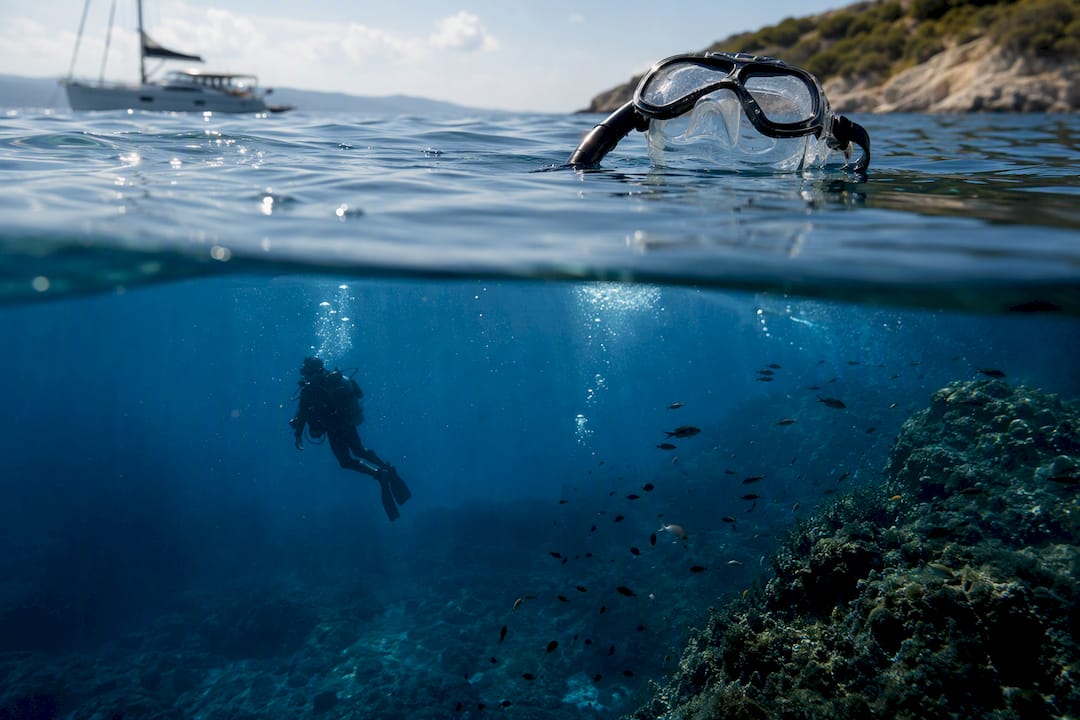
A family snorkeling a shallow cove near Neos Marmaras gets constant, easy sightings of small fish and rock formations without any training curve. A photographer chasing macro subjects, tiny nudibranchs or camouflaged blennies, usually needs the stability and proximity that scuba provides, since holding position at depth beats bobbing at the surface. An adrenaline seeker drawn to a wall dive wants the descent itself, not just what’s at the bottom.
A few practical notes worth knowing:
- Visibility is often best in the top few meters, which works in snorkelers’ favor
- Fish behave differently near the surface, more skittish, than they do at depth where divers can hold still and watch
- Mask fog ruins more snorkeling photos than bad lighting does
Pro Tip: Defog your mask with a drop of baby shampoo and a rinse before entering the water. It works better than most commercial defog sprays and costs nothing.
Cost and Logistics: Budgeting Your Trip
A snorkel gear rental typically runs a modest daily fee, and a guided snorkel trip adds a boat and local knowledge on top of that. Scuba sits in a different bracket entirely: an Open Water certification course is a multi-day investment, and even a single guided fun dive with gear rental costs more than an entire day of snorkeling.
Time commitment follows the same pattern. A snorkel outing can happen in an afternoon with zero prep. A scuba certification typically spans three to four days of classroom time, pool sessions, and open-water dives before you’re independently certified.
For a boat-based day near Nikiti or Paliouri, a private charter usually handles sun protection stops, hydration, and site selection, leaving you to just show up with a swimsuit and sunscreen.
A simple day built around either activity looks like this:
- Morning pickup and briefing on conditions
- Boat transfer to a sheltered cove or dive site
- Gear fitting and safety review
- Snorkel session or guided dive (30 to 60 minutes underwater time for a dive)
- Surface break with refreshments
- Return transfer and wrap-up
Which One Matches Your Travel Style?
Match the activity to your profile before you match it to the destination:
- Families with young kids: snorkeling in shallow, sheltered coves
- Non-swimmers or nervous swimmers: snorkeling with a flotation vest, or skip it for shore-based swimming instead
- Photographers: scuba diving for stability and proximity to subjects
- Fitness-focused travelers: either works, but scuba demands a baseline of aerobic comfort
- Thrill-seekers: scuba diving, especially wall dives or wreck sites
Three questions settle most indecision fast:
- Are you comfortable floating in open water without panicking?
- Do you have three to four days to spend on certification, or just an afternoon?
- Is your budget closer to a rental fee or a course fee?
Plenty of travelers do both on the same trip. Start with a snorkel session to test your comfort level, then book a supervised introductory dive later in the week if you’re hooked. It’s the lowest-risk way to find out which one you actually prefer, rather than guessing from a brochure.
How Snorkeling and Ocean Time Affect Your Health
A small 8-week snorkel training study tracked 12 young swimmers and found measurable gains in VO2max, FEV1, and peak expiratory flow, alongside faster 100-meter freestyle times. That’s a small sample, and it doesn’t prove snorkeling alone builds fitness in every population, but it’s a coherent signal that regular snorkel breathing patterns can improve respiratory efficiency over time.
There’s also a psychological angle. Researchers and practitioners describe a “blue space” effect: time spent floating in open water, breathing slowly and rhythmically, tends to lower stress in ways similar to other mindful, low-impact exercise. Snorkeling may be more restorative for many people precisely because it skips the technical vigilance diving demands, gauge checks, depth limits, ascent rates, and simply lets you drift and observe.
The respiratory gains from an 8-week snorkel program were real but measured in just 12 participants, so treat it as an encouraging early signal rather than a settled finding.
If you have a heart condition, asthma, or another health concern, talk to a clinician before either activity, and be honest with your operator about any limitations before booking.
A Local Note From the Water
I’ve watched plenty of first-time snorkelers hesitate at the edge of the boat near Kassandra, only to relax within minutes once they realize how forgiving a sheltered cove can be. My advice: pick sheltered bays over exposed points when currents are unpredictable, and let a guided snorkel tour or supervised introductory dive handle the route planning. Private charters make this easier, especially with mixed groups, since snorkelers and divers can share one boat without either group waiting on the other.
A Simpler Way to Snorkel Around Sithonia
Halkidiki Boat Sailing solves the one problem most snorkel trips create: figuring out where to go and who’s watching the conditions. Instead of renting gear, driving to a beach, and hoping the water’s calm, you book one private charter that already includes snorkeling equipment, a local skipper who knows which coves near Neos Marmaras and Nikiti are sheltered that day, and a route built around your group’s comfort level.
A private charter typically includes:
- A professional skipper who reads local conditions before choosing a stop
- Snorkeling gear bundled into the trip, no separate rental stop needed
- Flexible itinerary that can mix a snorkel cove with a scenic sail
- Refreshments and shade breaks between water sessions
If your group has both cautious snorkelers and confident swimmers wanting more, the Sunset Private Cruise is a low-friction option built for exactly that mix. Check available dates and book directly online before your travel window fills up.
Sources
- PADI blog — Snorkeling vs Scuba Diving
- Divers Alert Network — Diving skills refresher
- UTJSPe study — Effect of snorkeling training on respiratory efficiency
- DAN — Safe diving practices
- Merck Manuals — Diving safety precautions and prevention
For route ideas near sheltered coves, the Sithonia maps and route pack is a useful planning resource before booking.
FAQ
Can a non-swimmer try snorkeling?
Yes, with a flotation vest and a guided, shallow, sheltered site, non-swimmers can often snorkel safely, though comfort in open water still matters more than technique.
Can you go fully underwater while snorkeling?
You can dive briefly with a snorkel by holding your breath, but you must clear the tube of water before breathing again once you resurface, which limits how long and how deep you can go.
Why shouldn’t you dive with a snorkel still in your mouth?
Switching to a scuba regulator means your snorkel is no longer needed, and keeping it in your mouth adds an unnecessary obstruction that can interfere with proper regulator use underwater.
Which is easier, snorkeling or scuba diving?
Snorkeling is easier to start since it needs no certification and minimal gear, while scuba diving requires formal training before you can dive independently.
Is snorkeling or diving better for a first Halkidiki trip?
Most first-time visitors to Sithonia start with a guided snorkeling stop on a private charter, then consider a supervised introductory dive later in the trip once they know how comfortable they are in open water.