
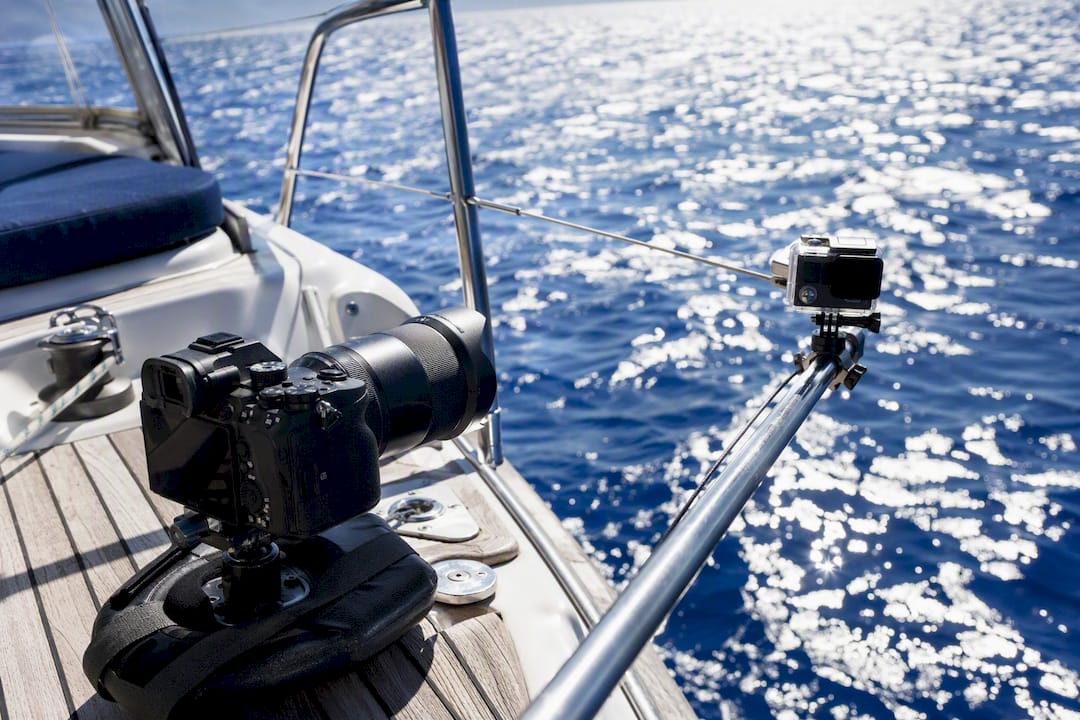
For most sailors, a weather-sealed mirrorless body paired with an action camera backup gives you the best mix of image quality, ruggedness, and mounting flexibility. That combination handles everything from a golden-hour anchorage shot in Neos Marmaras to a spray-soaked bow run without forcing you to choose between quality and survival.
Here’s the quick verdict by category:
- Weather-sealed mirrorless (best all-around): Superior image quality, interchangeable lenses, best for portraits and landscapes at anchor.
- Action camera like the GoPro Hero series (best backup): Fully waterproof, mountable anywhere, ideal for POV and rough-water shots.
- Rugged waterproof compact like the OM System Tough TG-6/TG-7 (best minimalist option): No housing needed, great for guests who don’t want to fuss with gear.
- Drone like a DJI Mini series (best for aerials): Stunning overhead shots of the boat and coastline, but only in calm, low-traffic conditions.
- Smartphone kit (best lightweight backup): Always in your pocket, good enough for social posts, weak in harsh light or fast motion.
Key Takeaways
A weather-sealed mirrorless body with an action camera backup gives most sailing photographers the strongest balance of image quality, ruggedness, and mounting flexibility on the water.
| Point | Details |
|---|---|
| Primary kit choice | Weather-sealed mirrorless plus an action camera backup covers most sailing scenarios. |
| Lens priorities | Cover wide (10–24mm), standard (24–70mm), and telephoto (70–300mm) equivalents for full onboard coverage. |
| Saltwater defense | Wipe spray immediately, never swap lenses on a moving boat, and rinse housings in fresh water daily. |
| Mounting safety | Tether every camera and pick calm helm-area positions for the steadiest horizon. |
| Book a photo-friendly charter | Halkidiki Boat Sailing offers private and sunset cruises around Sithonia with crew support for safe mounting spots. |
Table of Contents
- 1. Choosing Your Core Sailing Camera: Mirrorless, Compact, or Action Cam?
- 2. Mounts, Clamps, and Safety Gear That Keep Cameras Attached
- 3. Camera Settings and Shooting Techniques for Life at Sea
- 4. Protecting Your Gear From Salt, Spray, and Humidity
- 5. Matching Your Budget to Your Photography Goals
- 6. Shooting From a Chartered Yacht in Sithonia
- Why I Trust Rugged Gear Over Fragile Perfection
- Book a Photo-Friendly Sail With a Crew That Gets It
- Sources
- FAQ
1. Choosing Your Core Sailing Camera: Mirrorless, Compact, or Action Cam?
The real decision comes down to a trade-off between sensor size and survivability. A larger sensor captures more detail and handles shadows and highlights better, but it also demands more protection from salt and spray. A rugged compact sacrifices some image quality for the peace of mind that comes with never worrying about a rogue wave.
For lens selection, three focal ranges cover almost everything you’ll shoot on a sailing trip. A wide angle around 10–24mm equivalent handles deck scenes, rigging, and tight cockpit shots where space is limited. A standard zoom in the 24–70mm or 24–105mm equivalent range is your workhorse for portraits of crew, sail detail, and general coverage. A longer 70–300mm equivalent earns its weight for distant wildlife, shoreline villages like Nikiti, or another boat passing on the horizon.
Practical Sailor’s buyer’s guide points to Olympus and OM System Tough compacts as reliable long-term boating cameras, and that reputation holds because the TG-series is waterproof-certified to roughly 15 meters without a housing. That removes an entire category of gear failure for casual shooters.
Action cameras and 360-degree rigs like the Insta360 One X2 or One RS earn their spot as secondary tools rather than primary cameras. GoPro’s own guidance highlights waterproof depth ratings out of the box and HyperSmooth stabilization as the two features that make them genuinely useful afloat, especially for POV shots from the bow or a swimmer’s-eye view during a snorkel stop.
A DJI Mini series drone adds a genuinely different perspective, capturing the boat’s wake against turquoise water in a way no deck-mounted camera can. Skip the flight, though, when guests are moving around the cockpit, the wind is gusting past 15 knots, or the skipper flags rigging overhead as a hazard.
2. Mounts, Clamps, and Safety Gear That Keep Cameras Attached
A boat moves in ways a tripod was never designed for, so your mounting kit matters almost as much as the camera itself. Build a small kit around these core pieces:
- Suction cup mount: Fast to attach to hulls, hatches, or smooth deck surfaces for a stable low-angle shot.
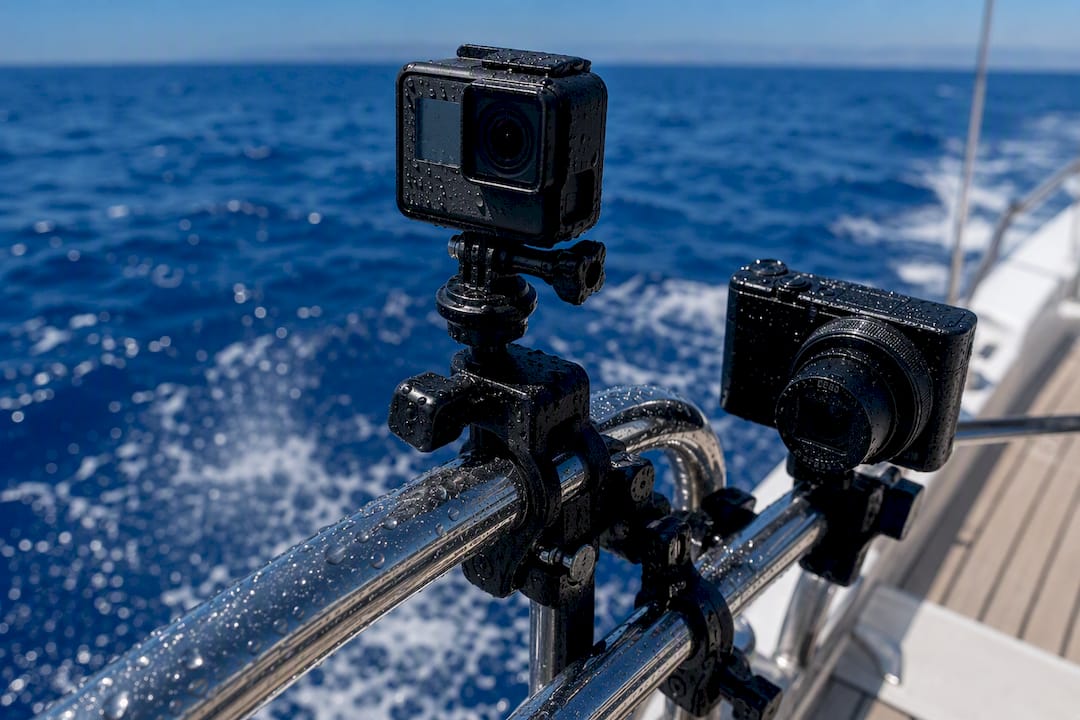
- Rail clamp: Secures to stanchions and pushpits for a steady, elevated view of the whole deck.
- Pole or boom extension: Gets the camera over the water or above the crowd for a genuine bird’s-eye angle.
- Chest harness: Frees your hands while sailing and keeps the horizon roughly level as you move.
- Adhesive mount: Permanent-feeling but repositionable, useful on a helmet or a fixed structural point.
- Magnetic base: Convenient on steel fittings, but use it cautiously since a wave can shake it loose faster than you’d expect.
Beyond mounts, a few safety accessories separate photographers who keep their gear from those who don’t: a wrist or neck tether, a floatation pod or case for action cams (per Yachting World’s testing), quick-release straps, and a small dry bag or pelican-style case for stowage between shots.
Pro Tip: Mount choice changes with position on the boat. Bow mounts capture the most dramatic spray but pitch the hardest, so keep shutter speed high there. Stern mounts stay steadier and suit wake shots. Helm-area mounts give the calmest horizon, which makes them the safest bet for longer video takes.
3. Camera Settings and Shooting Techniques for Life at Sea
Freezing spray or a crew member mid-tack starts with shutter speed. Keep it at 1/1000s or faster for action, and drop no lower than 1/250s for general handheld shots on a moving deck. Auto-ISO with a capped ceiling (around ISO 3200 on most mirrorless bodies) handles the sea’s constantly shifting light without introducing excessive noise.
For video, match frame rate to intent: 24fps for a cinematic feel, 30fps for straightforward documentation, 60fps for smooth playback of fast action, and 120fps or higher when you want dramatic slow motion of a jib being hauled in.
Most action cameras include horizon lock or electronic leveling, and turning it on is close to mandatory on a rolling deck. It won’t fix a bow tossing on a swell but it saves a noticeable percentage of unusable footage. For stills, spot metering on your subject (a crew member’s face, a sail’s leading edge) outperforms average metering when backlight from the sun bounces hard off the water. Shooting RAW gives you room to recover shadow detail that JPEG compression would otherwise crush, and a graduated neutral-density filter helps balance a bright sky against a darker hull or sea in a single frame.
For composition, include rigging or a sail edge in the frame to give scale to open water, shoot low from a dinghy when you can for a more dramatic angle, and build a simple shot list before you leave the dock: bow run, stern wake, a crew action shot, and at least one relaxed portrait.
Pro Tip: Skip the tripod. A short monopod or a rail clamp gives you 90% of the stability with a fraction of the bulk, and you can reposition it in seconds when the boat changes tack.
4. Protecting Your Gear From Salt, Spray, and Humidity
Saltwater spray is the single biggest threat to any camera on a boat, and the fix is mostly discipline rather than expensive gear. Follow this sequence every time you shoot on deck:
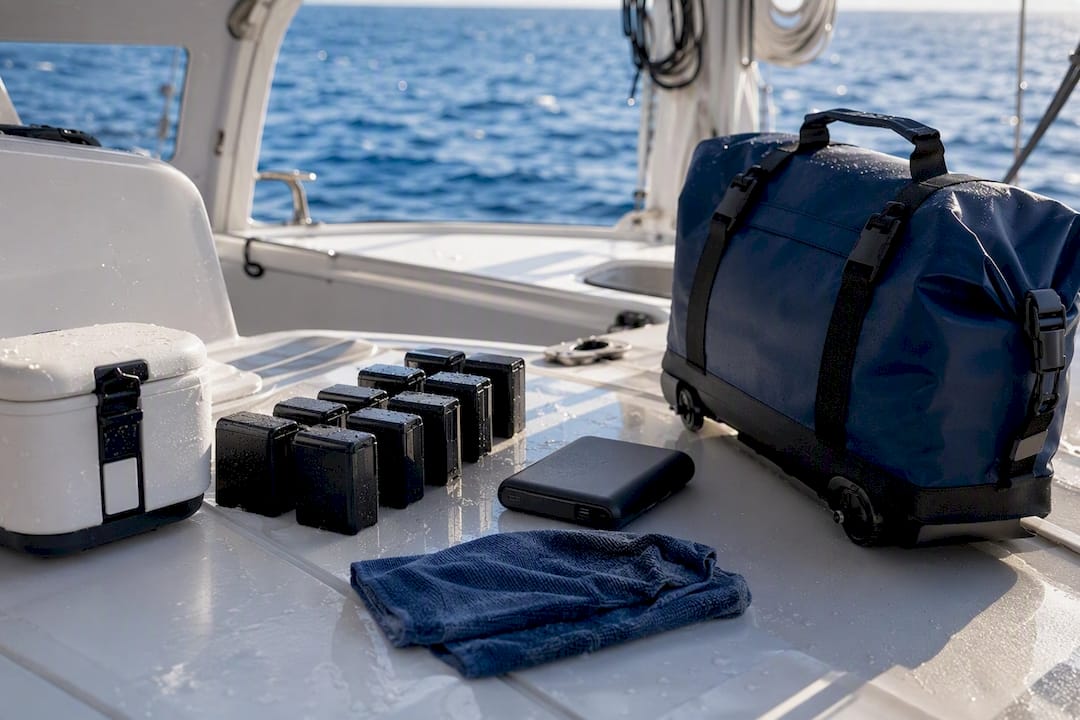
- Wipe spray off housings and lens barrels with a microfiber cloth as soon as you notice it, not at the end of the day.
- Never change lenses on a moving boat. Salt crystals find their way onto the sensor faster than you’d think.
- Rinse waterproof housings and action cams in fresh water at the end of a salty day, then dry thoroughly before stowing.
- Pack silica gel packets into your camera bag or pelican case to manage residual humidity overnight.
Outex’s boating gear guide confirms this exact sequence as the standard defense against corrosion and lens-film buildup, and it’s the same advice serious cruisers repeat season after season.
Battery care deserves its own habit: carry two or three spares, use a marine-rated USB power bank for topping up between stops, and store batteries at room temperature rather than leaving them in direct sun on the deck. And never leave a camera loose near the rail, even for a second. Tether it, every time.
5. Matching Your Budget to Your Photography Goals
Your budget shapes more than image quality. It determines how much you’ll spend on housings, mounts, and eventual repairs after a few seasons of salt exposure.
- Budget tier: A rugged waterproof compact plus a smartphone and one action camera covers casual documentation without any housing costs.
- Enthusiast tier: A weather-sealed mirrorless crop-sensor body with a 24–70mm equivalent lens, backed by an action camera for POV shots, balances quality and durability.
- Pro or resilient tier: A full-frame weather-sealed mirrorless body, a 24–105mm lens, a 70–300mm for distance work, and dedicated housings for the harshest days.
When deciding where to spend first, prioritize in this order:
- A quality lens over a marginally better body.
- A reliable mounting system that won’t fail mid-shoot.
- Waterproof housings for anything not already sealed.
- Extra batteries and reliable charging.
Rugged compacts and action cameras also tend to hold resale value better than delicate mirrorless setups, since buyers specifically shopping secondhand marine gear know exactly what they’re getting.
6. Shooting From a Chartered Yacht in Sithonia
Packing for a day charter comes down to a short list: one primary camera in a padded case, one action cam with a spare battery, a rail clamp, a dry bag, and a microfiber cloth kept within reach at all times.
Worth prioritizing on a typical route through Neos Marmaras or Nikiti:
- A bow run shot as the yacht clears the harbor.
- Candid crew portraits during sail trimming.
- A split anchor shot showing the snorkel area both above and below the surface near a cove off Kassandra.
Always ask the skipper for a calm window before mounting gear on rails or rigging, and treat a missed shot as far less costly than a camera in the water. Read more on Halkidiki’s private sailing routes for planning specific stops.
| Point | Details |
|---|---|
| Best packing order | Camera, action cam, mount, dry bag, microfiber cloth, in that reach order. |
| Highest-value shots | Bow run, crew portraits, and a split anchor/snorkel shot. |
| Crew coordination | Ask the skipper for calm windows before mounting gear near rails or rigging. |
Why I Trust Rugged Gear Over Fragile Perfection
Chasing the sharpest possible image on a boat is a losing game if the camera doesn’t survive the trip. Rugged, mountable gear consistently outperforms delicate setups on the water because it gets used more, in more conditions, without hesitation.
Book a Photo-Friendly Sail With a Crew That Gets It
Most photography guides tell you what gear to buy. We can tell you where to actually use it. Halkidiki Boat Sailing runs private and small-group charters around Sithonia with a crew that knows exactly which rail sections are safe for a suction mount and which coves near Neos Marmaras give you the best light without fighting a crowd of other boats. Unlike a public excursion boat where you’re stuck with fixed timing, our routes and stop lengths adjust so you can chase golden hour instead of working around someone else’s schedule. If you want a sunset run built around photography rather than squeezed in as an afterthought, book the sunset private cruise aboard Off The Hook and tell the crew you’re shooting. They’ll help you find the calm windows before you even ask.
Sources
- Camera Gear for Cruisers: A Buyer’s Guide – Practical Sailor
- How To Use Your GoPro as the Ultimate Boat Camera
- Boating protection & gear care – Outex
- 6 of the best action cameras for capturing your sailing adventures – Yachting World
FAQ
What Is the Best Camera for Sailing Photography?
A weather-sealed mirrorless camera paired with a waterproof action camera like a GoPro Hero series model covers the widest range of sailing scenarios, from crew portraits to spray-heavy action shots.
Do I Need a Waterproof Housing for My Camera on a Boat?
Rugged compacts like the OM System Tough TG-6 are waterproof to roughly 15 meters without a housing, but mirrorless and DSLR bodies need a dedicated housing or careful spray management to survive a full day at sea.
What Settings Should I Use for Sailing Action Shots?
Use a shutter speed of at least 1/1000s to freeze spray and motion, cap your ISO around 3200, and enable horizon lock on action cameras to counter the boat’s constant movement.
Can I Fly a Drone While Sailing?
You can, but only in calm conditions with the skipper’s approval, since rigging, other passengers, and wind gusts create real hazards for a DJI Mini series drone near a moving sailboat.
How Do I Book a Photography-Focused Sailing Trip in Halkidiki?
Halkidiki Boat Sailing offers private day and sunset charters around Sithonia, including Neos Marmaras and Nikiti, with crew who can suggest calm mounting windows and photo-friendly stops along the route.