
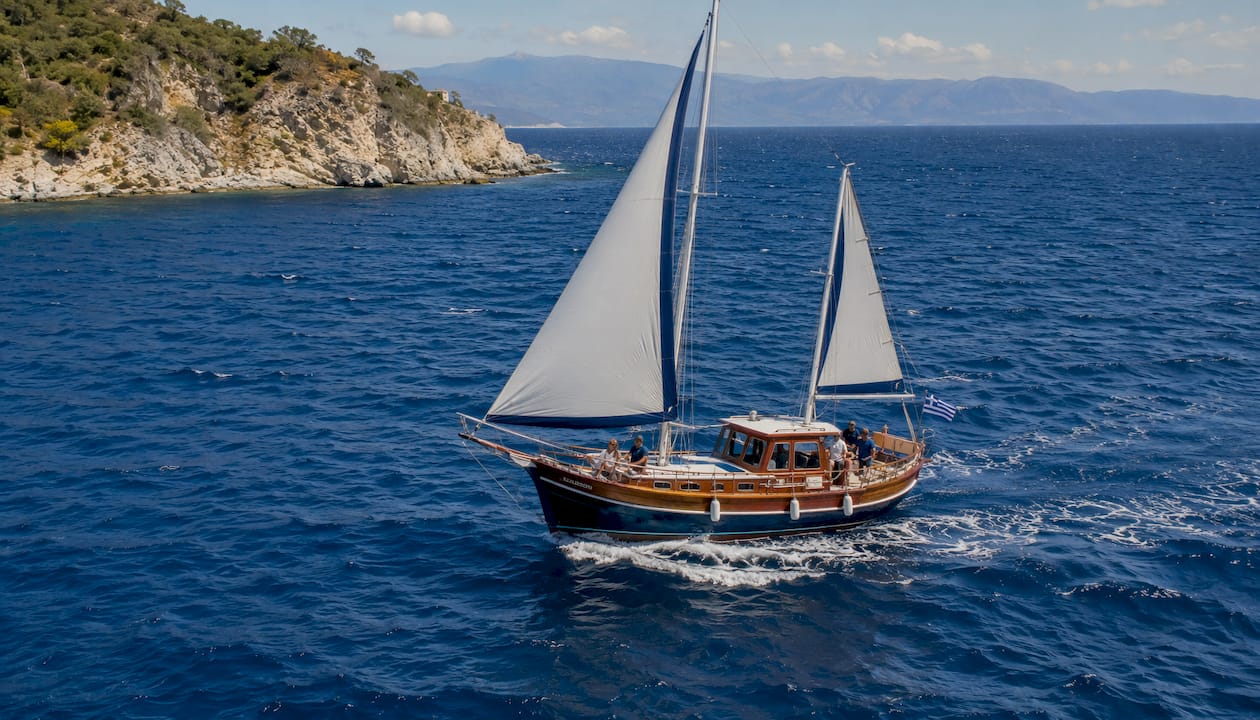
For most travelers, the best introduction to Greek sailing boats is a skippered monohull or a private crewed kaiki — one gives you the freedom of a full charter, the other gives you something money rarely buys: genuine cultural texture. The four main vessel types you’ll encounter are the traditional kaiki (caique), the monohull sailing yacht, the catamaran, and the gulet or motorsailer, each suited to a different trip style, group size, and sailing region.
Here’s a quick orientation before you dive deeper:
- Kaiki/caique: Best for authentic, boutique day cruises and short coastal hops, especially in Halkidiki’s Sithonia peninsula around Neos Marmaras and Nikiti.
- Monohull sailing yacht: The most versatile choice for week-long Greek island hopping, available bareboat or skippered.
- Catamaran: Ideal for families or groups of 6–10 who want stability, deck space, and comfort in open-water crossings.
- Gulet/motorsailer: Perfect for those who want the look of a traditional wooden vessel with the reliability of an engine, popular on longer Aegean routes.
If you’re planning a first trip, start with a skippered charter or a fully crewed day cruise. If you’re researching boats for sale, read the buying section before committing to a listing.
Table of Contents
- What types of Greek sailing boats should you choose?
- Where should you sail in Greece, and what are the best routes?
- What charter style fits your trip, and what does it cost?
- Should you buy a boat in Greece or keep chartering?
- Why traditional kaikia matter, and what you should know before sailing one
- What is life actually like onboard a Greek sailing boat?
- How do you choose the right boat or charter company?
- Key Takeaways
- Why slowing down is the real secret to a Greek sailing trip
- Sail Halkidiki with Halkidiki Boat Sailing’s “Off The Hook”
- Useful sources and next reading
- FAQ
What types of Greek sailing boats should you choose?
Greece offers a wider range of vessel types than almost any other Mediterranean destination, and the right choice depends on your group, your budget, and how much sailing you actually want to do.
| Boat Type | Best For | Capacity | Typical Weekly Rate | Comfort Level | Greek Conditions Notes |
|---|---|---|---|---|---|
| Kaiki/Caique | Couples, small groups, cultural experience | 6–12 guests | Varies by operator | Rustic to moderate | Excellent in sheltered bays; avoid open Aegean in Meltemi |
| Monohull (38–45 ft) | Couples, families, intermediate sailors | 4–6 guests | €1,600–€2,800+ | Good | Handles Meltemi well; fits most marina berths |
| Catamaran (44–48 ft) | Families, larger groups, luxury | 6–10 guests | €5,500–€12,000 per week peak season | Excellent | Stable in chop; needs wider berths, limits some anchorages |
| Gulet/Motorsailer | Groups wanting comfort and scenery | 6–10 guests | Varies widely | High | Motor-assisted; ideal for Dodecanese and northern Aegean |

Kaiki/caique
The traditional kaiki has a wide beam set far aft and a long, sharp bow — a silhouette that has defined Greek harbors for centuries. Many have been thoughtfully repurposed for excursion tourism, and sailing on one feels genuinely different from stepping aboard a fiberglass production yacht. The craftsmanship is visible everywhere: in the curved planking, the hand-fitted rigging, and the way the hull settles into the water. For sheltered coastal cruising around Halkidiki’s Sithonia, Paliouri, or Kassandra, a well-maintained kaiki is hard to beat for atmosphere.
Monohull sailing yacht
Beneteau and Jeanneau dominate the Greek charter fleet, and for good reason. Models like the Beneteau Oceanis 38.1 or the Jeanneau Sun Odyssey 440 offer a practical balance of performance, cabin space, and marina compatibility. A 38–45 ft monohull comfortably sleeps four to six adults and fits into virtually every Greek harbor. For the Cyclades or Ionian, this is the workhorse of the charter world.
Catamaran
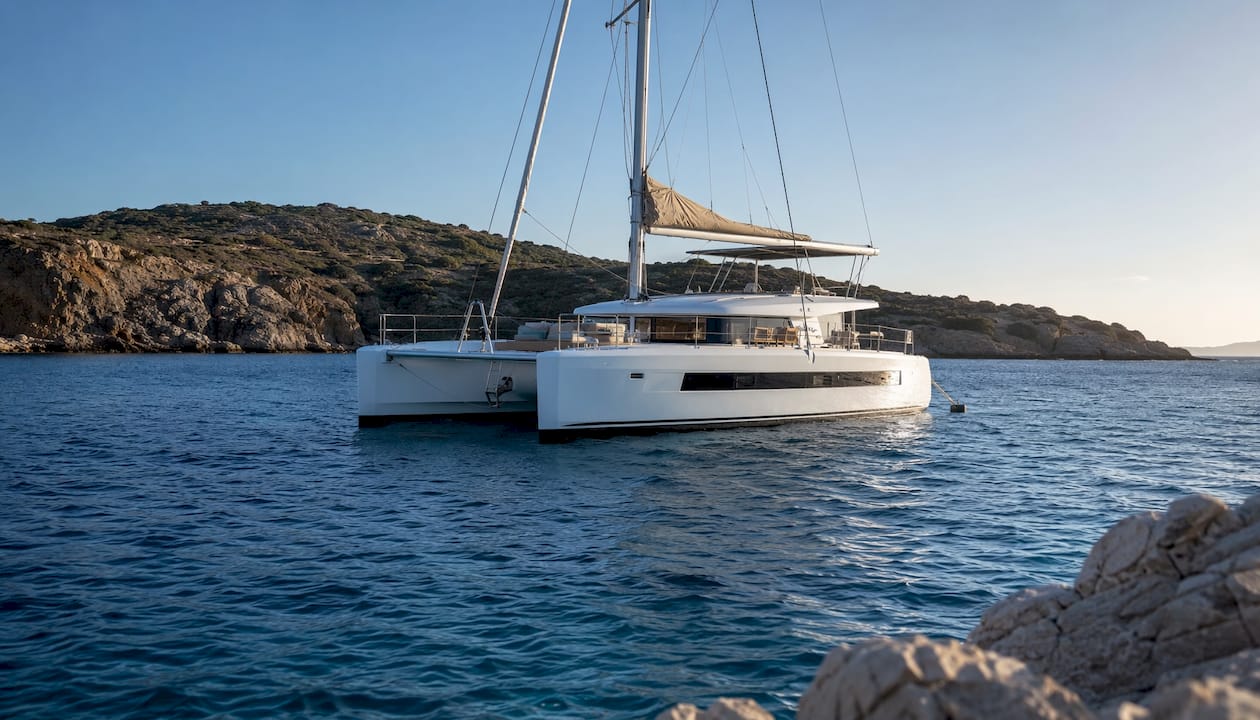
Catamarans give you the deck space of a small apartment and the stability that makes nervous sailors relax. The trade-off is cost and marina logistics: peak-season rates for a 44–48 ft catamaran commonly range from €5,500 to €12,000 per week, and some smaller Greek harbors simply don’t have the beam clearance. If your group is eight or more, or if you have young children, the extra comfort is worth the premium.
Gulet/motorsailer
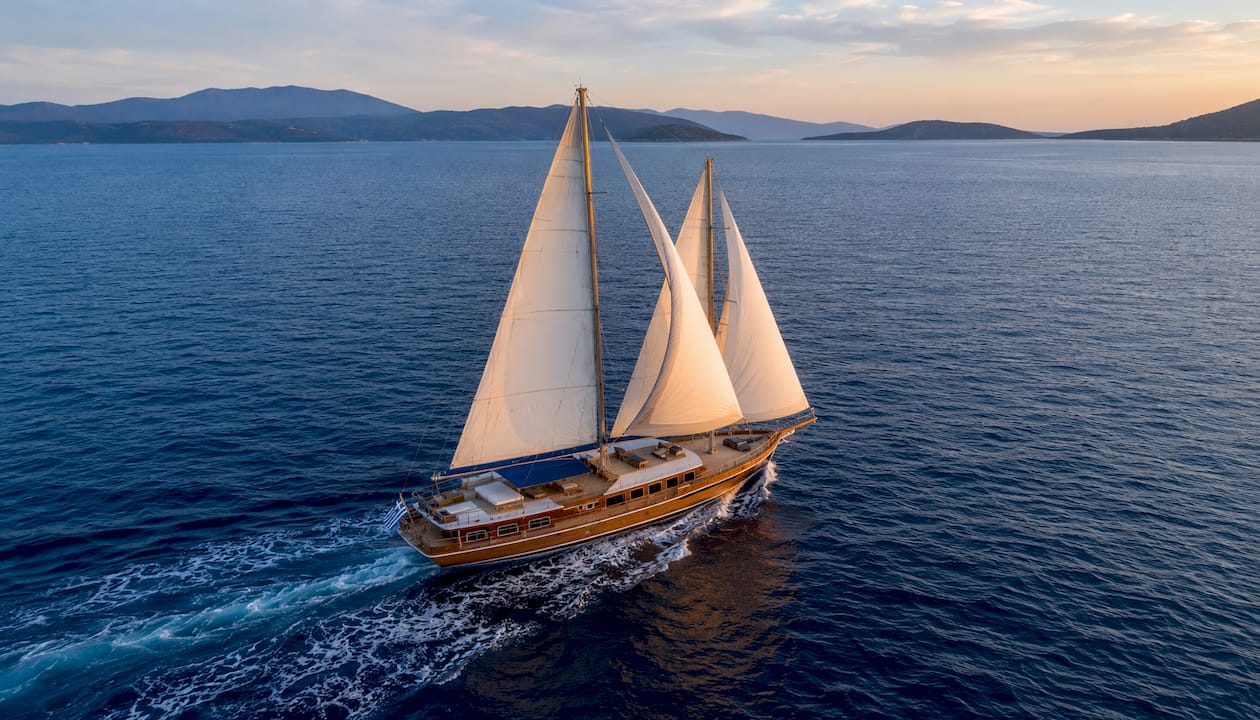
The gulet is a Turkish-influenced wooden motorsailer that has become popular throughout the Aegean. It’s a motorsailer that offers the aesthetic of a traditional vessel with the practicality of a reliable diesel engine. Groups who want to cover ground without worrying about wind angles tend to love them.
Where should you sail in Greece, and what are the best routes?
Greece has a vast coastline and thousands of islands, with a portion of these islands inhabited. Each cruising region has its own personality, wind regime, and crowd level.
Regional profiles at a glance:
- Ionian Sea: Gentle Maistros winds (10–15 knots most afternoons), green mountains, calm water. The best region for first-timers and families. Base marinas at Lefkas and Corfu.
- Saronic Gulf: Athens is right there, hops average 10–15 NM, and the sea stays flat through most of summer. The classic beginner’s classroom.
- Cyclades: The most photogenic region and the most demanding. The Meltemi dominates July and August, commonly reaching Force 5–6, with gusts to 35 knots between islands like Mykonos and Tinos. Rewarding for confident crews; stressful for beginners.
- Dodecanese: Rhodes, Kos, and Patmos anchor a region that blends Turkish-influenced architecture with open-sea passages. Longer legs, more varied anchorages.
- Sporades: Skiathos, Skopelos, and Alonnisos offer forested mountains and relatively uncrowded anchorages. A quieter alternative to the Cyclades.
- Halkidiki (Sithonia peninsula): Sheltered, boutique, and dramatically beautiful. The three peninsulas of Kassandra, Sithonia, and Athos create a natural wind shadow that keeps conditions manageable even in high summer. Neos Marmaras, Nikiti, and Paliouri are the key departure points for exploring hidden coves, sea caves, and the uninhabited islet of Kelifos.
Best months: May, June, and September offer the best balance of warm water, manageable winds, and fewer crowds. July and August are peak Meltemi season in the Aegean; the Ionian and Halkidiki remain calmer.
Three sample itineraries
-
Halkidiki half-day (4–5 hours, Sithonia): Depart Neos Marmaras in the morning, sail south along the Sithonia coastline to Kelifos Isle for a swim stop in turquoise water, then return via a sheltered cove near Paliouri. No experience required; ideal as a first taste of the Aegean.
-
Halkidiki 3–5 day loop: Day 1, depart Nikiti and sail to a secluded anchorage on the eastern Sithonia coast. Day 2, continue south to the waters off Paliouri and overnight at anchor. Day 3, cross to Kassandra’s western shore for a beach stop, then return north. Days 4–5 can extend to the Sporades if conditions allow. This loop suits a small private group with a local skipper who knows the afternoon wind shifts.
-
Saronic Gulf 7-day loop (classic first charter): Athens (Alimos Marina) to Aegina (17 NM), Hydra (22 NM), Spetses (11 NM), Ermioni (7 NM), Poros (15 NM), and back to Athens (22 NM). Total distance roughly 80 NM, with flat water and a harbor every night. The scent of pistachios at Aegina’s quay and the car-free cobblestones of Hydra make this route memorable for all the right reasons.
What charter style fits your trip, and what does it cost?
Choosing the right charter style matters as much as choosing the right boat. Each format suits a different level of experience and a different kind of trip.
- Bareboat charter: You take the helm yourself. You need a recognized qualification — Greek maritime practice requires at least an ICC or equivalent (RYA Day Skipper, ASA 104, or national equivalent), plus a VHF radio certificate and a documented logbook. A 38 ft monohull starts around €1,600 per week in low season and climbs to €2,800 or more in August. Fuel, mooring fees, and provisioning are typically extra.
- Skippered charter: You add a professional skipper to a bareboat, usually at €150–€200 per day. This is the smartest option for sailors who have some experience but don’t know Greek waters. The skipper handles navigation, weather calls, and harbor entry — you sail as much or as little as you like.
- Fully crewed charter: The boat comes with a full crew including a cook. Rates scale significantly, but the experience is closer to a floating boutique hotel. Popular for honeymoons, milestone birthdays, and corporate groups.
- Flotilla: You sail your own boat in a loose convoy with a lead yacht and support crew. Social, structured, and excellent for building confidence. Most flotilla operators base out of the Ionian.
- Day cruise / private crewed excursion: No license, no provisioning, no planning. You board a fully crewed vessel, the skipper handles everything, and you spend the day swimming, eating, and watching the coastline slide past. This is the format Halkidiki Boat Sailing specializes in, and it’s the right choice for vacationers who want the sea without the logistics.
Pro Tip: If you’re considering a bareboat charter in the Cyclades in July or August, be honest about your Meltemi experience. Many first-time charterers underestimate how quickly Force 6 conditions develop after noon. The Ionian or Halkidiki in the same months will give you a far more enjoyable trip.
Should you buy a boat in Greece or keep chartering?
Browsing listings on YachtWorld or similar marketplaces, you’ll find a wide range of used Beneteau and Jeanneau yachts listed in Greek waters, often at prices that look tempting compared to annual charter costs. The math deserves a clear look.
Buying makes sense when:
- You plan to sail in Greece for at least 4–6 weeks per year.
- You’re comfortable with the administrative reality of Greek boat registration, VAT compliance, and transfer paperwork.
- You have a reliable local contact for maintenance, hauling, and winter storage.
- You’re considering a liveaboard arrangement or extended cruising.
Chartering makes more sense when:
- You visit Greece once or twice a year for one to two weeks.
- You want to try different regions and boat types before committing.
- You prefer predictable costs with no surprise maintenance bills.
- You’re drawn to traditional wooden vessels like kaikia, which carry higher maintenance demands.
A practical buying checklist:
- Commission an independent marine survey before any offer — hull, rigging, engine, and electrics.
- Verify VAT status. Boats sold within the EU must have paid VAT; an undocumented boat can create serious problems at customs.
- Check mooring availability and annual costs at your intended home port. Berths in popular marinas can be scarce and expensive.
- Budget for annual haul-out, antifouling, and rigging inspection — typically several thousand euros per year for a 40 ft boat.
- If buying a wooden kaiki, factor in the specialized maintenance described in the next section.
The general rule: if you’re chartering more than six weeks a year in the same region, ownership starts to pencil out. Below that threshold, chartering gives you more flexibility for less total cost.
Why traditional kaikia matter, and what you should know before sailing one
The kaiki is more than a picturesque backdrop for vacation photos. Traditional Greek wooden boats were technologically established in the Aegean around the 18th century, and shipyards on islands like Samos and Syros still build and repair them today, though overall orders have declined sharply in recent decades.
“The kaiki is a living organism — timber construction behaves differently at sea and embodies local craft knowledge accumulated over generations. Choosing a well-maintained kaiki supports the cultural preservation of a tradition that cannot be replaced by fiberglass.”
— Traditional boatbuilding research, Tandfonline
What makes sailing on a kaiki genuinely different is the sensory experience: the creak of the planking underway, the smell of pine resin and salt, the way the hull moves through a swell with a softness that no production yacht replicates. Samos kaikia are particularly prized for their raw material — timber from a local pine species selected for its high resin content and durability in saltwater.
The preservation picture is sobering. Destruction subsidies and fleet reduction policies have eliminated thousands of traditional vessels over the past few decades. Museums and apprenticeship programs, including the Wooden Boatbuilding School in Samos, are working to reverse that trend with EU-supported funding. When you choose a kaiki excursion over a generic charter, you’re voting with your wallet for a craft tradition that genuinely needs the support.
Maintenance reality for wooden boats: Wooden hulls expand when wet and seal naturally, but they can shrink and crack when left out of water for extended periods. Owners must plan careful haul-out schedules, continuous wet storage, or regular hull monitoring. Rigging and mast maintenance cycles also differ from fiberglass boats. If you’re considering buying a kaiki, budget for a specialist wooden-boat surveyor and a local shipwright relationship.
Pro Tip: When booking a kaiki excursion, ask the operator when the boat was last hauled and whether the hull has been recently recaulked. A well-maintained wooden boat is a joy; a neglected one is a safety concern. A confident operator will answer these questions without hesitation.
What is life actually like onboard a Greek sailing boat?
Living aboard, even for a single day, is different from any hotel experience. Here’s what to expect.
Space and layout: A 40 ft monohull typically has two to three cabins, one or two heads (bathrooms), and a compact galley. Storage is tight. Pack soft bags, not hard suitcases, and bring only what fits in an overhead locker. Catamarans offer more living space but the same principle applies.
A typical day at sea:
- Morning departure (7:00–9:00 AM) while conditions are calm and the Meltemi hasn’t built.
- Two to three hours of sailing to the day’s destination.
- Anchor in a sheltered cove for a midday swim and lunch.
- Afternoon sail or motor to the evening anchorage or marina.
- Sundowner at anchor, dinner ashore or on deck.
Provisioning: On a bareboat or skippered charter, you provision yourself at a supermarket before departure. On a fully crewed or private day cruise like those offered by Halkidiki Boat Sailing, refreshments, snacks, and water are included. Fuel is typically included in private crewed packages; on bareboat charters, you pay at the pump.
Onboard etiquette and environmental responsibility:
- Greece has over 13,676 km of coastline and thousands of free anchorages, but anchor responsibly. Posidonia seagrass meadows are protected across much of the Aegean; dropping anchor on them causes lasting damage. Use sandy patches.
- Keep noise low in anchorages after 10:00 PM. Other boats are close, and sound carries across water.
- Take all waste ashore. Pump-out facilities exist at marinas; use them.
Safety basics: Always wear a lifejacket in open water and at night. Check the weather forecast every morning — the Meltemi builds fast, and a 15-knot morning can become 30 knots by 2:00 PM. If you’re on a skippered or crewed charter, your skipper handles this; if you’re bareboat, the POSEIDON weather service and Windy are the tools Greek sailors rely on.
How do you choose the right boat or charter company?
A confident booking comes down to asking the right questions in the right order.
- Define your group: How many people, what ages, any mobility considerations? This determines minimum cabin count and deck accessibility.
- Choose your boat type: Monohull for sailing performance, catamaran for space and stability, kaiki for cultural experience, gulet for comfort-first groups.
- Match your itinerary to your experience: Ionian or Halkidiki for beginners and families; Cyclades for confident sailors; Dodecanese for those who want longer passages.
- Set a realistic budget: Include the boat rate, skipper fee if applicable, fuel, mooring, provisioning, and a 10–15% contingency for weather delays or extra nights.
- Check safety credentials: Ask for the skipper’s certificate number and verify it is current. Confirm the boat carries a valid safety equipment inventory (flares, life raft, EPIRB).
- Read recent reviews: Look for mentions of the boat’s actual condition, not just the scenery. A glowing review that never mentions the boat is a mild red flag.
Questions to ask any charter operator before booking:
- What qualifications does the skipper hold, and how many seasons have they sailed this specific region?
- What does the insurance cover, and what is the damage deposit?
- What is the cancellation and weather policy?
- Is fuel included, or paid separately?
- What safety equipment is on board, and when was the life raft last serviced?
Red flags to watch for: No current-season photos of the actual boat, vague answers about insurance coverage, a skipper described only as “experienced” with no named qualification, and pricing that seems too low for the boat size and season.
Pro Tip: For Halkidiki specifically, ask whether your skipper knows the afternoon wind patterns around Sithonia’s eastern coast and the sheltered anchorages near Paliouri and Kassandra. Local knowledge of these specific coves is what separates a good day from a great one. George Dimitriadis at Halkidiki Boat Sailing is a useful benchmark for what that local expertise looks like.
Key Takeaways
Matching your boat type to your region, season, and experience level is the single decision that determines whether a Greek sailing trip is memorable or stressful.
| Point | Details |
|---|---|
| Match boat to conditions | Monohulls suit most Greek regions; catamarans add comfort for families; kaikia excel in sheltered Halkidiki waters. |
| Season shapes the route | May, June, and September offer the best conditions; July–August Meltemi makes the Cyclades demanding for beginners. |
| Charter style before budget | Choose bareboat, skippered, or crewed based on your experience first, then fit the budget to that choice. |
| Buying requires commitment | Ownership pencils out only if you sail Greece 4–6+ weeks per year; otherwise chartering offers more flexibility and lower total cost. |
| Halkidiki Boat Sailing | Fully crewed private cruises aboard “Off The Hook” cover Neos Marmaras, Nikiti, Paliouri, and Kelifos Isle with all logistics included. |
Why slowing down is the real secret to a Greek sailing trip
The travelers who come back from Greece talking about it for years are rarely the ones who covered the most miles. They’re the ones who spent an extra hour anchored in a cove they hadn’t planned to stop at, or who shared a meal with a fisherman on a kaiki dock in Neos Marmaras because the afternoon wind picked up and there was no reason to rush.
Private crewed charters in Halkidiki’s Sithonia peninsula are particularly well-suited to this kind of flexibility. When your skipper knows the local waters intimately, an afternoon shift in the breeze becomes an invitation to duck into a sheltered bay near Kassandra rather than a problem to manage. The best Halkidiki destinations aren’t always on a map — sometimes they’re the ones your skipper suggests after reading the sky at noon. Build that slack into your itinerary, and Greece will fill it with something better than whatever you had planned.
Sail Halkidiki with Halkidiki Boat Sailing’s “Off The Hook”
Most Greek charter options ask you to manage the logistics yourself: provisioning, fuel, weather routing, mooring fees. Halkidiki Boat Sailing takes a different approach. Every cruise aboard Off The Hook is fully crewed and all-inclusive, with a professional local skipper, fuel, snorkeling gear, refreshments, and snacks bundled into a single price. No hidden extras, no pre-departure supermarket run.
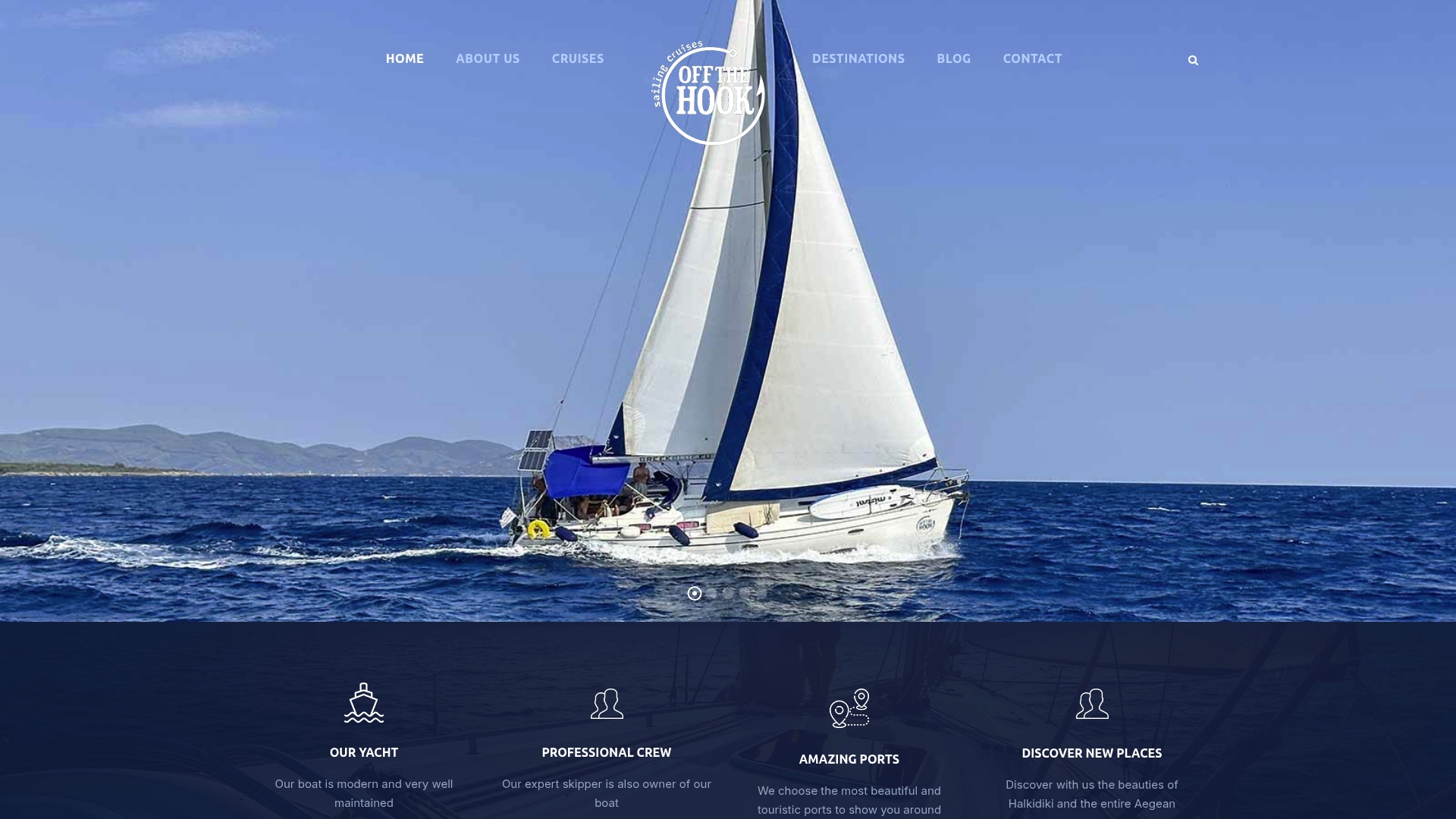
The yacht operates exclusively in Halkidiki’s Sithonia waters, covering the pristine coastline between Neos Marmaras, Nikiti, Paliouri, and Kassandra, with regular stops at secluded lagoons and the turquoise waters off Kelifos Isle that are simply unreachable by land. That hyper-local focus means the skipper knows every anchorage, every afternoon wind shift, and every hidden cove worth the detour.
Options range from a four-hour sunset private cruise to a full seven-day weekly private cruise for groups who want to explore the full Sithonia coastline at a relaxed pace. Families, couples, and milestone celebration groups are all well-served by the boutique, single-yacht model. Check availability and book directly at halkidikiboatsailing.com.
Useful sources and next reading
- The Complete Guide to Sailing in Greece, The Seafarer: Comprehensive regional breakdown covering the Ionian, Saronic, Cyclades, Dodecanese, and Sporades with seasonal wind data and base marina details. The most practical single reference for planning a Greek charter.
- Traditional Shipbuilding on the Island of Samos, Tandfonline: Peer-reviewed documentation of kaiki construction techniques, timber selection, and the current state of Aegean boatbuilding. Essential reading before booking a traditional wooden boat experience.
- The Museum of Aegean Boatbuilding and the Wooden Boatbuilding School in Samos, Greek News Agenda: Covers the cultural preservation programs and apprenticeship initiatives working to keep kaiki construction alive. Useful context for travelers who want their choices to support local craft traditions.
- Wooden Boat Maintenance Tips, Boatlife: Practical guidance on hull behavior, haul-out schedules, and wet storage for wooden boats. Relevant for anyone considering buying a kaiki or booking a wooden-boat charter.
- AP News: Traditional Greek Wooden Boat Builders, a Dwindling Craft: Vivid on-the-ground reporting from Samos on the state of traditional boatbuilding and the craftsmen keeping it alive.
- Halkidiki Boat Sailing Destinations: For live availability, specific Halkidiki anchorage details, and booking options across the Sithonia coastline.
FAQ
What is the traditional old Greek sailing boat called?
The traditional Greek wooden sailing boat is called a kaiki (also spelled caïque). It is characterized by a wide beam set far aft and a long sharp bow, and has been used for fishing, cargo, and passenger transport across the Aegean for centuries.
What Greek islands are best for sailing?
The Ionian Islands (Lefkada, Kefalonia, Ithaca, Corfu) are best for beginners and families due to gentle winds and calm water. The Cyclades (Paros, Naxos, Santorini) reward more experienced sailors, while Halkidiki’s Sithonia peninsula offers sheltered, boutique cruising with fewer crowds.
What are Greek fishing boats called?
Traditional Greek fishing boats are called kaikia (plural of kaiki). Many are still hand-built in wooden boatyards on islands like Samos and Syros, though their numbers have declined significantly due to cheaper fiberglass alternatives.
Do you need a license to charter a sailboat in Greece?
Yes. Greek maritime practice requires the skipper of a bareboat charter to hold a recognized qualification such as an ICC, RYA Day Skipper, or ASA equivalent, along with a VHF radio certificate and a documented logbook. If you don’t hold a qualification, hiring a skipper at €150–€200 per day is the straightforward solution.
Is Halkidiki good for sailing if you’ve never chartered before?
Halkidiki’s Sithonia waters, particularly around Neos Marmaras, Nikiti, Paliouri, and Kassandra, are among the most sheltered in northern Greece, making them an excellent choice for first-time sailors. A fully crewed private cruise like those offered by Halkidiki Boat Sailing removes the need for any sailing experience at all.