
TL;DR:
- The Aegean Sea offers rewarding sailing conditions with seasonal shifts that affect wind, temperature, and crowds. The Meltemi wind dominates from late June to mid-August, creating choppy waters but manageable conditions with local knowledge. October provides warm sea temperatures, low crowds, and calm weather, making it an ideal time for sailing.
What the Aegean Sea weather actually means for your sailing trip
The Aegean Sea offers some of the most rewarding sailing conditions in the Mediterranean, but the weather here follows a rhythm you want to understand before you book. Around Halkidiki’s Sithonia peninsula, including the waters off Neos Marmaras, Nikiti, and Paliouri, conditions shift meaningfully by season, and knowing those shifts is the difference between a dreamy cruise and a choppy afternoon you didn’t plan for.
Here’s a quick seasonal snapshot:
- May to mid-June: Warm, calm seas with air temperatures of 20–26°C. Ideal for relaxed sailing with minimal wind interference.
- Late June to mid-August: The Meltemi arrives, a strong North/Northeast wind that can push seas to 2.0–3.0m in the open Aegean. Still manageable with local knowledge, but itineraries need flexibility.
- September to October: The Meltemi fades. Sea temperatures hold at 22–24°C, crowds thin out, and conditions become genuinely pleasant again.
- November to April: Cooler air, occasional rain, and shorter daylight hours. Not prime sailing season, though mild days do occur.
Rainfall is rare from June through August but picks up noticeably from October onward. Daylight in peak summer runs well past 8:30 PM local time, giving you long, golden afternoons on the water. Visibility across the Aegean is typically excellent throughout summer, with the Hellenic National Meteorological Service (HNMS) serving as the authoritative source for official marine forecasts covering the North Aegean waters around Halkidiki.
Pro Tip: Book your private cruise in May, early June, or September to catch warm water, calm seas, and far fewer boats sharing the same hidden coves.
Table of Contents
- ️ How the Meltemi wind shapes sailing around Halkidiki
- When are sea temperatures and sailing conditions at their best?
- How to find reliable marine weather forecasts for Halkidiki sailing
- ⛵ What to expect aboard Off The Hook across the seasons
- ️ Visibility and fog on the Aegean: what sailors need to know
- Key Takeaways
- FAQ
️ How the Meltemi wind shapes sailing around Halkidiki
The Meltemi is the Aegean’s defining summer wind. It blows from the North and Northeast, typically building through late June and reaching its strongest phase from mid-July through mid-August. On exposed stretches of the North Aegean, wave heights during peak Meltemi can become quite high, with gusts intensifying during afternoon hours and sometimes sustaining for several days without a break.
| Month | Avg. Wind Strength | Typical Wave Height | Sea Conditions |
|---|---|---|---|
| May | Light (2–3 Beaufort) | 0.3–0.8m | Calm, ideal |
| June | Moderate (3–4 Beaufort) | 0.5–1.2m | Mostly pleasant |
| July | Strong (5–7 Beaufort) | 1.5–3.0m | Choppy to rough |
| August | Strong (5–7 Beaufort) | 1.5–3.0m | Choppy to rough |
| September | Moderate (3–4 Beaufort) | 0.5–1.2m | Calm, pleasant |
| October | Light (2–3 Beaufort) | 0.3–0.8m | Very calm |
Near Sithonia’s western coast and the waters around Neos Marmaras, the peninsula itself provides some natural shelter from the prevailing North/Northeast flow. Skilled skippers use this geography deliberately, routing guests into protected bays when the open Aegean turns lively.
The Aegean’s roughness is often exaggerated by people who’ve never actually sailed it. With proper timing and local knowledge, the Meltemi is a manageable wind, not a threat. The key is reading the forecast early in the morning and adjusting departure times or anchorages before conditions build in the afternoon.
The Aegean Sea is not considered particularly rough compared to other global sailing destinations, though the Meltemi can change surface conditions rapidly. George Dimitriadis, the skipper behind Halkidiki Boat Sailing’s Off The Hook, draws on deep local knowledge to read these shifts and reroute toward sheltered anchorages near Kassandra or Paliouri when the open water turns demanding.
When are sea temperatures and sailing conditions at their best?
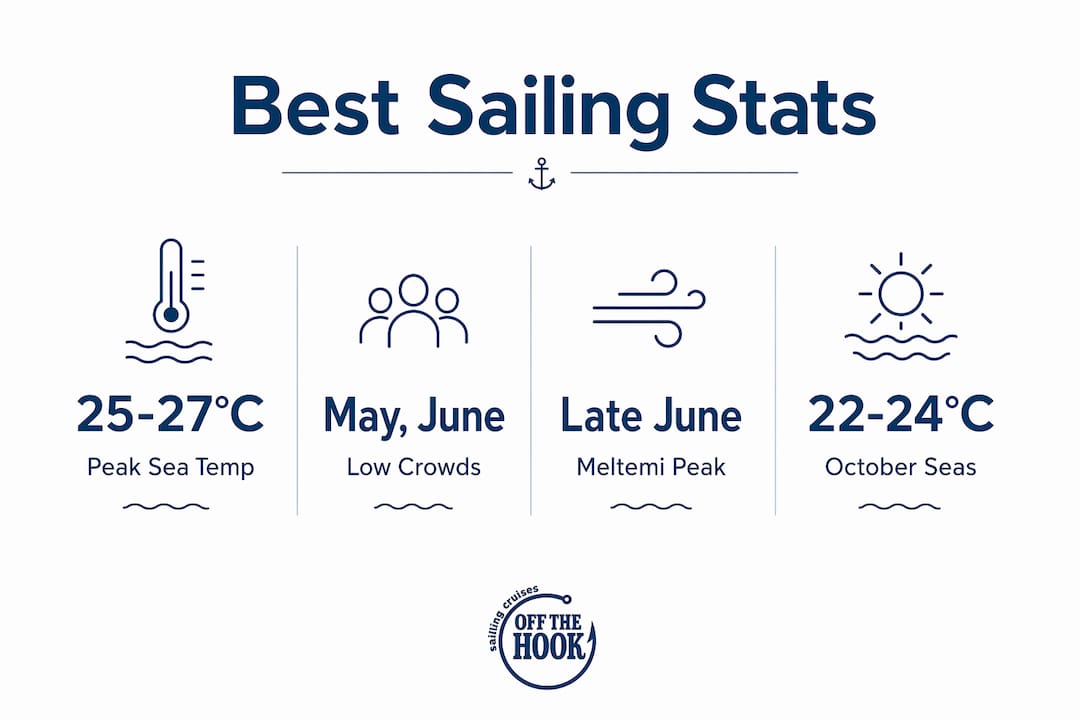
Choosing the right month transforms your experience. The Aegean’s peak summer sea temperatures reach 25–27°C (78–80°F) from late July through early September, perfect for snorkeling and swimming stops. But peak summer also brings the Meltemi at full strength.
| Month | Air Temp (°C) | Sea Temp (°C) | Crowds | Overall Sailing |
|---|---|---|---|---|
| May | 18–24 | 18–20 | Low | Excellent |
| June | 24–30 | 22–24 | Moderate | Very good |
| July | 28–30 | 25–27 | High | Good (wind-dependent) |
| August | 28–30 | 25–27 | Very high | Good (wind-dependent) |
| September | 22–26 | 23–25 | Low | Excellent |
| October | 18–26 | 22–24 | Very low | Outstanding |
October deserves special attention. Air temperatures in Halkidiki range from 18–26°C, and sea temperatures stay at 22–24°C, which is warmer than what most American coastal destinations manage even in July. Crowds are gone, prices drop, and the Meltemi has largely retreated. For a private sailing cruise, it’s one of the most rewarding months on the calendar.
November brings a shift. Temperatures cool, rainfall increases, and daylight shortens noticeably. It’s still possible to sail on calm days, but the window for comfortable open-water cruising narrows considerably.
How to find reliable marine weather forecasts for Halkidiki sailing
Good forecasting is the foundation of a safe and enjoyable cruise. These are the resources that actually matter:
Official sources:
- HNMS marine forecasts publish daily updates covering surface winds at 10m, significant wave height and direction, and wave period for the North Aegean, the precise zone covering Halkidiki’s waters.
- Windfinder’s Aegean Sea forecast provides GFS-model wind and wave data updated four times daily, with 10-day outlooks and hourly resolution useful for timing departures.
- The University of the Aegean’s Department of Marine Sciences publishes numerical model forecasts for North and Central Aegean surface temperature, wave height, and current velocity.
What to look for in a forecast:
- Surface wind speed and direction at 10m: anything above 5 Beaufort (around 17–21 knots) warrants a route review.
- Significant wave height: waves above 1.5m affect comfort on smaller vessels; above 2.0m, sheltered alternatives become the priority.
- Wave period: short, steep chop (under 5 seconds) is more uncomfortable than longer swells of the same height.
- Afternoon build: Meltemi winds typically intensify between noon and 6 PM. Early departures from Neos Marmaras or Nikiti often mean calmer water for the first half of the day.
Official forecasts can underestimate local gusts in sheltered channels and bays. A skipper with years of experience in these specific waters adds judgment that no model fully replicates.
⛵ What to expect aboard Off The Hook across the seasons
Aboard Halkidiki Boat Sailing’s Off The Hook, every cruise is planned around the actual forecast, not a fixed template. Skipper George Dimitriadis checks HNMS and Windfinder each morning before departure and adjusts the route accordingly, whether that means heading south toward Paliouri’s sheltered coves or anchoring off Kelyfos Island when the northern exposure looks rough.
Weather is part of the experience, not an obstacle. When the Meltemi picks up, we simply find the spots that the wind can’t reach. Some of the most beautiful anchorages around Sithonia are only accessible because the crowds follow the main routes.
Practical tips for sailing in variable Aegean conditions:
- Bring a light windbreaker even in July. Wind chill on a moving boat at 20 knots feels significantly cooler than the air temperature suggests.
- Wear reef-safe sunscreen and reapply often. Mediterranean UV intensity is high, especially on the water.
- Stay hydrated. Refreshments are included aboard Off The Hook, but the combination of sun and sea air dehydrates faster than most guests expect.
- Flexible footwear: non-slip deck shoes or sandals with straps are far more practical than flip-flops when the boat heels.
Snorkeling stops, swimming breaks, and sightseeing at spots like Kelyfos Island are all weather-dependent in timing, not in availability. The weekly private cruise format gives the most flexibility, allowing multi-day itineraries to shift around weather windows rather than forcing a fixed schedule.
️ Visibility and fog on the Aegean: what sailors need to know
Visibility in the Aegean is one of its genuine strengths. For most of the sailing season, from May through October, conditions are clear and bright, with the Turkish State Meteorological Service’s extended marine forecasts consistently reporting “good” visibility across the Aegean zone even during active Meltemi periods.
Fog is rare in summer. When it does appear, it tends to occur in the early morning hours of spring and late autumn, typically burning off within an hour or two of sunrise. Haze from Saharan dust can occasionally reduce visibility to a few kilometers during southerly wind events, but these episodes are short-lived and don’t typically affect navigation safety.
The practical implication for cruise guests is straightforward: the Aegean’s clarity is part of what makes it so visually stunning. Turquoise water, pine-covered coastlines, and distant island silhouettes are visible in sharp detail on most sailing days around Sithonia and the waters off Neos Marmaras.
Key Takeaways
The best Aegean sailing conditions around Halkidiki fall in May, early June, September, and October, when warm seas and calm winds combine with low crowds.
| Point | Details |
|---|---|
| Meltemi timing | The Meltemi peaks from late June to mid-August, with waves reaching 2.0–3.0m in the open Aegean. |
| October swimming | Sea temperatures hold at 22–24°C in October, warmer than most U.S. summer coastal spots. |
| Peak sea temps | Late July through early September brings 25–27°C sea temperatures, ideal for water activities. |
| Best forecast source | HNMS provides official daily marine forecasts covering surface winds, wave height, and wave period for the North Aegean. |
| Visibility | Fog is rare in summer; visibility across the Aegean is typically good throughout the sailing season. |
FAQ
When is the Aegean Sea calmest for sailing?
May, early June, September, and October offer the calmest conditions, with light winds and generally low wave heights around Halkidiki’s Sithonia peninsula.
Is the Aegean Sea rough in October?
October is actually one of the most pleasant months to sail. The Meltemi has retreated, sea temperatures stay at 22–24°C, and conditions are calm and uncrowded.
Where can I find a reliable marine weather forecast for the Aegean Sea?
The Hellenic National Meteorological Service (HNMS) publishes official daily marine forecasts for the North Aegean, including surface winds, wave heights, and wave periods. Windfinder also provides user-friendly 10-day forecasts updated four times daily.
Why does the Aegean Sea feel cold sometimes in summer?
The Meltemi wind drives surface water away from coastlines, pulling cooler water up from depth in a process called upwelling. This can make the sea feel noticeably cooler near exposed northern shores even during July and August.
What is the Aegean Sea weather like in November?
November brings cooler air temperatures, increased rainfall, and shorter daylight hours. Sailing is still possible on calm days, but the reliable open-water cruising window narrows significantly compared to the shoulder season months.