

Tip 10% to 15% of the base charter fee, in cash euros, handed to the captain on the morning of disembarkation. That percentage applies only to the base fee itself, never to the Advance Provisioning Allowance (APA), VAT, or delivery costs. Ten percent covers a solid, professional charter; 15% recognizes a crew that went well beyond the job description.
TL;DR:
- Tipping Greek yacht crew typically ranges from 10% to 15% of the base charter fee, with 10% as a standard baseline and 15% for exceptional service.
- Tips should be calculated solely on the contracted base fee, excluding the advance provisioning allowance, VAT, delivery charges, or extras.
- Gratuity is pooled and handed to the captain, who fairly distributes it among crew members based on roles and effort, with private envelopes discouraged.
- For short day trips, a per-person tip of €10 to €20 for full days or €5 to €10 for half-days is the customary norm, not a percentage of the total.
- Cash in euros remains preferred for tipping, handed over quietly on the final morning or disembarkation, with wire transfers as an alternative if arranged early.
Table of Contents
- Yacht Crew Gratuity Greece: Standard Rates Explained
- How Do You Calculate the Base Charter Fee for Tipping?
- Who Gets the Tip and How Is It Split?
- When Should You Tip More or Less Than Standard?
- What Should You Tip on a Day Charter or Sunset Sail?
- What’s the Best Way to Pay Yacht Crew Gratuity in Greece?
- Why Does Tipping Etiquette Matter So Much in Greece?
- Can’t Tip or Need to Change the Arrangement?
- A Local Skipper’s Take on Tipping Aboard Off the Hook
- What Actually Matters Most When Tipping Yacht Crew in Greece
- Book Off the Hook with Tipping Guidance Built In
- Sources
- FAQ
Yacht Crew Gratuity Greece: Standard Rates Explained
The MYBA Association, the trade body most Mediterranean brokers reference for charter contracts, sets its customary gratuity guidance at a 5% to 15% band of the base charter fee. That range sounds wide until you look at how it actually gets used on the water. Caribbean charters tend to drift toward the top of global tipping norms, but Mediterranean practice, and Greece specifically, settles into a tighter 10% to 15% window as the practical planning figure most charterers and brokers actually apply.
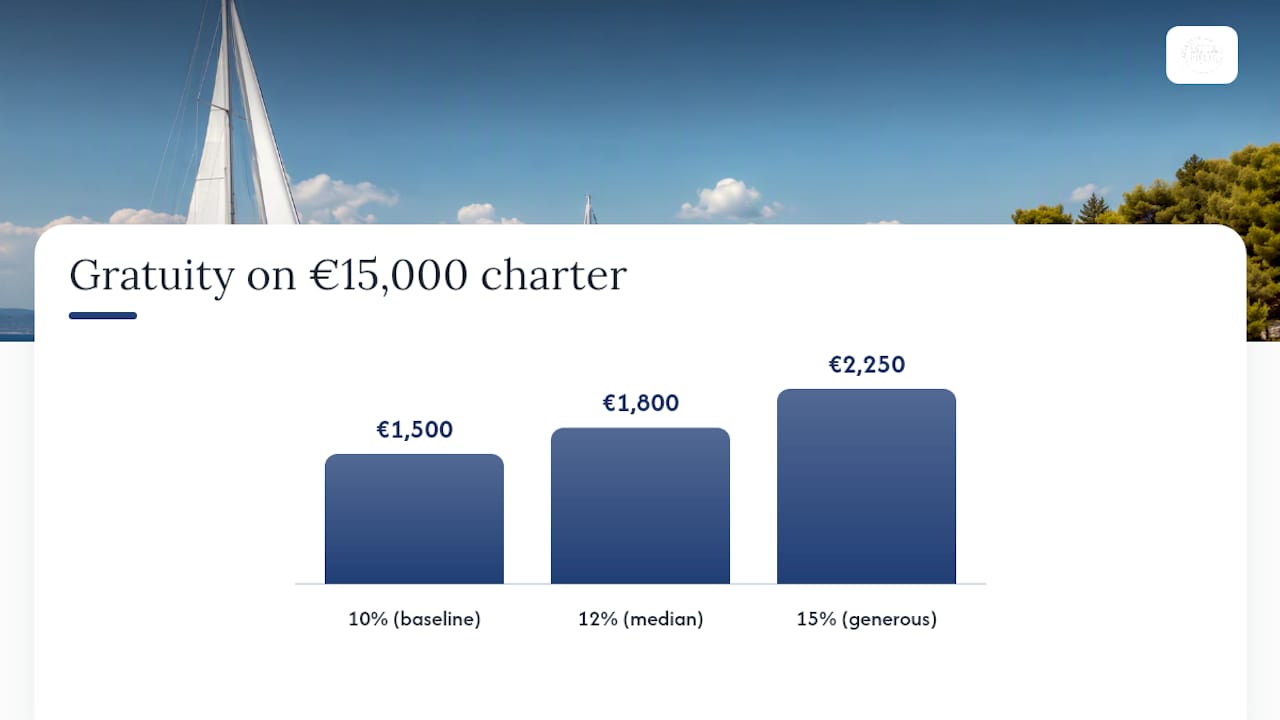
Market data on Greek charters narrows things further. Guidance built specifically around Greek yacht charter crew gratuity reports a median sitting around 10% to 12%, with 15% treated as the generous upper end reserved for standout service. That’s a useful anchor if you’re the type who prefers a number over a range. Budget for 10% as your baseline, keep 15% in reserve for a crew that earns it, and you’re aligned with what brokers actually see charter after charter.
Here’s how that translates into real currency for the kind of week-long sailing charter common along the Sithonia peninsula and broader Aegean:
Notice the jump between 10% and 15% on a €15,000 base: €750. That gap is exactly why the percentage you choose matters more than most guests assume, and why it pays to understand what actually counts toward that base figure before you do the math.
How Do You Calculate the Base Charter Fee for Tipping?
Confusion here causes more overpaid and underpaid tips than almost any other charter mistake. The base charter fee is the contracted rental price for the vessel and crew, the number quoted before anything else gets added. The APA, by contrast, is a separate advance fund, typically 25% to 35% of the base fee, that covers fuel, provisioning, dockage, and other running costs during the trip. Guests fund the APA upfront and get a reconciled statement at the end showing what was actually spent.
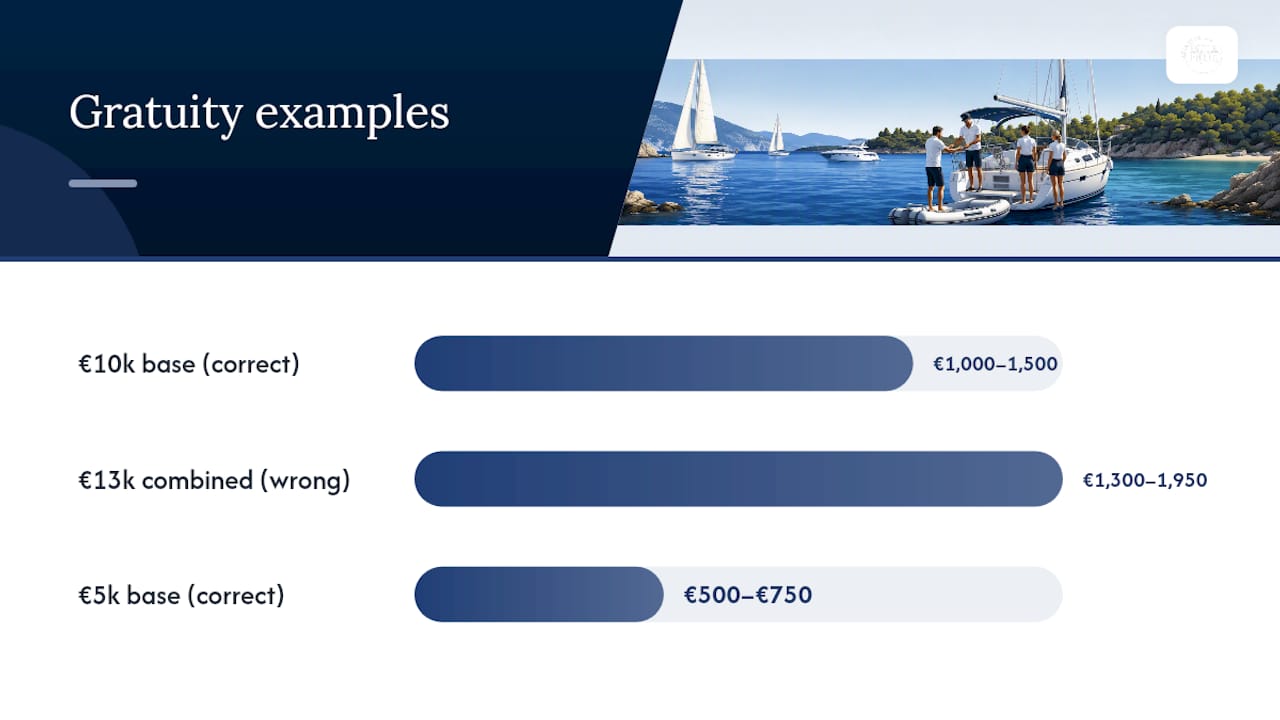
Gratuity is calculated on the base fee only. Never on the APA, never on VAT, and never on extras like delivery fees or one-off equipment rentals. The widely used Greek charter rule is explicit on this point precisely because so many first-time charterers get it wrong, often overpaying by including APA reconciliation totals in their math.
Two quick examples show the difference:
- A charter with a €10,000 base fee and a €3,000 APA draw should generate a tip of €1,000 to €1,500 (10% to 15% of €10,000), not €1,300 to €1,950 calculated against the combined €13,000.
- A charter with a €5,000 base fee, VAT, and a delivery fee calculates gratuity based only on the base fee, regardless of the final invoice total.
The planner’s rule is simple enough to memorize before your trip: find the base charter fee line on your contract, multiply by 0.10 to 0.15, and that’s your gratuity budget. Everything else on the invoice is noise for this particular calculation.
Who Gets the Tip and How Is It Split?
Gratuity in Greek yacht charters flows as one pooled sum, handed to the captain, who then distributes it among the crew. This isn’t a formality. It reflects how these teams actually operate day to day, with the captain managing schedules, assignments, and morale across everyone aboard.
Distribution ratios vary by boat and crew structure, but a common illustrative pattern looks something like this:
- Captain: a larger share reflecting responsibility for the vessel, route planning, and guest safety.
- Chef or crew handling meals and provisioning: a meaningful share, often close to the captain’s given the direct guest interaction.
- Deckhands and additional crew: shares split according to role and tenure aboard.
The reasoning behind pooling matters as much as the mechanics. Handing separate envelopes to each crew member individually can create friction, implied rankings, or resentment, none of which serves anyone well on a boat where the whole team eats, works, and lives in close quarters for days at a time. One pooled envelope preserves that dynamic and lets the captain, who understands the internal workload distribution far better than a guest could, allocate fairly.
That said, if one crew member genuinely went above and beyond, a small separate envelope acknowledging that person specifically is entirely acceptable. If a partner article on crew roles aboard sailing tours is any guide, understanding what each role actually does during a charter makes it far easier to recognize genuine standout effort versus simply doing the job well.
Pro Tip: Keep any individual envelope discreet, hand it over privately at a quiet moment, not during a group goodbye, so it reads as personal appreciation rather than a public comparison to teammates.
When Should You Tip More or Less Than Standard?
The percentage you choose sends a message whether you intend it to or not. A tip below roughly 7% reads as dissatisfaction to most experienced crews, even if that wasn’t your intent. Ten percent is the accepted baseline for solid, professional service with no complaints. Fifteen percent signals genuine enthusiasm, the kind of trip guests talk about for years.
- A crew that managed a wedding or milestone celebration aboard, handling logistics far outside a standard day sail.
- Exceptional weather or routing decisions that saved the trip, such as a captain rerouting around a sudden meltemi wind system.
- A medical or safety incident handled calmly and competently, where the crew’s response genuinely mattered.
If service fell short, the answer isn’t a silent, minimal tip left without explanation. A quiet, private conversation with the captain, ideally before disembarkation, gives the crew a chance to understand what went wrong and gives you a chance to see if it gets addressed before you leave the boat. Confrontation in front of other guests or crew members helps no one and tends to escalate rather than resolve.
What Should You Tip on a Day Charter or Sunset Sail?
Percentage-of-base math works well for weekly charters, but it falls apart on shorter trips where there’s no multi-thousand-euro base fee to calculate against. For day tours and half-day sails, flat per-person tipping is the norm instead.
Guidance on Greek day-boat tipping suggests €5 to €10 per person for half-day excursions and €10 to €20 per person for full-day trips, scaled by group size and how involved the crew was throughout.
For a private sailing day trip, sunset sail, or half-day cruise, a reasonable approach looks like this:
- Half-day private sail (around four hours): €10 to €20 per person, or a flat €40 to €80 for a small group, handed to the skipper at the end.
- Full-day private cruise (around seven hours): €20 to €40 per person, reflecting the longer day and typically more involved service, snorkeling stops, and meal service.
- Small-group sailing tours with a dedicated skipper and crew member: split the total roughly two-thirds to the skipper, one-third to supporting crew, though a flat combined amount handed to the skipper works just as well for shorter trips.
Shore excursions bundled into a longer sailing itinerary, guided walks or archaeological site visits, follow their own separate norm of roughly €3 to €10 for the driver or guide, distinct from anything you tip the sailing crew.
What’s the Best Way to Pay Yacht Crew Gratuity in Greece?
Cash in euros remains the clear preference across Greek charter crews, and for good reason. It lets the captain divide the pool immediately, without waiting on bank transfers to clear or dealing with currency conversion. Frontier Yachting’s regional guidance backs this up directly: crews want euros in hand, and if a wire transfer is the only option, it should be pre-arranged well ahead of time and completed on the morning of disembarkation, not days later.
A straightforward payment sequence looks like this:
- Withdraw or set aside enough euros in cash before boarding, calculated against your expected base fee tip range, so you’re not scrambling for an ATM on the last day.
- Place the full gratuity amount in a single envelope rather than loose bills.
- Choose the right moment: the final morning, often over coffee before disembarkation, works better than a rushed handoff at the dock.
- Hand the envelope directly to the captain, with a brief word of thanks.
- If a separate envelope for an individual crew member applies, hand that over privately and separately.
For multi-week or high-value charters where carrying several thousand euros in cash feels impractical, a wire transfer arranged in advance with the charter company is a reasonable alternative. Confirm the timing and amount in writing beforehand so there’s no ambiguity about intent once the trip wraps up.
Pro Tip: If you’re paying by wire, send a short confirmation message to the captain on the morning of disembarkation so the crew knows the payment is coming rather than wondering if gratuity was overlooked.
Gratuities are generally treated as personal income for crew members rather than revenue subject to VAT, which is part of why they sit outside the standard invoice and get handled separately at the end of the charter.
Why Does Tipping Etiquette Matter So Much in Greece?
Gratuity in Greek charter culture is discretionary in name only. In practice, it’s a strong cultural expectation for private charters, woven into how crews evaluate whether a trip went well and whether they’d want to work with that broker or guest again. Skipping it entirely, without explanation, reads as a genuine social misstep rather than a simple oversight.
The amount itself carries meaning crews pick up on quickly. A generous, appropriate tip builds the kind of relationship that pays off on repeat charters, where a captain remembers a guest fondly and goes out of their way on route planning or timing for a return visit. A stingy or absent tip, especially after a smooth trip, tends to stick in a crew’s memory the other direction.
One point worth keeping in mind: generosity is a private matter, not a public performance. The gratuity itself should stay a quiet transaction between guests and captain, away from other charter parties or dockside audiences. Modesty in how you hand it over, paired with real generosity in the amount, is the combination that lands best. Loud gestures about tipping amounts tend to read as showing off rather than genuine appreciation, which somewhat defeats the purpose.
Can’t Tip or Need to Change the Arrangement?
Budget constraints or service disputes happen, and there’s a respectful way to handle both. If an issue arises during the charter, raise it privately with the captain as soon as possible rather than waiting until the final morning or airing it in front of other guests. Most problems, a scheduling misunderstanding, a provisioning shortfall, get resolved far more easily when addressed early and calmly.
If you agreed to a wire transfer instead of cash, get the amount and timing confirmed in writing beforehand so there’s no confusion once the charter ends. A brief, direct conversation with the captain explaining the situation, paired with whatever smaller token of appreciation you can manage, preserves the relationship far better than simply disembarking without a word.
A Local Skipper’s Take on Tipping Aboard Off the Hook
Guests chartering along the Sithonia peninsula, whether departing from Neos Marmaras, Nikiti, Paliouri, or Kassandra, tend to ask the same handful of questions about tipping before they even step aboard. A five-step checklist covers most of it: bring euros in cash rather than counting on card payment for gratuity, use a single envelope rather than loose bills, plan the handoff for the final morning rather than mid-trip, add a short personal note or word of thanks alongside the cash, and keep any individual crew envelope separate and private.
Local crews across Halkidiki consistently prefer cash euros over transfers, mainly because it lets everyone get paid before they head home for the evening rather than waiting on a bank transfer to clear. Guests chartering Off the Hook will find the company’s tipping guidance laid out clearly ahead of the trip, which removes most of the last-minute uncertainty that trips up first-time charterers elsewhere in Greece. For guests unfamiliar with the region, a quick look at where Halkidiki sits within Greece helps frame why these particular bays and coves draw sailing charters in the first place.
What Actually Matters Most When Tipping Yacht Crew in Greece
The broker guidance and the on-the-water reality mostly agree, which is rarer than you’d think in the charter world.
Where conventional advice tends to fall short is treating tipping as a pure math exercise. It isn’t. Crews remember how a guest treated them over the course of a week far more than the third decimal of a percentage.
If you take one thing from all this, prioritize the calculation base over the percentage. Getting the base fee versus APA distinction wrong is the single most common, and most easily avoided, mistake charterers make. Get that right first, then let the percentage reflect how the week actually went.
— George
Book Off the Hook with Tipping Guidance Built In
Halkidiki Boat Sailing runs one boat, and that focus means one thing for gratuity questions: no guesswork buried in fine print across a fleet of different vessels and crews. Every charter aboard Off the Hook, whether it’s the Full Day Private Cruise, the Sunset Private Cruise, or the Weekly Private Cruise, comes with clear tipping guidance communicated at booking and reflected plainly on the final invoice, so there’s nothing to calculate on the fly at disembarkation.
The full-day cruise runs from €600, the sunset sail from €400, and the weekly private charter at €500 per day, all fully crewed with a professional local skipper familiar with the coves around Sithonia. If you’re planning a trip along Neos Marmaras, Nikiti, or the wider Halkidiki coastline and want the tipping conversation settled before you even step aboard, check available dates for Off the Hook and book directly through the site.
Sources
- MYBA Association
- How Much Should You Tip Your Yacht Charter Crew in Greece? – my Greek Yacht Charter
- Tipping in Greece 2026 — How much, when & complete guide
- Greek Yacht Charter Crew Gratuity Guide 2026 – George Yachts
- How Much to Tip Yacht Crew | Real Rates by Region (2026)
FAQ
How much should you tip a boat captain in Greece?
For day charters, a flat per-person amount of €10 to €40 depending on trip length is more common than a percentage.
Is €5 a good tip in Greece?
For a short taxi ride or casual restaurant meal, €5 is a reasonable, well-received tip. For yacht crew gratuity, €5 only fits the lower end of per-person day-tour tipping and would fall well short of the percentage-based norm expected on a private charter.
Is it considered rude not to tip in Greece?
For private yacht charters specifically, skipping the tip entirely without explanation reads as a real social misstep, since gratuity is culturally expected even though it remains technically discretionary. If budget is genuinely tight, a brief, honest word to the captain along with a smaller token amount is far better received than silence.