
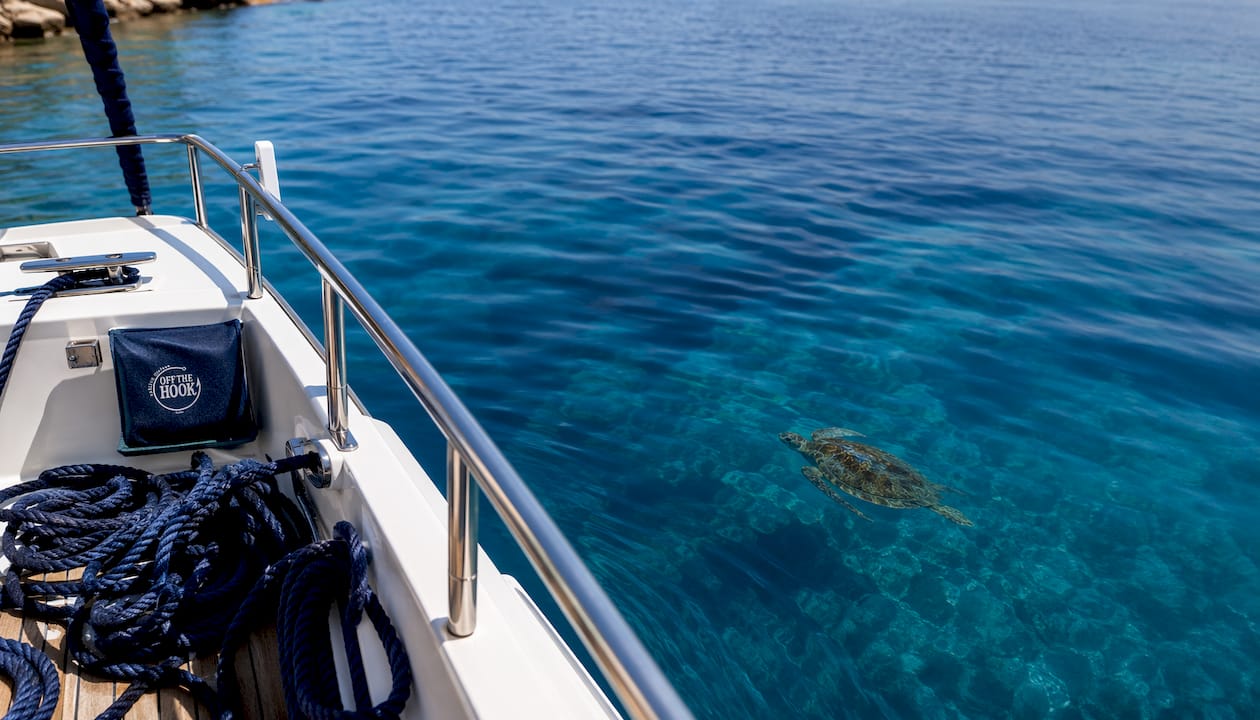
Greek waters are home to one of the Mediterranean’s richest collections of marine species, from the massive Sperm Whale patrolling the Hellenic Trench to loggerhead turtles nesting along southern shores. The marine life in Greece spans three distinct sea basins, the Aegean, Ionian, and Mediterranean, each supporting its own web of habitats and creatures. Whether you’re planning a snorkeling trip off Sithonia’s coast near Neos Marmaras or simply curious about what lives beneath those famous turquoise waters, here’s what you’ll actually find:
- Marine mammals: Sperm Whales, Humpback Whales, bottlenose and striped dolphins, Mediterranean Monk Seals
- Sea turtles: Loggerhead (Caretta caretta), Green, and the rarer Leatherback
- Fish and invertebrates: Octopus, damselfish, parrotfish, moray eels, nudibranchs, and venomous lionfish
- Key habitats: Posidonia seagrass meadows, rocky substrates, coastal caves, and shallow coral formations
- Seasonal patterns: Sperm Whales peak in the Aegean from may through september; loggerheads nest in spring to early summer; jellyfish blooms follow summer currents
Conservation pressure is real. Organizations like Archelon and WWF are actively working to protect species that face mounting threats from plastic pollution, vessel strikes, and discarded fishing gear.
Key marine mammals you can find in Greek waters
Greece’s seas support a surprisingly diverse lineup of marine mammals, many of which are rarely seen in other parts of the Mediterranean.
Sperm Whale
The largest marine predator in Greek waters is the Sperm Whale, capable of reaching very large sizes, with lengths and weights typical for mature individuals. A monitored population lives in Greece, concentrated along the Hellenic Trench stretching from Crete toward the Ionian Sea, and in the Aegean near islands like Mykonos. They are social animals, forming large groups that hunt together and communicate through echolocation. Sightings peak between may and september.
Humpback Whale
Humpback Whales are occasional visitors to Greek waters rather than permanent residents, typically spotted during seasonal migrations through the eastern Mediterranean. Their acrobatic breaching behavior makes them unmistakable when they do appear. Sightings are rare enough that each confirmed encounter draws attention from marine researchers.
Mediterranean Monk Seal
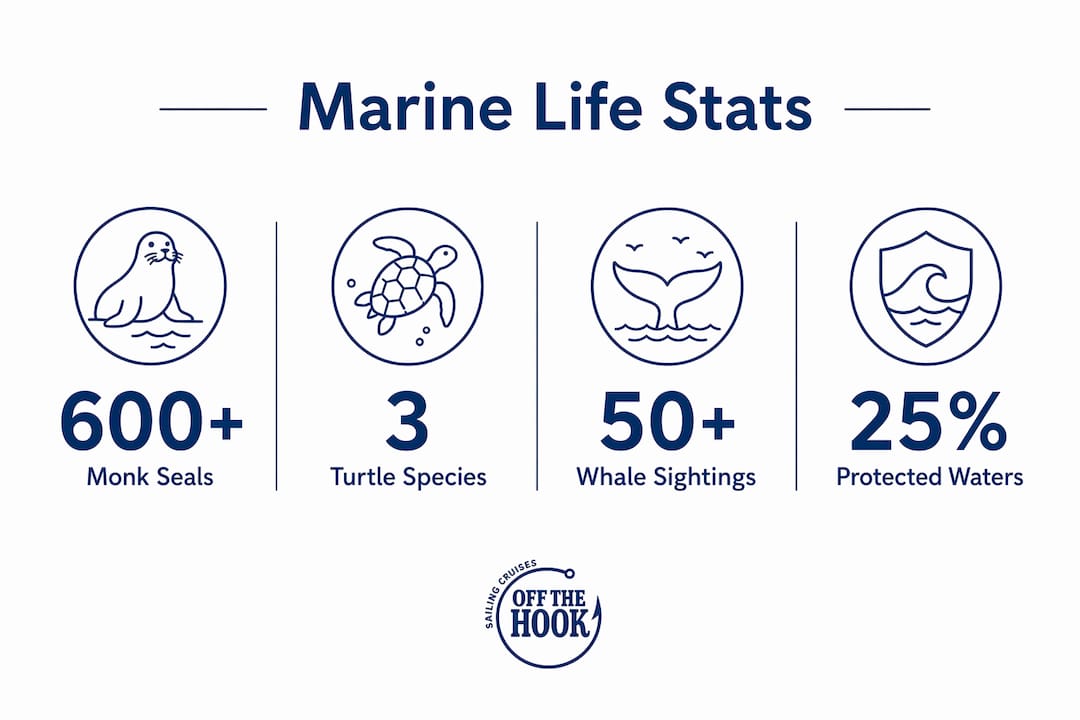
With just over 600 individuals remaining in the wild, the Mediterranean Monk Seal (Monachus monachus) is one of the world’s most endangered marine mammals. These seals favor coastal caves and remote rocky shorelines. Your best chance of a sighting is the Alonissos Island National Marine Park, which has operated since the 1990s specifically to protect this population.
Dolphins
| Species | Typical Length | Primary Location |
|---|---|---|
| Bottlenose dolphin | medium size | Gulf of Corinth, Corinthian Gulf |
| Striped dolphin | medium size | Open Aegean and Ionian seas |
| Common dolphin | medium size | Ionian Sea, coastal waters |
Bottlenose dolphins are the most frequently encountered species, particularly in the Gulf of Corinth. They live in social communities, use echolocation to locate fish and squid, and have lifespans exceeding 40 years. Striped dolphins prefer open water and are often spotted riding bow waves in the Aegean.
Pro Tip: Skipper George Dimitriadis knows the seasonal movement patterns of dolphins around Sithonia’s coastline. Early morning departures from Neos Marmaras tend to yield the best sightings before afternoon winds pick up.
Sea turtles around Greece and their conservation
Three sea turtle species inhabit Greek waters, each with a distinct ecological role and conservation status.
| Species | Average Size | Nesting Region | Conservation Status |
|---|---|---|---|
| Loggerhead (Caretta caretta) | medium-sized | Zakynthos, Kefalonia, Crete | Vulnerable |
| Green Turtle | medium-sized | Eastern Mediterranean | Endangered |
| Leatherback | large carapace size typical | Rare visitor, no fixed nesting | Critically rare in Greece |
Loggerhead turtles are the most visible species in Greece. They nest primarily along southern shores, with Zakynthos’s Bay of Laganas being the most famous site. Nesting season runs from april through june, when females come ashore at night to lay eggs. In Halkidiki’s waters around Nikiti and Kassandra, travelers are far more likely to encounter reef species like octopuses than nesting turtles, though loggerheads do pass through the northern Aegean.
Green Sea Turtles are less common in Greek waters but appear regularly in the eastern Mediterranean. They feed primarily on seagrass, making Posidonia meadows a critical habitat for their survival.
Leatherback turtles are the rarest of the three. Archelon’s research recorded only 57 sightings over five decades in Greek waters, with carapace lengths ranging from 1.23 to 1.80 meters. These deep-diving giants follow jellyfish blooms and are essentially ocean wanderers rather than residents.
Archelon and WWF both run active monitoring and nest protection programs. Volunteers patrol nesting beaches nightly during the season, relocate threatened eggs, and treat injured turtles at dedicated rehabilitation centers.
Common fish and invertebrates in Greek marine ecosystems
The reef and rocky-bottom communities around Greece are where most snorkelers and divers spend their time, and the variety is genuinely impressive.
- Octopus (Octopus vulgaris): Masters of camouflage, octopuses are common around rocky substrates and shallow reefs throughout Sithonia, including the waters near Paliouri and Kelyfos Island. They hunt nocturnally and can change both color and texture in milliseconds.
- Damselfish: Small, territorial, and brilliantly colored, damselfish are among the most visible reef residents. They aggressively defend patches of algae and are a reliable sign of healthy reef structure.
- Parrotfish: These colorful fish graze on algae and coral, playing a direct role in reef health by preventing algae overgrowth.
- Moray eel: Nocturnal hunters that shelter in rock crevices during the day. Morays look intimidating but rarely interact with snorkelers unless provoked.
- Nudibranchs: Tiny, vividly colored sea slugs found on rocky bottoms. Spotting one requires a slow, patient approach and good visibility.
- Lionfish (Pterois miles): An invasive species spreading through Greek waters due to warming seas. Their venomous spines make them dangerous to touch, though they are not aggressive toward swimmers. Divers should give them a wide berth.
| Species | Habitat | Notable Behavior |
|---|---|---|
| Octopus | Rocky bottoms, reefs | Camouflage, nocturnal hunting |
| Damselfish | Shallow reefs | Territorial algae farming |
| Moray eel | Rock crevices | Nocturnal, ambush predator |
| Lionfish | Deeper reef zones | Venomous spines, invasive |
| Parrotfish | Coral and algae zones | Grazes reef, supports balance |
Marine biodiversity hotspots and ecosystem health in Greece
Greece’s most ecologically significant marine areas are concentrated around island groups and protected bays. The Alonissos Island National Marine Park stands out as the largest marine protected area in the Mediterranean, sheltering Monk Seals, dolphins, and a rich fish community. Kelyfos Island near Neos Marmaras in Sithonia offers accessible snorkeling with clear visibility and diverse reef life, making it a favorite stop on sailing excursions through the area.
The broader picture, however, is one of stress. WWF reports that a significant portion of Mediterranean fish stocks are overexploited. The Archipelagos Institute highlights significant gaps between marine protection legislation and actual enforcement, resulting in continued overfishing and habitat degradation across Greek waters. Invasive lionfish, expanding northward as sea temperatures rise, add further pressure to already strained reef communities.
Pro Tip: Photo-ID and acoustic bioacoustics are the primary research methods the Archipelagos Institute uses to track marine mammal populations around the Aegean. If you spot a dolphin or whale, noting distinctive fin markings can contribute to citizen science databases.
Marine protected areas (MPAs) cover a fraction of Greek territorial waters, and enforcement remains inconsistent outside the most prominent parks. Conservation groups Archelon and WWF continue to push for expanded protections and stricter fishing regulations, particularly around key nesting and feeding grounds.
️ How climate change is reshaping Greek marine life
Warming sea temperatures are already producing measurable shifts in Greek marine ecosystems. Species like lionfish, native to the Red Sea and Indian Ocean, have established breeding populations in the Aegean and Ionian seas, outcompeting native reef fish and disrupting food webs that took centuries to stabilize.
Posidonia seagrass meadows, which serve as nurseries for juvenile fish and feeding grounds for Green Sea Turtles, are retreating in areas where water temperatures have risen above their tolerance range. These meadows also absorb carbon dioxide, so their decline has consequences well beyond the species that depend on them directly.
Jellyfish blooms, particularly Pelagia noctiluca, are becoming more frequent and longer-lasting in Greek coastal waters. Warmer winters allow jellyfish populations to survive and grow earlier in the season. Local skippers monitor current and wind patterns to anticipate when blooms move toward shore, which is practical knowledge that makes a real difference for swimmers planning beach days around Nikiti or Kassandra.
Cetacean populations face shifting prey distributions as the fish species they depend on move to cooler, deeper waters. The Aegean Sea, already under severe stress from noise pollution and overfishing, is seeing marine mammal populations adapt their ranges in ways that researchers are still working to fully document.
FAQ
What is the largest predator in Greek waters?
The Sperm Whale is the largest marine predator in Greek waters, commonly found in the Hellenic Trench and the Aegean Sea.
Is it safe to swim in the sea in Greece?
Greek seas are generally safe for swimmers. No fatal shark attacks have been documented in Greek waters for decades, though seasonal jellyfish blooms and the presence of venomous lionfish at deeper dive sites are worth being aware of.
Do Greek waters have sharks?
Yes, but they pose minimal risk to humans. Basking Sharks, the second-largest shark species, are harmless filter feeders spotted off the coast of Rhodes. Sharks in Greek waters are far more threatened by human activity than the reverse.
How rough are the seas around the Greek islands?
Conditions vary significantly by season and location. The Aegean can produce strong winds and swells, particularly in summer when the Meltemi wind blows, while sheltered bays around Sithonia near Neos Marmaras and Paliouri tend to offer calmer, more predictable waters ideal for sailing and snorkeling.
Key Takeaways
Greek marine life is richest where habitats are protected, pollution is controlled, and fishing pressure is managed, making conservation the single biggest factor in what you’ll actually encounter underwater.
| Point | Details |
|---|---|
| Sperm Whale is the top predator | Largest marine predator; found in the Hellenic Trench and Aegean Sea from May through September. |
| Leatherback turtles are extremely rare | Only 57 sightings recorded in Greek waters over five decades, per Archelon research. |
| 58% of fish stocks are overexploited | WWF data shows the majority of Mediterranean fish populations are under severe fishing pressure. |
| Climate change is expanding invasive species | Lionfish and jellyfish blooms are increasing as sea temperatures rise across Greek waters. |
| Halkidiki offers accessible marine encounters | Waters around Neos Marmaras, Nikiti, and Kelyfos Island provide snorkeling with octopus, reef fish, and dolphins. |
Ready to see Greek marine life up close? Halkidiki Boat Sailing’s weekly private cruise aboard Off The Hook takes you through the pristine waters of Sithonia, with snorkeling gear included and skipper George Dimitriadis guiding you to the spots where the sea truly comes alive.
Explore all sailing cruises and find the experience that fits your group, from a golden-hour sunset sail to a full week exploring hidden coves and vibrant reefs.