
TL;DR:
- Hiring a boat in Greece allows access to secluded beaches and coves inaccessible by land or public transport. Choosing the appropriate vessel depends on experience, group size, and licensing requirements, with options from license-free motorboats to fully crewed sailboats. Booking early during peak season and understanding costs and legal rules help ensure a smooth and enjoyable sea adventure.
Hiring a boat in Greece is the most direct way to reach the turquoise coves, pine-fringed lagoons, and secluded beaches that no tour bus or public ferry will ever take you to. The industry term is “boat charter,” and it covers everything from a simple license-free motorboat rented by the hour to a fully crewed sailing sailboat booked for a week. Greece offers all of it, and Halkidiki Sithonia, with its crystalline waters around Neos Marmaras, Nikiti, Paliouri, and Kassandra, ranks among the most rewarding regions in the country for coastal exploration by sea. This guide covers boat types, licensing rules, pricing, and booking strategy so you can plan with confidence.
What types of boats can you hire in Greece?
Greece offers four main boat categories, and the right choice depends on your experience, group size, and how much freedom you want on the water.
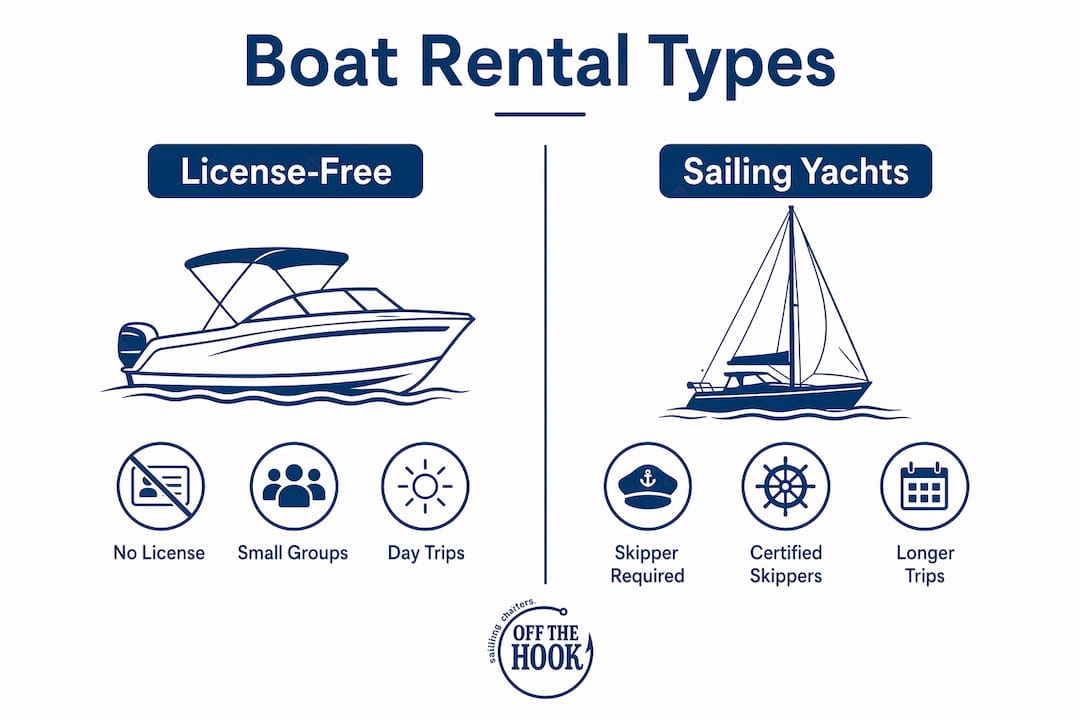
License-free motorboats are the most popular option for first-time renters. These small day boats typically carry 4–8 passengers and run engines at or below 30–40 HP. Small day-rental motorboats require only a short induction rather than a formal license, which means almost anyone can get on the water within minutes of arriving at the dock. They are ideal for exploring nearby coves and beaches at your own pace.
Bareboat sailing yachts give certified skippers full independence. You take the helm, plan the route, and sail without a crew. The tradeoff is that bareboat charters require an ICC or an equivalent national sailing license for legal operation. These yachts range from 30 to 50 feet and suit experienced sailors who want multi-day freedom around Halkidiki’s three peninsulas.
Skippered and crewed boats are the best fit for travelers who want the experience without the responsibility. A professional skipper handles navigation, weather decisions, and local knowledge. Skippered rentals are recommended by experts for better safety and a richer experience, especially for first-time visitors to Greek waters.
| Boat type | License needed | Best for | Capacity |
|---|---|---|---|
| License-free motorboat | None (induction only) | Beginners, day trips | 4–8 people |
| Bareboat sailing yacht | ICC or equivalent | Certified skippers | 6–12 people |
| Skippered boat | None (customer) | Families, groups | 6–20 people |
| Crewed charter yacht | None (customer) | Luxury, multi-day | 6–20 people |
Pro Tip: If your group has mixed experience levels, a skippered boat gives everyone the freedom to relax while a professional handles the sailing. You get the adventure without the stress.
How do licensing and legal requirements affect boat hiring in Greece?
Greek maritime law draws a clear line between license-free and licensed rentals, and understanding that line protects you from legal trouble on the water.
License-free rentals apply to small boats with engines at or below 30–40 HP. The legal responsibility, however, stays with the renter even without a license. That means you are accountable for safe operation, respecting speed limits in harbor zones, and following any local navigation restrictions. Operators are required to provide a mandatory safety briefing before departure, covering emergency equipment, fuel procedures, and restricted areas.
For bareboat charters, the rules are stricter. Greek maritime authorities require the skipper to hold a valid ICC or a recognized national equivalent. Sailing without the correct documentation can result in fines and vessel impoundment. If you are unsure whether your license qualifies, check with the Hellenic Coast Guard or confirm directly with your charter operator before booking.
Hiring a skippered boat removes the licensing burden entirely. The skipper holds all required certifications, and you simply enjoy the ride. For travelers exploring Halkidiki Sithonia’s more remote coastlines around Neos Marmaras and Paliouri for the first time, this is the safest and most rewarding option.
Key legal points every renter should know:
- You must carry valid ID and any required license on board at all times.
- Speed limits apply in harbor zones and near swimming areas. Violations carry on-the-spot fines.
- Anchoring is prohibited in protected Posidonia seagrass zones, which are marked on nautical charts.
- Alcohol consumption while operating a vessel is subject to the same legal limits as driving.
- Emergency equipment, including life jackets and flares, must be on board and accessible.
When and where should you book your boat rental in Greece?
Timing your booking correctly saves money and guarantees availability, especially during Greece’s peak summer months.
Peak season rentals in July and August require booking 3–6 weeks in advance. Popular areas like Halkidiki Sithonia, Neos Marmaras, and Nikiti fill up fast because demand from both domestic and international travelers peaks during those weeks. Waiting until you arrive almost always means paying a premium for whatever is left, or finding nothing at all.
Shoulder season, covering june and september, gives you far more flexibility. Shoulder season bookings typically need only 1–2 weeks of lead time, and prices drop noticeably. The sea is still warm, the crowds thin out, and the light in Halkidiki during late september is genuinely spectacular.
Where you book also affects what you pay. Booking directly in Athens yields 10–20% lower prices compared to popular islands like Mykonos for the same boat types. That price gap reflects demand, not quality. The same logic applies within Halkidiki: booking directly with a local operator in Neos Marmaras or Kassandra will almost always beat the price you find through an online aggregator. Online platforms often include 15–30% markups; direct bookings with local operators offer better prices and more personalized service.
Here is a practical booking sequence to follow:
- Decide your dates and group size at least 6 weeks before peak travel.
- Research local operators in your target area, such as Neos Marmaras or Nikiti, and contact them directly.
- Compare two or three quotes, including what is bundled (fuel, skipper, safety gear).
- Confirm the cancellation policy in writing before paying any deposit.
- Book the best Halkidiki destinations you want to visit and share them with your operator so they can plan the route.
Pro Tip: Last-minute cancellations do happen, even in peak season. If you are flexible on dates, call local operators directly in the week before your trip. You may find a quality boat at a reduced rate.
What are the typical costs and cancellation policies when hiring boats in Greece?
Knowing the real cost of a boat rental in Greece means looking beyond the daily rate and accounting for what is not included.
Daily rental prices for small motorboats start around €90–€130. Larger bareboat sailing yachts range from €350 to €1,200 per day depending on season and size. Those figures represent the base charter fee only. Fuel, port fees, and provisions are typically separate, and they add up quickly on a multi-day trip.
For crewed yacht charters, budget for an Additional Provisioning Allowance, known as APA. APA typically runs 25–35% of the total charter fee and covers fuel, port fees, and food expenses. On a €3,000 weekly charter, that means setting aside an additional €750–€1,050 before you even step on board.
Cancellation policies follow a fairly standard structure across the industry:
- 30+ days before departure: 100% refund of the deposit.
- 15–30 days before departure: 50% refund.
- Within 15 days of departure: No refund.
Standard cancellation timelines reflect the difficulty operators face in rebooking a vessel on short notice during peak season. Always read the cancellation clause before signing, and consider travel insurance that covers charter cancellations if you are booking months in advance.
| Cost item | Typical range | Notes |
|---|---|---|
| License-free motorboat | €90–€130 per day | Fuel often extra |
| Bareboat sailing yacht | €350–€1,200 per day | Seasonal variation |
| APA (crewed charters) | 25–35% of charter fee | Covers fuel, ports, food |
| Skipper fee | €100–€200 per day | If not included |
| Port fees | €20–€80 per night | Varies by marina |
What should you know before and during your boat rental in Halkidiki?
Halkidiki Sithonia rewards prepared travelers. A few practical steps before and during your rental make the difference between a smooth day on the water and an avoidable headache.
Pre-departure inspection is non-negotiable. Walk through the boat with the operator before signing anything. Check the engine, fuel level, life jackets, fire extinguisher, anchor, and bilge pump. Note any existing scratches or damage on the handover form. Photograph everything. This protects you from being charged for damage you did not cause.
Weather awareness is equally critical. The Aegean can shift from glassy calm to choppy within an hour, especially in the afternoon when the Meltemi wind picks up. The safest boating window in Halkidiki is typically between 8:00 AM and 1:00 PM. Check the Halkidiki beaches guide for sheltered anchorages near Nikiti and Paliouri that offer protection when afternoon winds arrive.
Practical tips for a safe and enjoyable rental:
- File a float plan with someone onshore, including your departure point, planned route, and expected return time.
- Carry a paper nautical chart as a backup. Phone signal drops in remote coves around Kassandra and Neos Marmaras.
- Respect the 5-knot speed limit within 300 meters of any beach or swimming area.
- Keep snorkeling gear, sunscreen, and drinking water on board. Dehydration on the water happens faster than most travelers expect.
- Know the emergency number for the Hellenic Coast Guard: 108.
Pro Tip: A local skipper from Neos Marmaras or Nikiti knows which coves are sheltered from the afternoon wind and which spots are only reachable by sea. That knowledge alone is worth the extra daily cost, especially on your first trip to Halkidiki Sithonia.
Key Takeaways
Hiring a boat in Greece requires matching the right vessel type to your license level, booking early for peak season, and budgeting beyond the base daily rate to include fuel, APA, and port fees.
| Point | Details |
|---|---|
| Choose the right boat type | Match your license level to the vessel: license-free for beginners, skippered for first-time visitors. |
| Book early for peak season | Reserve 3–6 weeks ahead in July and August to secure availability and fair pricing. |
| Budget for hidden costs | Add 25–35% APA on crewed charters to cover fuel, port fees, and provisions. |
| Book direct to save money | Direct bookings with local operators beat online platforms by 15–30% in most cases. |
| Inspect before you sign | Document all existing damage with photos before accepting the vessel handover. |
What I have learned from years on the water in Halkidiki
The single biggest mistake I see travelers make is choosing a boat based on price alone. A €90-per-day motorboat with no skipper sounds like a bargain until you are anchored in an unfamiliar cove with an afternoon Meltemi building and no idea which direction offers shelter. The water around Neos Marmaras and Kassandra is genuinely beautiful, but it demands respect.
My honest recommendation for first-time renters in Halkidiki Sithonia: book a skippered experience for at least your first day. Spend that time watching how the skipper reads the wind, where they anchor, and which routes they choose. You will learn more in one day with a knowledgeable local than you would from a week of solo trial and error. George Dimitriadis at Halkidiki Boat Sailing is exactly the kind of local expert I am describing.
The shoulder season argument is also underrated. September in Halkidiki is, in my view, the best month on the water. The crowds are gone, the sea temperature is still perfect for swimming, and the light in the late afternoon turns the pine-covered coastline around Paliouri into something genuinely breathtaking. Book in august if you must, but consider september seriously.
— George
Private sailing in Halkidiki with Halkidiki Boat Sailing
Halkidiki Boat Sailing operates the sailing boatOff The Hook exclusively in the waters of Halkidiki Sithonia, covering the coastlines around Neos Marmaras, Nikiti, Paliouri, and Kassandra. Every trip is fully crewed and all-inclusive, with fuel, snacks, refreshments, and snorkeling gear bundled into a single price. There are no hidden extras to calculate.
Whether you want a sunset private cruise for two or a week-long private charter for a group, the team builds the itinerary around your preferences. The yacht reaches lagoons and sea caves that are simply not accessible from the shore. If you are ready to see Halkidiki from the water, explore all available cruises and find the experience that fits your trip.
FAQ
Do you need a license to rent a boat in Greece?
No license is required for small motorboats with engines at or below 30–40 HP. Bareboat sailing yachts require an ICC or equivalent national license for legal operation.
How much does it cost to hire a boat in Greece?
Small motorboats start at around €90–€130 per day. Bareboat sailing yachts range from €350 to €1,200 per day depending on size and season.
How far in advance should you book a boat rental in Greece?
Book 3–6 weeks ahead for July and August rentals. Shoulder season trips in june or september typically need only 1–2 weeks of lead time.
What is the best area in Halkidiki for hiring a boat?
Halkidiki Sithonia, particularly the waters around Neos Marmaras, Nikiti, Paliouri, and Kassandra, offers some of the most scenic and accessible boating in northern Greece, with sheltered coves and clear turquoise water.
What does APA mean in a boat charter contract?
APA stands for Additional Provisioning Allowance. It covers fuel, port fees, and food on crewed charters and typically runs 25–35% of the base charter fee.