

Passenger safety on a Halkidiki crewed sailing charter starts with the skipper and a clear safety briefing. Follow the crew’s instructions, supervise your own children, and expect the skipper to adjust the route for weather. Every guest gets a lifejacket and a short walk-through of where the safety gear lives, and if the Aegean meltemi picks up, the itinerary bends around it, not the other way around.
TL;DR:
- The safety briefing covers location of gear, muster points, emergency signals, and procedures for man overboard and fire, emphasizing clarity and calmness.
- Confirm that the vessel is fully crewed, has child-sized lifejackets, a working VHF radio, and a well-stocked first aid kit before booking.
- The skipper can change or cancel the route at any time due to weather conditions, especially the seasonal meltemi wind, prioritizing passenger safety over plans.
- Passengers should wear lifejackets immediately if needed, stay calm, and avoid jumping or rushing in case of an emergency, trusting the crew’s trained response.
- Ask about specific safety gear, capacity limits, and weather contingency plans during pre-booking questions to avoid surprises and ensure safety expectations are clear.
Table of Contents
- What Happens During a Halkidiki Boat Safety Briefing?
- What Should You Ask Before Booking or Boarding?
- How Should You Behave on Deck, and What Do You Do in an Emergency?
- Why Does the Captain Change or Cancel the Route?
- An On-the-Water View of Safety Aboard Off The Hook
- What Happens if a Passenger Has a Medical Emergency Onboard?
- How Do Crew and Passengers Communicate During an Emergency?
- How Do You Prevent and Manage Seasickness?
- What Makes Halkidiki’s Waters Different for Sailing?
- Why Passenger-First Safety Beats Generic Boating Advice
- Book a Safety-Minded Sailing Charter in Halkidiki
- Sources
- FAQ
What Happens During a Halkidiki Boat Safety Briefing?
A good briefing takes a short period, depending on the boat and the group, and it happens before the lines come off the dock. The skipper isn’t reading a script to check a box. A properly run briefing is a show-and-tell that gives guests specific roles and locations, so nobody is guessing where anything is if the mood on deck suddenly changes.
Expect the crew to cover these points, usually in this order:
- Where the lifejackets are stored and how to put one on correctly.
- The muster point, meaning the exact spot on deck where everyone gathers if something goes wrong.
- The VHF radio’s location and which channel the crew monitors for emergencies.
- What happens if someone goes overboard, including what passengers should and should not do.
- Where the fire extinguishers are and what a fire alert sounds or looks like.
- The first aid kit’s location and who on the crew is trained to use it.
This isn’t paperwork dressed up as hospitality. Framing the briefing as a confidence builder rather than a chore tends to get guests more engaged, not less, and that engagement is exactly what makes people react calmly if anything actually happens. A rushed, jargon-heavy briefing is a red flag. A relaxed one where the skipper points, demonstrates, and answers questions is what you want.
Pro Tip: Ask the crew to show you the grab bag or life raft location during the briefing, even if they don’t mention it first. A crew that answers this comfortably has done this drill before.

What Should You Ask Before Booking or Boarding?
A few minutes of questions before you pay a deposit save you from surprises at the dock. Run through this list with the operator:
- Confirm the boat is fully crewed, not a bareboat rental, and ask how familiar the skipper is with local waters around Sithonia and Kassandra.
- Check the passenger limit against your group size. Vessels have certified capacities, and larger groups sometimes need a tandem charter or a differently certified boat rather than squeezing everyone onto one hull.
- Confirm which safety gear is included, especially child-sized lifejackets, a working VHF radio, and a stocked first aid kit.
- Ask what happens if weather forces a change: is there a contingency route, and what’s the cancellation or refund policy?
- Find out where the safety gear is stowed so you’re not hunting for it later.
Beyond the questions, pack smart. Non-slip shoes matter more than sandals once the deck gets wet, sunscreen and a hat cut down on heat exhaustion, and any regular medication belongs in your day bag, not checked luggage. If you’re traveling with kids, plan to supervise them yourself. Crew members watch the boat; parents watch the children. For a fuller sense of what a typical day looks like before you commit, the what to expect on a private boat tour guide walks through the whole guest experience.
How Should You Behave on Deck, and What Do You Do in an Emergency?
Basic deck etiquette keeps a sailing trip enjoyable and prevents most accidents before they start; familiarizing yourself with the Galateo yacht: le regole essenziali per salire a bordo can enhance your onboard conduct. The old sailor’s rule, one hand for yourself and one for the boat, still applies. Keep a hand on a rail or line whenever the boat is moving, wear the shoes the crew recommends, and stay seated in rough patches instead of standing to take photos.
- Lifejackets go on children immediately and stay on unless a crew member says otherwise.
- Learn which areas of the deck are “safe zones” for kids and which are off limits, like near the winches or the stern.
- If someone falls overboard, point at them, shout “man overboard,” and keep your eyes locked on their position. Guests should assist by staying calm and directing the crew, not by jumping in themselves, since an unplanned rescue attempt usually creates a second problem instead of solving the first.
- If you smell smoke or see fire, follow the crew to the muster point immediately and let them handle the extinguisher.
- When conditions turn rough, follow crew commands without hesitation and put on a lifejacket the moment you’re told to.
Man overboard incidents on well-run charters are rare precisely because briefings cover this scenario before anyone needs it. The goal on deck isn’t heroics. It’s staying visible, staying calm, and letting a trained crew do the job they’ve drilled for.
Why Does the Captain Change or Cancel the Route?
The skipper has final say over the itinerary, and that authority exists for one reason: your safety, not convenience. Charter agreements modeled on common professional practice, including MYBA-style clauses, give the captain the right to alter or cancel plans when conditions demand it, and no amount of guest preference overrides that call.
In Halkidiki, the biggest trigger is the Aegean meltemi, a strong seasonal wind that can turn a calm morning into a choppy afternoon within hours. Skippers watch forecasts constantly and often shift plans well before guests notice anything has changed.
- Expect the skipper to reroute toward sheltered bays near Neos Marmaras, Nikiti, Paliouri, or Kassandra rather than push through open water in building wind.
- Passenger capacity isn’t arbitrary. Greek maritime rules tie certified capacity to vessel type, and overnight guest counts are further capped by the number of registered berths, separate from the daytime passenger limit.
- If a skipper cancels or shortens a trip for safety, ask about the operator’s rebooking or refund policy before you book, not after.
Understanding local wind patterns ahead of time also helps set expectations. The Aegean weather guide breaks down what to expect by season.
An On-the-Water View of Safety Aboard Off The Hook
Running a single signature sailboat instead of a scattered fleet changes how safety actually works day to day. Off The Hook has one crew who knows every locker, every line, and every guest’s comfort level, instead of rotating staff learning a new boat each week.
That consistency shows up in the briefing itself. A crew that sails the same boat daily explains gear locations in plain language, without rehearsed jargon, because they’ve answered the same nervous first-timer’s questions dozens of times. It shows up faster in an emergency too, since there’s no hesitation about where the fire extinguisher or first aid kit sits.
What Happens if a Passenger Has a Medical Emergency Onboard?
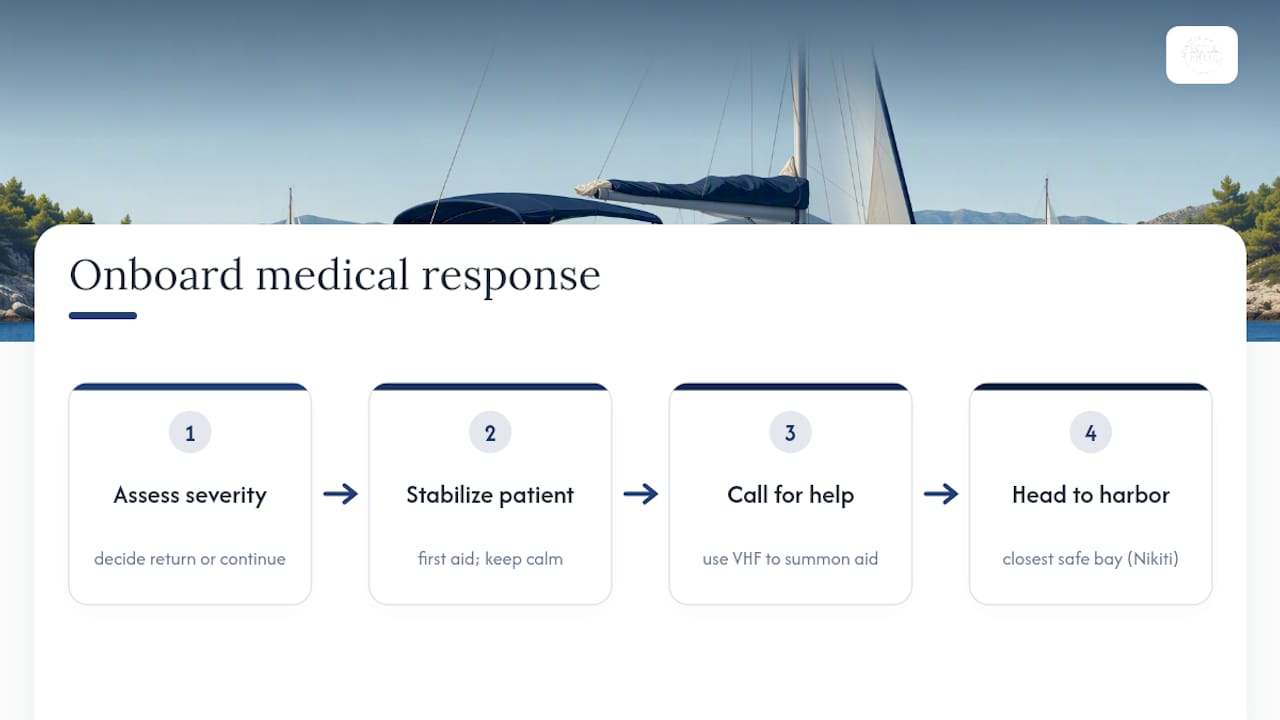
Every crewed charter should carry a stocked first aid kit, and the crew shows you exactly where it lives during the pre-sail briefing. For anything beyond a scraped knee or minor sunburn, the skipper’s first move is usually to assess severity and decide whether the trip needs to head back to the nearest port immediately.
Tell the crew about serious allergies, chronic conditions, or medications before you ever leave the dock, not once symptoms appear. A skipper who knows a guest carries an EpiPen or takes heart medication can react faster and skip guesswork entirely. If a medical situation does happen at sea, the crew’s priority is stabilizing the person, reaching the VHF radio to call for coast guard or medical support if needed, and getting to the closest safe harbor, which along the Sithonia coastline is often closer than guests assume given how many small bays sit near Neos Marmaras and Nikiti.
Passengers help most by staying out of the way, keeping other guests calm, and answering the crew’s questions clearly and quickly. Nobody expects you to perform first aid yourself unless you’re trained and the crew asks for help. Your job is simply to communicate, not to intervene.
How Do Crew and Passengers Communicate During an Emergency?
Communication on a small charter works best when it’s direct and immediate, not filtered through multiple people. On Off The Hook and similarly sized boats, the skipper or a designated crew member gives instructions straight to the group, usually by raising their voice, using short commands, and making eye contact with guests rather than relying on a loudspeaker system built for a much larger vessel.
Designating one guest as an informal point of contact, sometimes called a lead guest, can speed things up on a busy boat without changing who’s actually in charge. That person relays instructions to family members or friends who might be below deck or distracted, while the skipper focuses on running the boat. It’s a practical fix, not a shift in authority. The captain remains the final decision maker at every stage.
If you don’t understand an instruction, say so immediately rather than guessing. Crews would much rather repeat a command twice than have a guest move in the wrong direction during a tense moment. Clear, loud, simple language beats detailed explanation when time is short.
How Do You Prevent and Manage Seasickness?
Seasickness hits some people regardless of experience level, and it usually shows up within the first thirty to sixty minutes on the water. The good news: most of the common fixes are things you control before you ever step aboard.
Take motion sickness medication, whether over the counter or prescribed, at least thirty minutes to an hour before departure, since it works far better as prevention than as a cure once symptoms start. Eat a light meal beforehand instead of sailing on an empty stomach, and avoid heavy, greasy food the night before. Once aboard, staying on deck in fresh air and fixing your eyes on the horizon helps far more than heading below deck, where motion feels more exaggerated and the air is stiller.
If you do start feeling queasy, tell the crew early. They can often adjust seating, point you toward a spot with less motion, or slow things down if conditions allow. Ginger candy, plenty of water, and avoiding phone screens all help in the moment. There’s no shame in it. Even experienced sailors get caught out occasionally, and a good crew treats it as routine, not an inconvenience.
What Makes Halkidiki’s Waters Different for Sailing?
Halkidiki’s coastline, particularly around Sithonia’s Neos Marmaras, Nikiti, and Paliouri, and across to Kassandra, offers a mix of sheltered bays and more exposed stretches, which is exactly why local knowledge matters so much. A skipper who sails these waters regularly knows which coves offer quick shelter when the wind shifts and which stretches to avoid entirely during a meltemi warning.
The Aegean meltemi is the defining weather factor for the region, typically building through summer afternoons and easing by evening. This is precisely why sunset sails are often calmer and more comfortable than a midday trip during peak season. Water depth and underwater terrain near the hidden coves also matter for anchoring safely, something a skipper checks before dropping anchor rather than guessing based on the view from the surface.
Distances between safe harbors along this coastline are relatively short, which works in passengers’ favor. If a skipper needs to cut a trip short or change direction, a sheltered bay near Nikiti or Kassandra is usually not far off, unlike more remote sailing regions where the nearest safe port might be hours away. For more on how the coastline shapes route planning, the Halkidiki geography guide breaks down the layout of the peninsula.
Why Passenger-First Safety Beats Generic Boating Advice
Most safety advice aimed at boaters assumes the reader is at the helm, checking their own equipment and reading their own charts. That advice is close to useless for someone stepping onto a crewed charter as a guest. The judgment this research actually supports is simpler: your job as a passenger isn’t to master seamanship, it’s to know what a competent briefing looks like, what your own responsibilities are, and when to trust the skipper’s call over your own preference.
Conventional guides also underweight how much smaller charters change the equation. A five or six-guest sailboat with one consistent crew behaves nothing like a large tour operation cycling through staff and boats. The reader’s real priority should be asking pointed questions before booking, not memorizing knot names or radio protocols they’ll never use. Confidence on the water comes from clear communication, not technical mastery you were never expected to have.
— George
Book a Safety-Minded Sailing Charter in Halkidiki
Halkidiki Boat Sailing runs one dedicated vessel, Off The Hook, instead of juggling a fleet, which means every guest gets the same experienced skipper and the same thorough, plain-language briefing every time. Each cruise bundles a professional local crew, lifejackets, refreshments, snacks, and snorkeling gear into one price, so there’s nothing to negotiate once you’re aboard. Routes cover the sheltered coves and calm anchorages around Neos Marmaras, Nikiti, Paliouri, and Kassandra. The skipper adjusts course around wind and weather rather than pushing through it.
If you’re ready to see what a fully crewed, safety-first sail actually feels like, check available dates on the group and private charter booking page and get your questions about crew, capacity, and route answered directly before you book.
Sources
- The importance of a yacht safety briefing — Halcyon Yachts
- Greece Yacht Registration / Law 4256 (excerpt) — Vardikos
FAQ
Do I Need to Bring My Own Lifejacket?
No. Crewed charters, including Off The Hook, supply lifejackets for every guest, including sizes for children, as part of the standard safety briefing.
Can the Skipper Cancel My Trip for Weather?
Yes. Under standard charter practice, the captain has final authority to change or cancel the route if conditions like the Aegean meltemi make the original plan unsafe.
What Should I Do if Someone Falls Overboard?
Point at the person, shout “man overboard,” and keep your eyes fixed on their location while the crew handles the recovery. Do not jump in unless a crew member specifically tells you to.
How Long Does a Safety Briefing Usually Take?
Most briefings run five to twenty minutes, covering lifejackets, the muster point, VHF use, and emergency procedures before the boat leaves the dock.
What if My Group Is Larger Than the Boat’s Passenger Limit?
Ask the operator about certified capacity before booking. Larger groups sometimes need a tandem charter or a vessel certified for more guests rather than exceeding the limit on one boat.