
The most reliable formula for team building yacht ideas pairs one or two hands-on maritime activities with purposeful facilitation and generous downtime. The strongest categories are hands-on sailing tasks, navigation challenges, low-movement workshops, and themed social experiences, each chosen to fit the deck space and motion of a sailing boat rather than a crowded, overprogrammed day. Vessel capacity and port rules ultimately decide what is feasible, so confirm those limits before you build the agenda.
TL;DR:
- Give guests supervised helm turns in pairs or trios for 10 to 15 minutes; calm conditions and a crew member within arm’s reach are required.
- Capacity limits depend on the yacht’s flag and size; guidance cites 36 passengers for many large yachts and 60 for passenger yachts without an exemption.
- Plan one structured activity before lunch, one social or creative session afterward, and open time at both ends; keep a weather window and shore fallback.
- Confirm headcount, mobility needs, and seasickness history before booking, assign facilitator and crew duties separately, and collect dietary requirements at least a week ahead.
- Sunset cruises start at €400 for four hours, full day cruises at €600 for seven hours, and weekly cruises at €500 daily.
Table of Contents
- 1. Practical yacht-friendly team-building activities
- 2. How to plan and run the event: checklist, safety, and sample timelines
- 3. Operator advantage: what a boutique single-boat operator offers planners
- 4. Examples of successful past yacht team-building events with outcomes and feedback
- 5. Planner perspective: why the sea changes team dynamics
- 6. Booking with Halkidiki Boat Sailing: suitable packages for team events
- FAQ
- Sources
1. Practical yacht-friendly team-building activities
Sailing boats reward activities that rotate small groups rather than mobilize an entire deck at once. Limited space and constant motion make mental and navigation-based tasks a better fit than large physical games, and that constraint turns into a genuine advantage: it forces tighter group sizes and sharper facilitation, both of which tend to produce better engagement anyway.
Hands-on sailing tasks. Giving participants real responsibility, even briefly, tends to build trust faster than a scripted icebreaker because the stakes are real and the role matters to the group’s safety and progress.
- Helm time: Guests take turns steering under the skipper’s direct supervision, in pairs or trios of 2 to 3 people, for 10 to 15 minutes each; requires calm conditions and a crew member always within arm’s reach.
- Sail trim relay: Small teams compete to adjust a sail correctly on command, in groups of 3 to 4, taking about 20 minutes; needs clear instructions from the crew beforehand and works best with moderate wind.
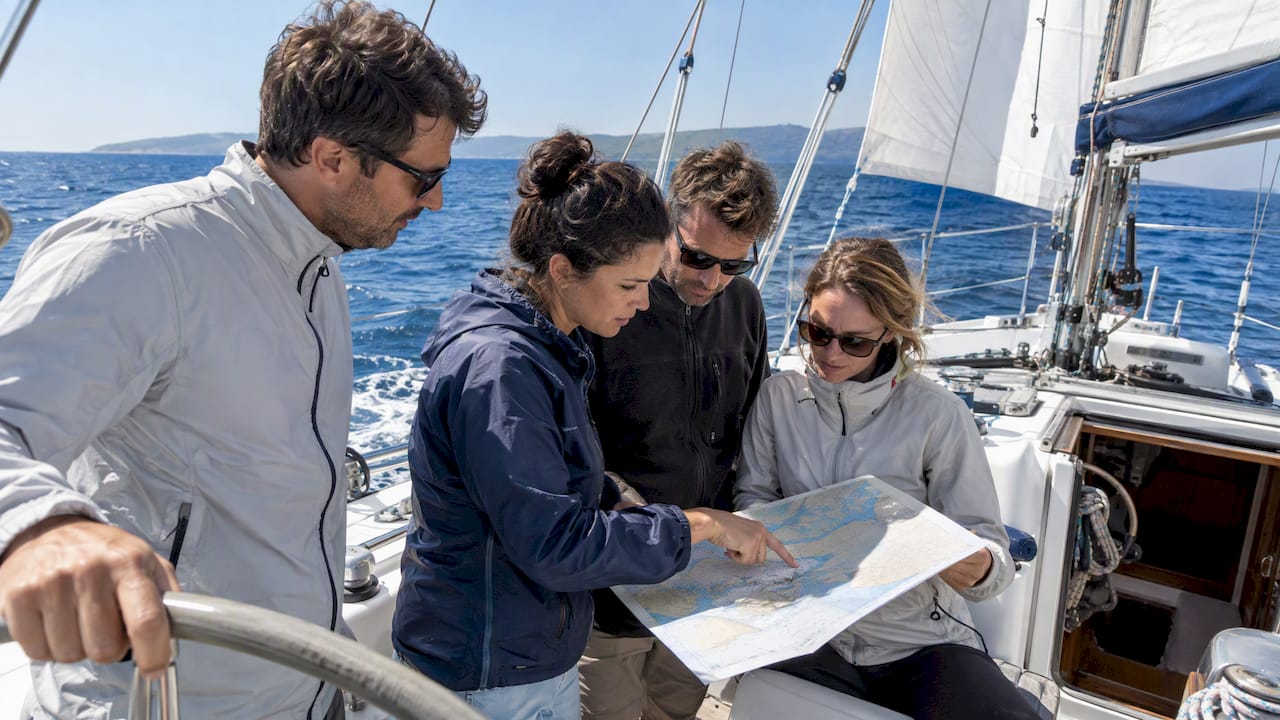
- Navigation relay: Teams plot a short course using a paper chart and compass, in groups of 4 to 5, over 30 to 40 minutes; needs basic chart-reading materials and a facilitator to keep scoring simple.
Pro Tip: Rotate subgroups through hands-on tasks while the rest of the team rests in the cockpit; this keeps energy high without crowding the working deck.
Problem-solving and low-movement options. These suit sailing boats especially well because they ask for focus, not space.
A navigation treasure hunt sends small teams to identify coastal landmarks or depth markers using a chart, typically running 30 to 45 minutes for groups of 4 to 6, with a simple answer sheet as the only material needed. A strategy sprint poses a short business case tied to the day’s objectives, works well seated in the cockpit or saloon, and runs 20 to 30 minutes for groups of any size when broken into tables of 4. A scenario drill, such as a simplified safety briefing turned into a quiz, reinforces the muster and lifejacket routine while doubling as a light competitive activity, taking about 15 minutes.
Social and creative options. These carry the lowest physical demands and the highest flexibility, which makes them useful as closers or as rain-contingency fillers.
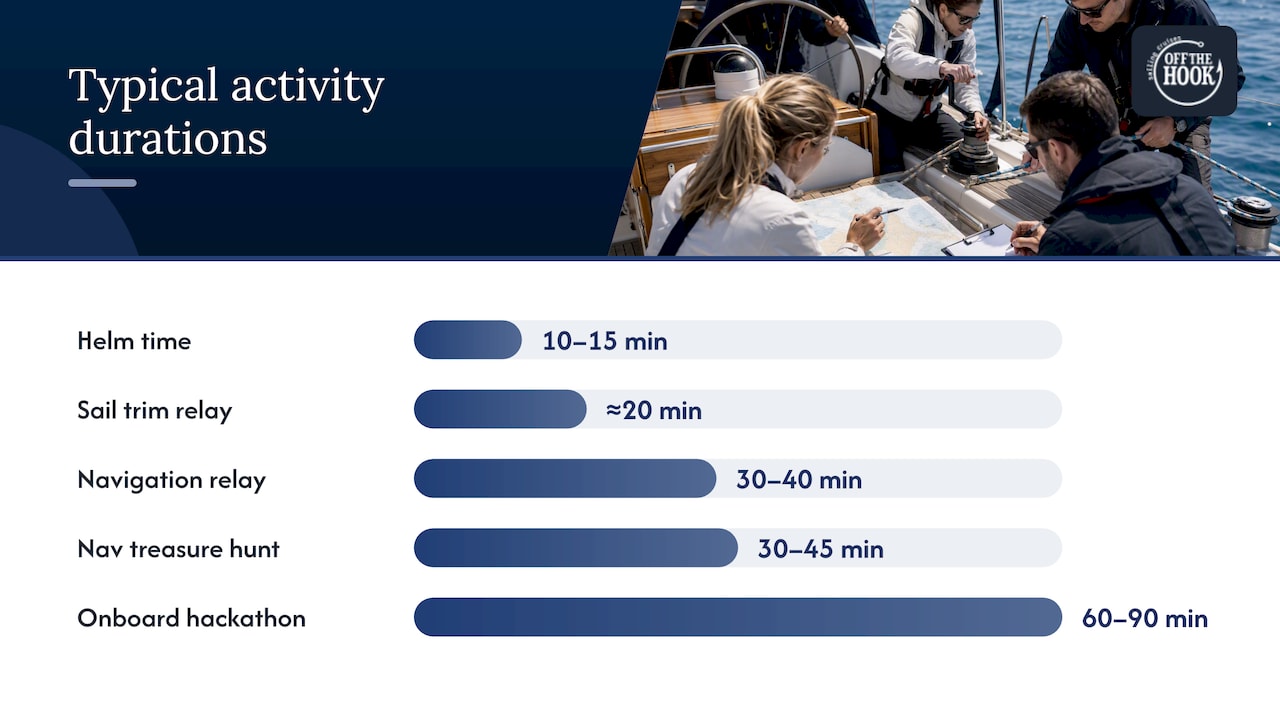
A themed storytelling dinner asks each small group to prepare and present a two-minute story tied to a prompt, works for any group size split into tables, and needs only index cards and roughly 45 minutes after the meal. A photo challenge sends pairs off with a shot list covering the boat, the coastline, and candid team moments, runs the length of the sail with no dedicated block needed, and costs nothing beyond phones already in pockets. An onboard hackathon frames a real business problem as a 60 to 90 minute sprint for groups of 4 to 6, using notebooks or a shared document, and works best scheduled during a calm midday stretch. A cooking competition using the galley’s limited equipment, such as a no-cook canapé challenge, fits groups of 3 to 4 per team, takes about 30 minutes, and needs ingredients pre-portioned by the crew to avoid congestion in a tight space.
Shore-linked extensions. A short stop breaks up the rhythm of the day and gives participants a chance to move freely after a stretch on deck.
- A brief island stop for a swim or walk works for any group size and needs 30 to 60 minutes.
- Guided snorkeling suits groups of 6 to 10 at a time, runs 30 to 45 minutes, and needs gear and a safety briefing.
- A cliff-side picnic anchored near a quiet cove works for the full group and needs about 60 to 90 minutes plus food logistics arranged in advance.
Across all of these, the planner’s real job is sequencing: one structured activity before lunch, one social or creative activity after, and open time at both ends of the day.
2. How to plan and run the event: checklist, safety, and sample timelines
Good yacht events are built backward from objectives, not forward from a list of activities. Start with what the day needs to achieve, then select the one or two activities from the previous section that match it.
Before booking, confirm these essentials:
- Define the objective (bonding, leadership development, a working retreat) so activity choices have a clear purpose.
- Confirm headcount, mobility needs, and any sea-sickness history so the crew can plan seating and activity pacing accordingly.
- Separate facilitator duties from crew duties in writing, so no one assumes the skipper will also run icebreakers.
- Collect dietary needs at least a week ahead so galley planning and any onboard cooking activities run smoothly.
- Check insurance coverage for the group and confirm it with the operator before the date is locked in.
Safety and regulatory highlights. Passenger capacity is not a formality. Guidance from the Cayman Islands describes thresholds such as 36 passengers for many large yachts and 60 for passenger yachts operating without an exemption, and it calls for an approved risk assessment once a group exceeds the relevant small-event limits.
Statistic callout: Malta’s Passenger Yacht Code sets specific compliance rules for yachts of 500 gross tons or more carrying between 12 and 36 passengers, a reminder that flag-state rules shift with vessel size and registration. Planners should always confirm which framework applies to the specific boat they are booking, since requirements differ by flag and jurisdiction.
Sample half-day timeline (4 hours): Boarding and safety briefing (20 minutes), departure and welcome drinks (20 minutes), one structured activity such as a navigation relay (40 minutes), free swim or snorkel stop (45 minutes), lunch (60 minutes), a social activity like a photo challenge (30 minutes), relaxed sail back (45 minutes).
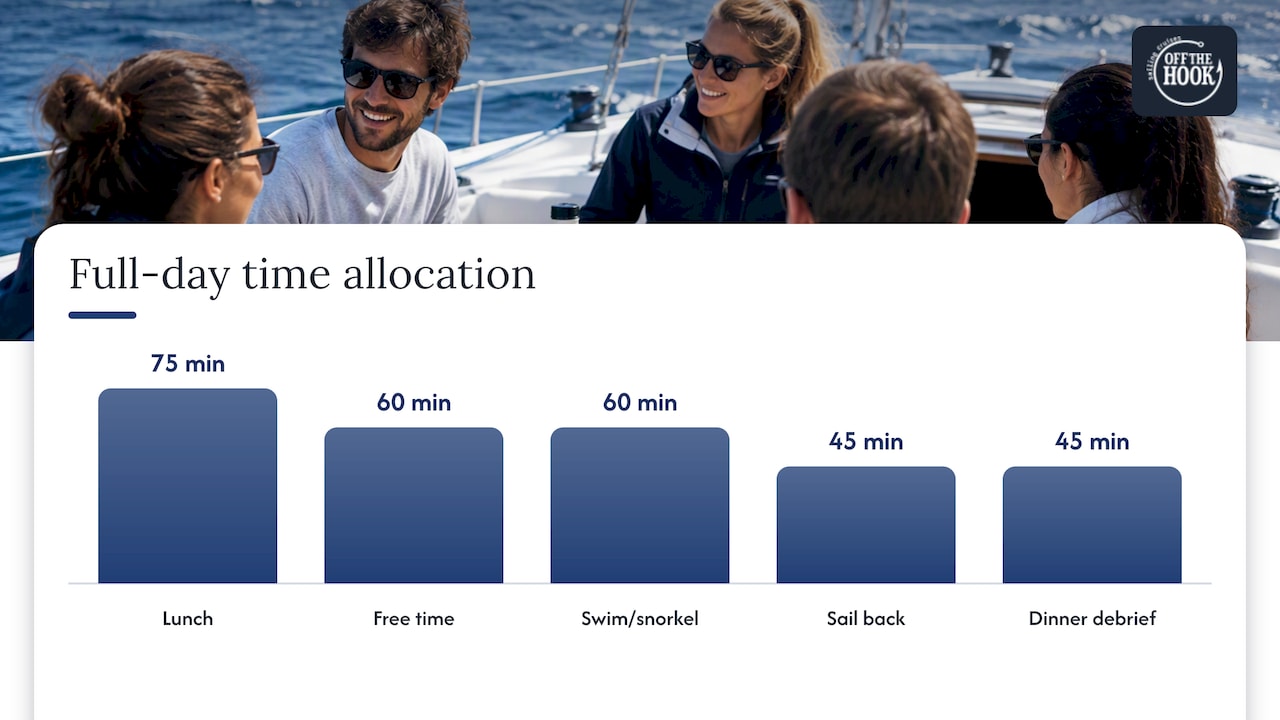
Sample full-day timeline (7 hours): Boarding and briefing (20 minutes), morning sail with helm time rotations (45 minutes), navigation treasure hunt (40 minutes), swim and snorkel stop (60 minutes), lunch (75 minutes), strategy sprint tied to business objectives (30 minutes), free time or cliff-side picnic (60 minutes), storytelling dinner segment or hackathon debrief (45 minutes), sail back (45 minutes).
Build in a weather window and a shore fallback for both timelines, confirm who handles a medical issue if one arises, and have the captain and facilitator run a short pre-brief before guests board.
3. Operator advantage: what a boutique single-boat operator offers planners
A single-vessel operator removes a lot of the coordination risk that comes with juggling a fleet. We run one signature sailing boat, Off The Hook, which means the same skipper, the same deck layout, and the same routines every time a group books with us.
- A fully crewed private or group cruise, with the skipper, fuel, refreshments, snacks, and snorkeling gear included in the package.
- Tailor-made routes around Halkidiki’s Sithonia peninsula, including Neos Marmaras, Nikiti, Paliouri, and Kassandra.
- Consistent crew familiarity with the boat’s anchor spots, which matters when you need a quiet cove for a structured activity rather than a crowded public bay.
- Privacy for a corporate group, since the boat is booked exclusively rather than shared with other parties.
That consistency gives planners something hard to get from a larger fleet: predictable logistics from one booking to the next.
4. Examples of successful past yacht team-building events with outcomes and feedback
Sail-based programs tend to produce a specific kind of feedback: participants mention the activity itself less than the feeling of having done something real together. A case study on short Channel crossings describes hands-on sailing participation as a format where trust and leadership roles emerge naturally, without contrived icebreakers, simply because the tasks on board carry genuine consequences.
Academic work on short, intensive sail training environments echoes this pattern: research on trust development during sail training found that trust and cohesion build in phases across a voyage, with competence-based trust, built from watching colleagues handle a task well, playing a significant role in how groups bond under maritime conditions.
Practitioner guidance on designing engaging yacht team-building programs reinforces the same lesson from the planning side: programs that balance one or two structured activities with ample downtime consistently produce higher satisfaction than densely packed agendas. The common thread across these accounts is simple. Teams remember the moment someone unexpected took the helm or called the right heading, not the itinerary that got them there.
5. Planner perspective: why the sea changes team dynamics
A boat strips away the usual workplace hierarchy faster than any facilitated exercise I have seen described. Shared vulnerability, a wobbly deck, a shared task, a real decision about a sail, accelerates trust in ways a conference room rarely does. Sail-based events earn their cost for small to medium teams, leadership development cohorts, and crisis-simulation exercises where real stakes matter more than staged ones.
The common mistake is over-programming. A day stacked with back-to-back activities drains people on the water faster than on land. Protect the rhythm: one real task, real rest, repeat.
— George
6. Booking with Halkidiki Boat Sailing: suitable packages for team events
Once you know which activities fit your objectives, matching them to the right duration is straightforward. Our Full Day Private Cruise, Sunset Private Cruise, and Weekly Private Cruise packages suit different timelines and needs. For current prices and details, please visit our pricing page.
- Every package includes a skipper, crew, refreshments, and snorkeling gear.
- Routes are tailored to Sithonia destinations like Neos Marmaras, Nikiti, Paliouri, and Kassandra.
- Booking is handled directly, with no fleet-sharing or scheduling conflicts.
To request a proposal, visit our booking page with your date range, headcount, and the objectives you want the day to serve, and we will shape the route and timeline around them.
FAQ
What are some good team building activities to do on a boat?
Hands-on sailing tasks like helm time and sail trim relays work well, alongside low-movement options like navigation treasure hunts and strategy sprints. The strongest programs pick one or two of these and leave the rest of the day open for rest and informal conversation.
What is the 12 person yacht rule?
Regulatory frameworks generally treat 12 passengers as a key threshold, with yachts carrying more than 12 passengers facing additional compliance requirements under frameworks like the Malta Passenger Yacht Code. The exact rule depends on the vessel’s flag state and gross tonnage, so always confirm the specific threshold with the operator before finalizing headcount.
What are some good themes for a yacht party?
Coastal or nautical storytelling themes work naturally on a sailing boat, since the setting already supplies the atmosphere. A simple theme tied to the group’s shared goals, paired with a photo challenge or a themed dinner segment, tends to land better than an elaborate costume concept on a boat with limited space.
How much does it cost to hire a yacht for a party?
With us, a Sunset Private Cruise (4 hrs) starts from €400 one-off, a Full Day Private Cruise (7 hrs) starts from €600 one-off, and a Weekly Private Cruise runs €500 per day. Exact pricing elsewhere depends heavily on vessel size, duration, and included crew and amenities.
Sources
- SHIPPING NOTICE 01/2025 (Rev 01) — Cayman Islands
- Malta Passenger Yacht Code (PYC) — Transport Malta
- Designing engaging programmes for yacht team building events — ThePointsTraveler
- Team Building at Sea: Channel Crossing by Sail — SailLink