
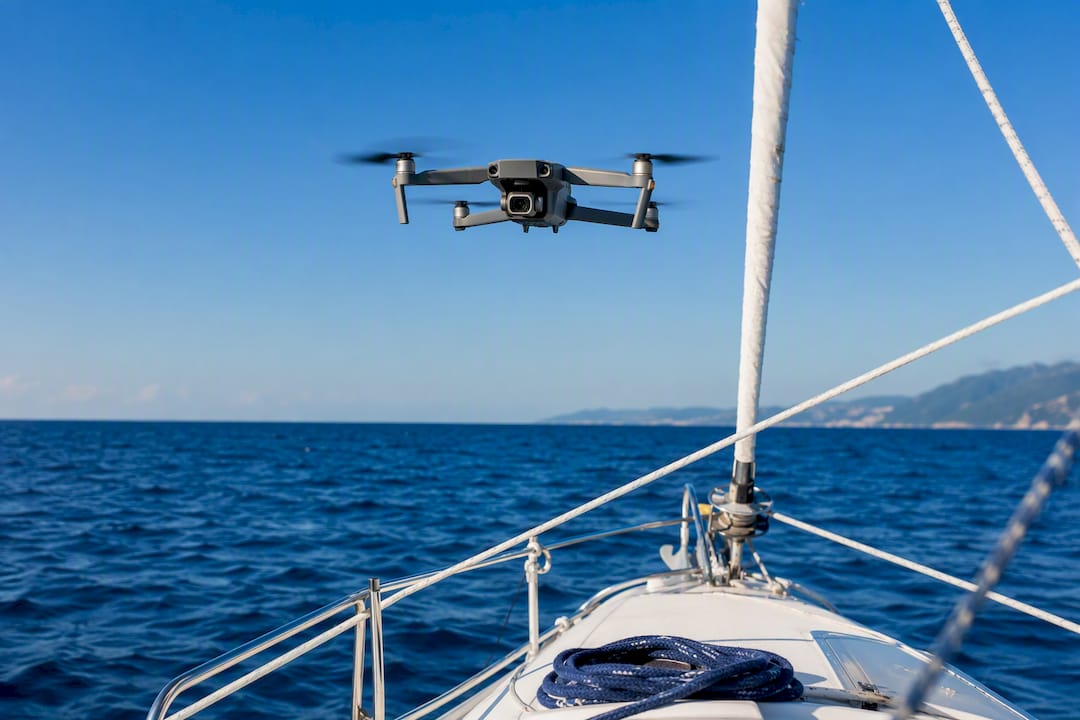
Yes, flying a drone from a sailing boat is doable, but only when you prioritize hand launch and hand catch over automation. The single rule that matters most: never trust Return-to-Home without updating the home point once you’re underway, since a boat that has drifted 200 meters will send your drone straight into open water. Before anything else, check the weather, confirm the airspace is open, and put a spotter on deck.
TL;DR:
- Using a dynamic home point or updating the GPS location before each flight reduces the risk of the drone flying into open water during return-to-home commands.
- Hand launching and catching the drone are safer and more reliable than automated takeoff and landing on a moving boat, especially in rough conditions.
- Disabling downward obstacle sensors during catching improves control but heightens the risk of prop injuries and requires careful handling.
- Maintaining visual line-of-sight and keeping the drone at least 15 to 20 meters from the boat helps mitigate risks from wind gusts and vessel movement.
- Preflighting on land and establishing clear hand signals with the crew are essential for safe operations, as salt spray, vibrations, and limited space complicate drone flying from a boat.
Table of Contents
- Why Launching and Landing From a Boat Is Uniquely Challenging
- Preflight Checks You Must Do Before Launching From a Boat
- How to Launch Safely From a Sailing Boat
- Safe Landing and Retrieval Techniques
- In-Flight Rules: Distance, Altitude, and Coordination
- Failsafes: RTH, Loss of Link, and Water-Landing Contingency
- Which Drone Features and Accessories Help Most on a Boat
- Practical Lessons From Sailing Operations in Halkidiki
- Setting Up Visual Markers to Help With Manual Catching
- How Boat Vibrations Affect Drone Sensors
- An Editorial Take on Boat Drone Safety
- Sources
- FAQ
Why Launching and Landing From a Boat Is Uniquely Challenging
A dock or a backyard doesn’t roll, pitch, or heave under your feet. A sailing boat does all three at once, and that constant motion changes everything about how a drone perceives its own takeoff point.
Most consumer drones lock their home point the moment they arm, then use GPS to calculate a path back to that fixed coordinate if you trigger Return-to-Home. On land, that works well. On a moving vessel, the boat has usually sailed away from that original GPS pin by the time you’re ready to land, so an automated RTH command can send the aircraft to a patch of empty water instead of your deck. Field reports from working drone photographers consistently flag home-point mismatch as the leading cause of drone loss on boats, which is exactly why hand launch and hand catch remain the standard for small sailing vessels.
Several other factors compound the risk:
- Deck-level GPS interference. Metal rigging, electronics, and the hull itself can distort satellite reception near the deck, especially in the first few seconds after takeoff.
- Salt spray and reflections. Water throws light and moisture at optical sensors, confusing obstacle-avoidance systems that were designed for dry, static environments.
- Limited launch space. A cockpit crowded with guests, lines, and gear leaves little clear real estate for a stable takeoff or landing zone.
- Electromagnetic noise. Onboard electronics and communication equipment can interfere with compass calibration if you power up too close to them.
None of this means boat drone flying is reckless. It means the margin for automation error is much smaller than it is on solid ground, and every pilot needs to plan around that from the first checklist item.
Preflight Checks You Must Do Before Launching From a Boat
Skipping preflight steps on land is forgivable. Skipping them on a boat is how drones end up at the bottom of the sea. Work through these in order, every single time.
- Calibrate the IMU and compass on land, not on deck. A boat’s shifting orientation and onboard metal will throw off calibration data, so do this before you leave the marina.
- Check airspace and local restrictions before departure. Use official aviation resources and mapping tools like those referenced by the FAA’s recreational flyer guidance to confirm you’re not entering a restricted or temporary flight zone.
- Inspect props, batteries, and firmware. Look for hairline cracks in the props, confirm firmware is current, and pack at least one charged spare battery per hour of expected flying.
- Assign a spotter and brief the crew. One person should watch the drone and the horizon while you fly; a dedicated spotter measurably improves recovery outcomes on moving vessels.
- Set failsafe behavior before takeoff. Configure loss-of-signal response to hover, not auto-land, and confirm your low-battery return threshold is conservative.
- Plan your launch and landing zone with the crew. Agree on hand signals or verbal calls for “clear to launch,” “coming in,” and “abort.”
Pilot-training resources built specifically around marine operations echo most of this list, including calibrating on land and masking downward sensors for hand-catches, a detail many recreational pilots overlook until their first failed landing attempt.
Pro Tip: Write your go/no-go checklist on a laminated card and keep it in the drone case. On a rocking boat, memory fails faster than you’d expect, and a physical checklist takes the guesswork out of a rushed launch.
Professional operators in the charter and production world take this further, often running a written risk assessment before any boat-based shoot and simply declining to fly when conditions fall outside their comfort zone. That discipline, saying no when the sea state or wind doesn’t cooperate, is arguably the most underrated skill in boat drone flying.
How to Launch Safely From a Sailing Boat
Hand launching is the gold standard for small sailing boats, and for good reason: it removes the need for a large, stable, obstacle-free deck area that most sailboats simply don’t have.
Hand launch technique
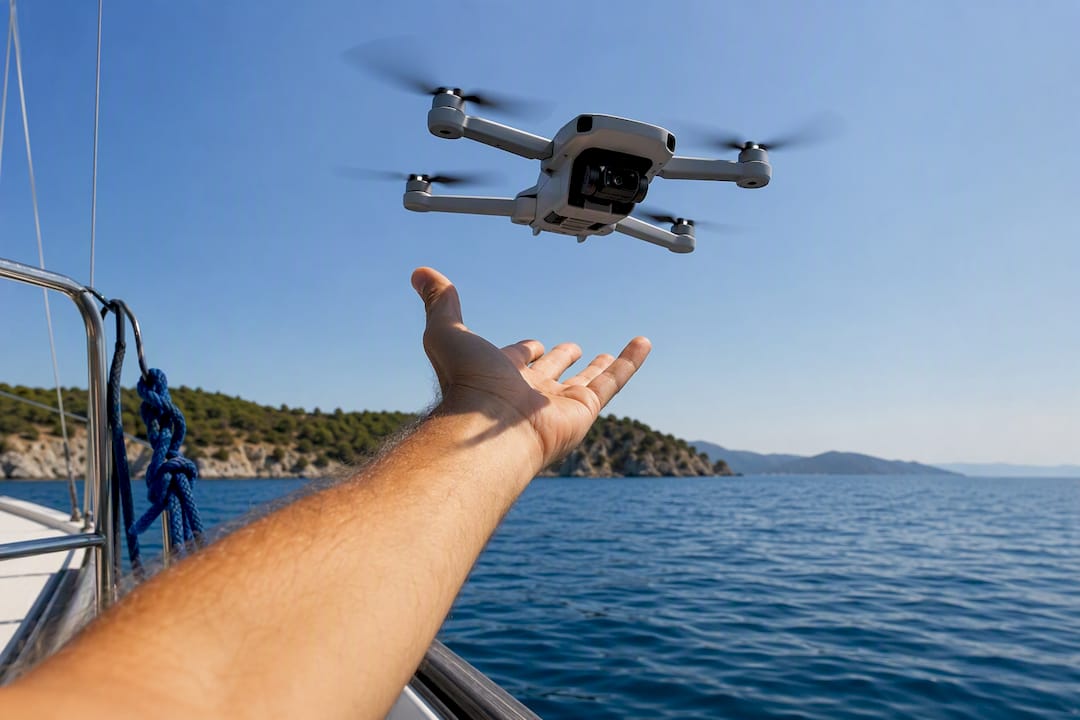
Hold the drone level in your palm with props spinning at idle, arm outstretched away from your body and clear of rigging or sails. Increase throttle smoothly until the drone lifts off your hand under its own power. Never toss a drone into the air like a paper plane. Let it climb away from your hand deliberately, and keep your fingers clear of the prop arc the entire time.
Deck launch, if hand launch isn’t practical
If you’re flying a larger drone that requires a deck launch, position it so the bow faces into the wind and current, which stabilizes the platform and gives you predictable airflow. Lift straight up in a smooth vertical climb, and fly directly away from the boat for at least 10 meters before making any turns. Don’t hover close to the mast or rigging while you get your bearings.
- Fly a brief stretch in ATTI or manual mode while clearing the vessel, since GPS lock near a metal deck can be unreliable in the first few seconds.
- Switch to GPS-stabilized flight once you’ve confirmed a strong satellite lock at a safe distance from the boat.
- Keep the throttle and control inputs smooth. Jerky corrections near the boat are how props clip rigging.
- Coordinate with the captain before launch. Ask them to hold a steady heading or reduce sail if the boat’s motion is making the takeoff harder than it needs to be.
Pro Tip: Launch from the leeward side whenever the boat’s heading allows it. It keeps prop wash and spray out of your face and gives you a cleaner sightline as the drone climbs away.
Safe Landing and Retrieval Techniques
Landing is where most boat drone incidents actually happen, and it’s the phase that separates confident pilots from lucky ones.
Hand-catch technique
Bring the drone to a stable hover a few feet off the deck, roughly at chest height, before attempting the catch. Approach from the side or slightly above, never from directly underneath, and keep your face angled away from the props. Grip the landing gear or the body firmly with a heavy leather glove, and power down the motors the instant you have a secure hold. Reaching under spinning props to grab a drone from below is one of the fastest ways to get cut.
- Wear a leather glove on your catching hand. Fabric gloves can shred on contact with a prop tip.
- Ask the captain to slow or hold a steady course before your final approach, since matching the boat’s relative motion is what makes a stable catch possible.
- Mask or disable downward-facing obstacle sensors before the catch attempt. Many drones will refuse to descend, or fight your control inputs, if the optical sensors detect your hand or the deck as an obstacle.
- If the first approach doesn’t feel right, don’t force it. Climb back to a safe hover, reposition, and try again.
Disabling those downward sensors trades one risk for another: you lose automated obstacle avoidance, but you gain a drone that actually responds to your commands during the catch. Most experienced boat pilots consider that an easy trade, and training resources built around marine flying agree, recommending sensor masking specifically for hand-catch scenarios.
Pro Tip: If your first two catch attempts fail, don’t go for a third on a shrinking battery. Bring the drone to a safe hover well clear of the boat, reassess wind and swell, and only try again once you’ve got a clean approach lined up.
In-Flight Rules: Distance, Altitude, and Coordination
Once you’re airborne, a handful of habits keep the flight recoverable no matter what the sea throws at you.
Maintain visual line-of-sight at all times, and keep a lateral buffer of at least 15 to 20 meters from the boat during normal flight. That buffer gives you room to react if a gust pushes the drone off course or the vessel changes heading unexpectedly.
- Avoid low passes directly over the deck or over people. A sudden drop in lift from turbulent air near the sails can bring a drone down fast.
- If more than one drone is flying, assign vertical separation, for example one aircraft above 30 meters and one below, and sequence launches and landings so only one drone is near the boat at a time.
- Watch wind gusts closely. If you see the drone drifting or fighting to hold position in GPS mode, switch to manual control and fly it back deliberately rather than trusting the autopilot to correct.
- Keep an eye on the horizon as well as your screen. A boat’s heading can shift faster than you’d expect under sail, and your escape route needs to shift with it.
None of this replaces basic airmanship. It just accounts for the fact that your takeoff and landing platform is never standing still.
Failsafes: RTH, Loss of Link, and Water-Landing Contingency
Set your failsafe behavior to hover in place on loss of signal, not auto-land. An automated landing sequence has no idea there’s open water, or a moving deck, beneath it.
- Update the home point manually before every flight leg, or use a dynamic home-to-RC setting if your drone supports it, so a triggered RTH brings the aircraft back toward the boat’s current position rather than its takeoff coordinate.
- Set a conservative return threshold, for example initiating your return at 40% battery rather than waiting until the drone’s own low-battery warning fires.
- If you lose link, mark your last known position, keep watching the horizon in that direction, and coordinate with your spotter and the captain before deciding whether to hold course or turn back.
- If the drone lands in water, retrieve it immediately. Prolonged immersion in saltwater almost always destroys the electronics beyond repair, so speed matters more than technique at that point.
- Once recovered from water, remove the battery if it’s safe to do so, rinse the airframe in fresh water, and let it dry fully before attempting to power it on again.
This is also where consumer expectations need a reality check. Professional maritime trials that achieve reliable autonomous drone recovery in rough seas do it with tethered systems and purpose-built stabilized platforms, engineering that has no equivalent on a small sailing boat. A 30 to 40 foot sailboat simply doesn’t have the seakeeping of a stabilized recovery vessel, which is exactly why manual hand-catch technique remains the safer bet for recreational and charter pilots. Regulatory guidance reinforces the same point from a different angle: automation never removes the pilot’s responsibility to plan for failsafes and manual recovery.
Which Drone Features and Accessories Help Most on a Boat
Not every drone is built for maritime use, and the differences matter more than most buying guides admit.
Prioritize a model with a hand-catch-friendly airframe, meaning props that sit slightly recessed or shielded, and landing gear or a body shape that’s easy to grip securely with a gloved hand. Look for a strong wind rating relative to the drone’s weight class, since even a modest sea breeze on open water can exceed the sustained wind speeds a lightweight drone can hold position against. A robust GPS and compass system that reacquires satellite lock quickly after a deck launch will save you the anxious seconds many pilots spend waiting for a solid signal.
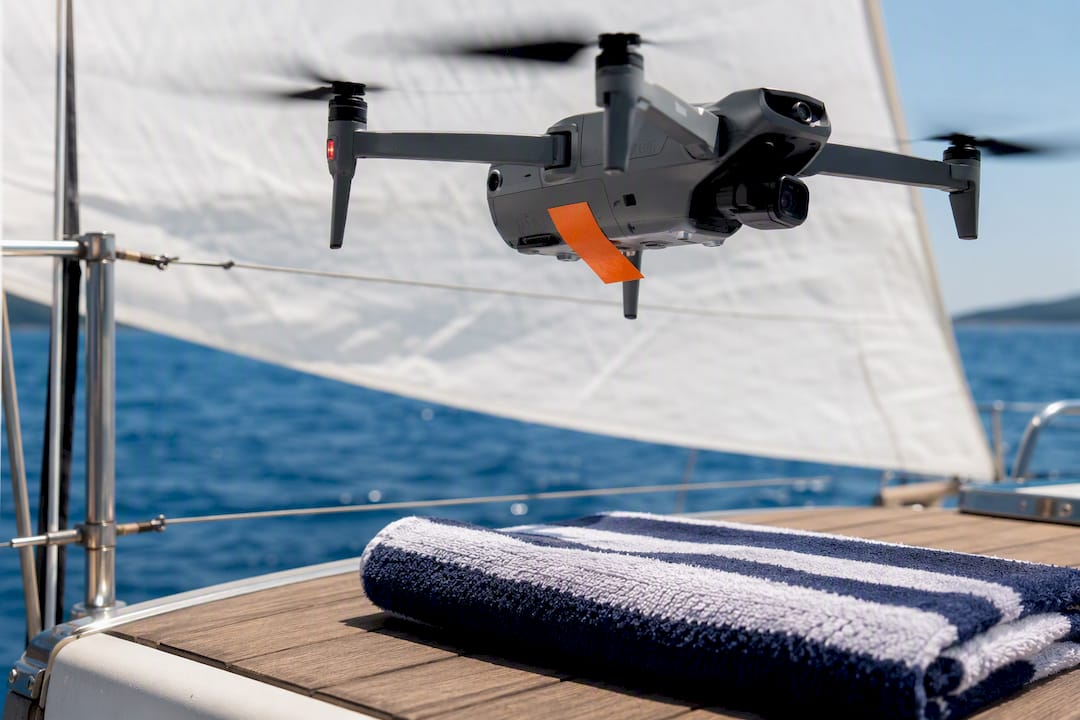
- A brightly colored or high-visibility underside, sometimes added with reflective tape, makes the drone far easier to track visually against a bright sky or glare off the water.
- Leather gloves for hand-catching, kept dry and accessible rather than buried in a bag.
- Spare props and at least one spare battery per flying session, since a cracked prop or a depleted cell on a boat means the flight is over.
- A dry bag or hard case with desiccant packs for storage between flights, since ambient humidity on open water is higher than it looks.
There’s a real tradeoff between compact, ultra-portable drones and the wind-handling and visibility of larger models. A pocket-sized drone is easier to hand-launch and stow, but it also gets pushed around by gusts that a heavier aircraft shrugs off. After every flight, rinse salt spray off the airframe with a lightly damp, fresh-water cloth and dry it completely, since salt residue accelerates corrosion on exposed contacts and motors far faster than most pilots expect. If aerial photography is part of your plan, pairing the right camera settings with the right sailing photography gear makes a noticeable difference in image quality once you’re airborne.
Practical Lessons From Sailing Operations in Halkidiki
Running drone-friendly charters aboard a single dedicated sailing boat teaches you things a generic guide never will. Aboard Off The Hook, every drone-inclusive charter starts with a safety brief covering the designated launch zone at the stern, where rigging and sail lines are clear, and a crew member is assigned specifically to spot the drone and relay calls to the skipper.
- The safety brief happens before the anchor drops, not after guests are already excited to fly.
- One crew member holds the spotter role for the entire drone segment, watching the aircraft and the horizon so the pilot can focus on the controls.
- The skipper holds a steady heading or reduces sail on request, since a stable platform makes every launch and catch easier.
Timing matters as much as technique. Around Halkidiki Sithonia, calmer conditions typically show up earlier in the day near Neos Marmaras and Nikiti, before the afternoon breeze picks up, while the sheltered coves near Paliouri and Kassandra can offer a quieter backdrop for a landing attempt when the open water gets choppy. Scheduling a drone segment around those calmer windows, rather than fighting a stiff afternoon wind, is usually the difference between a clean flight and three failed catch attempts.
Guest experience matters here too. Keeping the drone’s approach path clear of other boats and swimmers, and avoiding low passes over marine life, keeps the shoot enjoyable without adding stress to what should be a relaxed afternoon on the water.
Pro Tip: If you’re planning a dedicated aerial photo session, ask your skipper about anchoring in a sheltered cove first. A still, wind-protected pocket of water gives you a far more forgiving hand-catch than open sea ever will.
Guests who want to build an entire itinerary around calmer water and better light can review Sithonia’s coastal routes before booking, and pair the trip with a broader look at onboard photography techniques for capturing the coastline from both the deck and the air.
Setting Up Visual Markers to Help With Manual Catching
A drone silhouetted against bright sky or glittering water is harder to track than most pilots expect, and that split-second hesitation during a catch attempt is often what causes a miss.
Bright, high-contrast tape on the drone’s underside, orange or fluorescent yellow works well, gives you an instant visual anchor as it descends toward your hand. Some pilots go further and mark a physical catch zone on deck with a small square of contrasting tape or a folded towel, giving both the pilot and the spotter a shared reference point for where the hand-catch should happen.
A simple hand signal system works better than shouting over wind and engine noise. Agree beforehand on gestures for “descending,” “hold position,” and “abort,” so the spotter can communicate instantly without competing with the sound of wind in the sails. If you’re flying at dusk for a sunset shoot, a small strobe light attached to the drone’s arm makes it visible far longer than reflective tape alone, and gives you a critical few extra seconds to line up the catch as natural light fades.
None of this requires expensive gear. A roll of bright tape and an agreed set of hand signals solve most of the visibility problems pilots run into on their first few boat flights.
How Boat Vibrations Affect Drone Sensors
Sailboats vibrate constantly, from wind flex in the rigging, wave slap against the hull, and engine use during motoring segments, and that constant low-frequency shake can throw off a drone’s sensors before it ever leaves your hand.
IMU and compass calibration are the most sensitive to this. Calibrating a drone while it sits on a vibrating deck bakes that noise into the sensor’s baseline reading, which shows up later as drift or an unstable hover mid-flight. That’s the core reason calibration belongs on land, not on the boat, done well before you cast off.
Vibration also affects gimbal-stabilized cameras, sometimes introducing a faint jitter into footage captured moments after takeoff, before the gimbal has fully settled into flight. Letting the drone hover steadily for a few seconds after launch, rather than immediately flying toward your subject, gives the gimbal time to stabilize and produces noticeably cleaner footage.
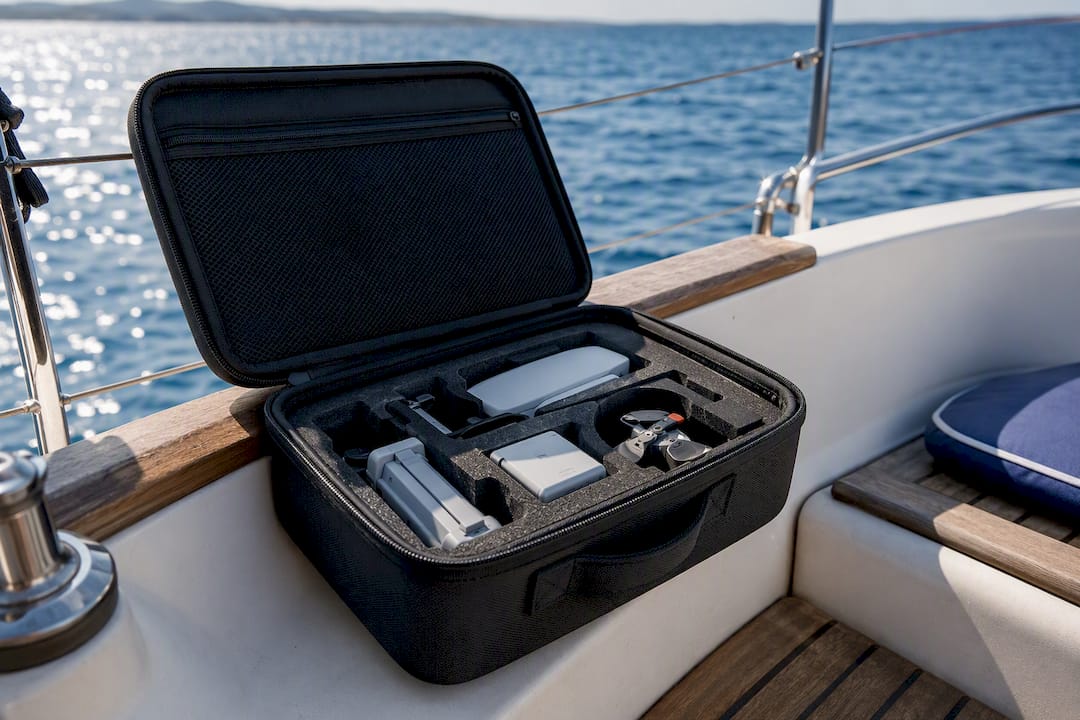
If you’re storing the drone onboard between flights, pack it in a padded case rather than setting it loose on a cushion or bench. Constant low-level vibration during transit can loosen prop screws and battery connections over the course of a full day on the water, small issues that are easy to miss until a prop works itself loose mid-flight.
An Editorial Take on Boat Drone Safety
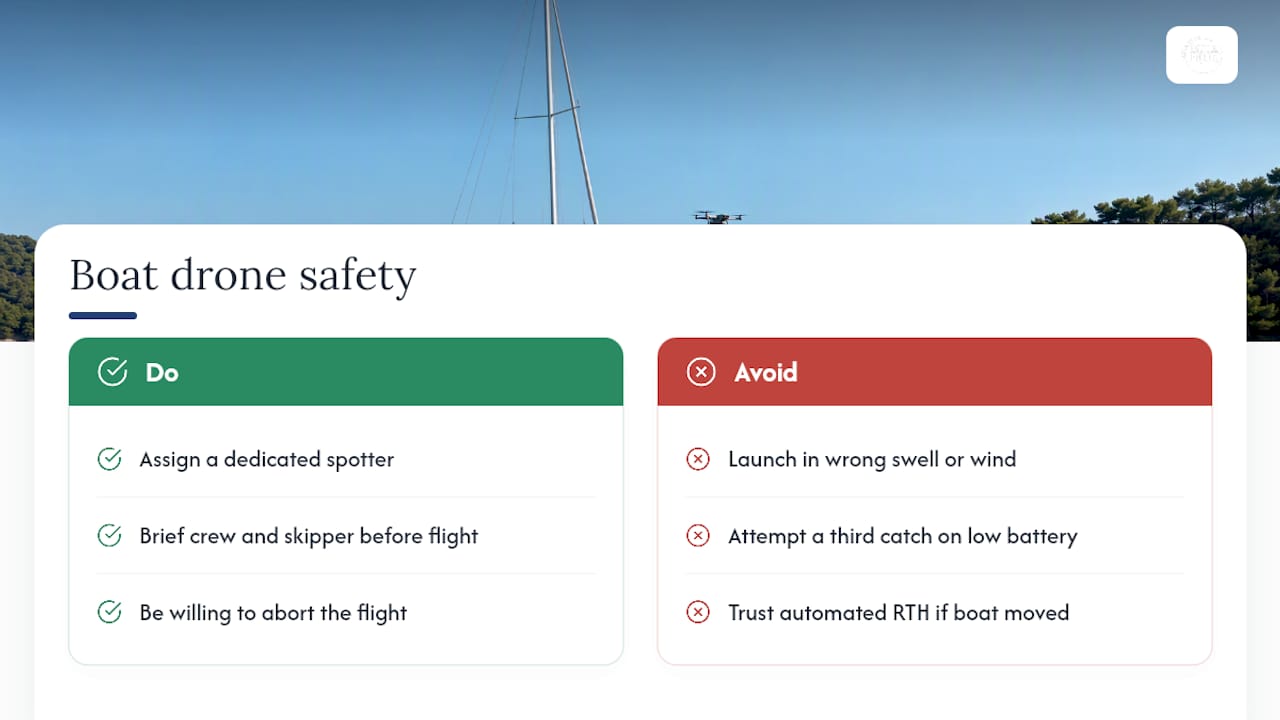
The conventional advice on this topic leans too hard on gear and not hard enough on judgment. Plenty of guides will tell you which drone has the best wind rating or the sharpest camera, but the research keeps pointing back to something simpler: the pilots who avoid losing drones are the ones willing to say no. No to a launch when the swell is wrong. No to a third catch attempt on a dying battery. No to trusting an automated RTH that has no idea the boat has moved.
What’s overrated is the assumption that better automation solves this problem. It doesn’t, not on a small sailing vessel. Professional trials that achieve reliable autonomous recovery use tethers and stabilized platforms that a 35-foot sailboat will never have. What’s underrated is the spotter role, the crew member who does nothing but watch the drone and talk to the captain. That single habit, more than any feature on the drone itself, is what turns a risky hobby into a manageable one.
If you’re planning a shoot around a charter, prioritize the conversation with your crew before you prioritize your gear list. A good skipper who understands what you’re trying to do will make the flight easier than any accessory will.
— George
Sources
Consult these before any boat-based flight:
- Recreational flyers | Federal Aviation Administration (FAA)
- Small Unmanned Aircraft Systems (UAS) regulations (Part 107) | FAA newsroom
- Flying A Drone From A Boat: Safety, Best Practices & Key Dangers — Jeroen Van Nieuwenhove
- 15 Tips on Flying a Drone from a Boat — Pilot Institute
- UK tests robot boat that can fly its own wired drone even in 14ft waves and stay at sea for weeks — TechRadar Pro
Rules differ by country and even by coastal zone, so treat every one of these as a starting point, not a final answer, for your specific location.
FAQ
Is It Legal to Fly a Drone From a Boat?
Generally yes, but rules vary by country and by specific coastal zone, so pilots should check regional aviation authority guidance, such as the FAA’s recreational flyer resources, before flying in any new location.
What Is the Best Drone to Fly From a Boat?
The best choice prioritizes a hand-catch-friendly body, a strong wind rating for its weight, and fast, reliable GPS reacquisition after a deck launch, rather than any single named model.
Can I Fly My Drone From a Cruise Ship?
Most cruise lines prohibit drone flights from their vessels for safety and liability reasons, and even where it’s technically allowed, the ship’s size and crowding make manual hand-catch nearly impossible, so this guidance is built around small private sailing boats, not large passenger ships.
Is It Legal to Fly a Drone Over Water?
Flying over open water is generally permitted, but pilots must still maintain visual line-of-sight, respect airspace restrictions, and follow the same registration and operating rules that apply over land, according to FAA guidance for recreational flyers.
Why Shouldn’t I Trust Return-to-Home on a Boat?
Return-to-Home targets the GPS coordinate recorded at takeoff, and a boat that has since moved will cause the drone to fly back to empty water instead of the vessel, which is why hand launch and hand catch remain the standard practice for small sailing boats.